Modern history in vivid black and white
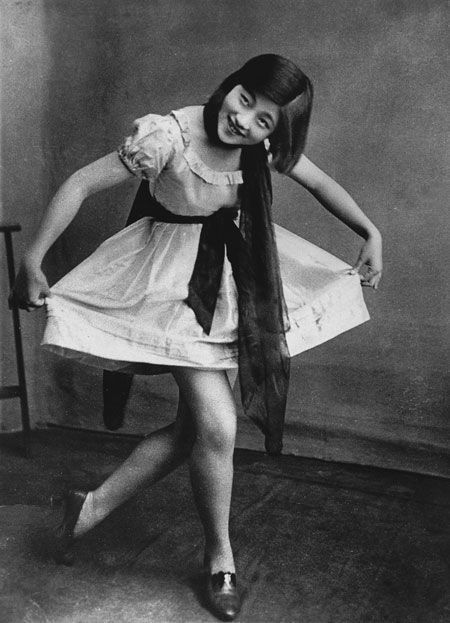
Shin Nak-kyun’s 1933 photo of iconic Korean modern dancer Choi Seung-hee.
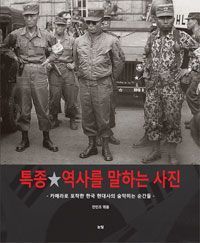
“Exclusive: Photos that Testify History;” Noonbit Publishing

Kim Seong-bae’s 1967 photo of commuters pulling up a woman onto a train to Mokpo the day before Chuseok, the Korean version of Thanksgiving.
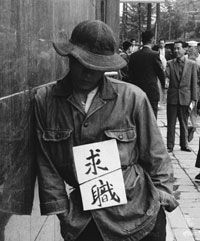
Limb Eung-sik’s 1953 photo of a man looking for a job.
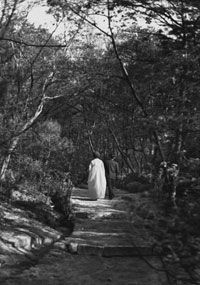
Hwang Kyu-tae’s 1963 photo of late President Park Chung-hee and his late wife Yuk Young-soo walking in the woods behind Cheong Wa Dae.

Choi Dong-wan’s 1970 photo of Jung In-sook, a well-known bar hostess-turned-socialite, found dead in a car in a road in Seoul. Police later found name cards of several high-profile figures, including former President Park Chung-hee and former spy chief Lee Hu-rak, at her home. The events surrounding Jung’s death remain a mystery.
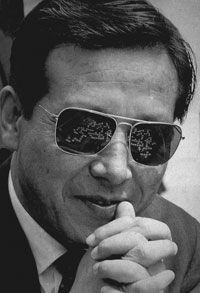
Kim Gyeong-tae’s 1968 photo of Kim Jong-pil, political heavyweight and founder of the Korean Central Intelligence agency, playing a board game in style.
By Kim Tong-hyung
Huh Jeong, the late photojournalist, was sipping coffee near Masan harbor when one of his police sources tipped him off that a dead man had emerged from the water.
He grabbed his old Kodak Retina and ran to the harbor’s central dock. There he found the floating body of a young man whose skull was split by a tear-gas grenade that penetrated from his eyes to the back of his head.
Equally horrified and enthralled, Huh started shooting away. He sensed that this was something big. He had no idea how right he really was.
The dead person Huh captured on his camera in the afternoon of April 11, 1960, happened to be Kim Ju-yul, a high school student who had went missing 20 days earlier after participating in a democratization protest.
While Huh developed his film and sent it to the regional office of the Busan Ilbo, the police pulled Kim’s body from the waters. And a historical tipping point was tipped.
``When I went back to the scene after the photo was done, an angry crowd was already carrying Kim’s body and marching toward the Masan City Hall, chanting `punish the dictatorial administration that killed Kim Ju-yul,’’’ Huh later remembered.
That was the protest that triggered the April 19 Revolution, a popular uprising led by labor and student groups that overthrew then-President Synman Rhee’s autocratic First Republic and irrevocably altered the shaping of contemporary Korea. Huh’s photo, published by the Busan Ilbo the next morning and by other dailies like Dong-A Ilbo in the following days, assured that the anger was spread to every corner of the country.
The disturbing image of Kim in the water highlights some of the significant works in Korean photojournalism featured in the new book, "Exclusive: Photos that Testify to History,’’ released by Noonbit Publishing. Freelance photojournalist Jeon Min-jo has done an admirable job in compiling a collection of pictures that takes readers to a short, direct and often shocking trip to history’s vault.
Some of the pictures in the book are iconic, like those of Kim or late Yonsei University student protestor Lee Han-yeol, who was captured by Reuters’ Jung Tae-won shortly after he was hit by a tear-gas grenade. Lee’s death sparked the democratization protests of June, 1987, which ended only after military strongman Chun Doo-hwan conceded to the demands and allowed a constitutional amendment for a free presidential election.
Some are rare, like the 1933 photo of a 22-year-old Choi Seung-hee, the colonial era modern dancer who in her time was called the ``Isadora Duncan of the East,’’ who disappeared from the public view in 1967 after being purged by the North Korean Communist party.
There is a photo of the late military strongman Park Chung-hee, father of current President Park Geun-hye, and his late wife Yuk Young-soo sharing a peaceful moment strolling in the woods behind Cheong Wa Dae.
It provides a bizarre contrast with photos in the later part of the book ― presidential bodyguards scrambling after Yuk was shot by North Korean sympathizer Mun Se-gwang in 1974 and a tied-up Kim Jae-kyu reenacting his assassination of Park in front of police five years later.
In another photo, former Presidents Chun Doo-hwan and Roh Tae-woo are exiting a restaurant happy and drunk in 1994, just days before they were summoned by prosecutors and questioned for their involvement in the bloody suppression of the Gwangju civilian uprising in 1980.
"Chun, who was drunk and couldn’t speak clearly, shouted toward the photographers at the scene ‘Don’t waste your film!,’’’ said Oh Dong-myeong, who was working with JoongAng Ilbo when he took the photo. The newspaper never used his photo, publishing an image of Chun and Roh shaking hands instead. It’s a gem for readers of the book.