Who owns history?
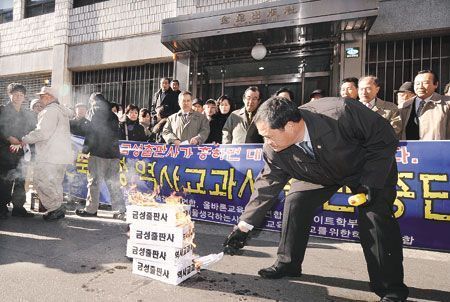
Members of rightwing civic groups burn history textbooks published by Kumsung Publishing, which they claim are “leftist,” in front of the company building in Mapo, Seoul, in November 2008. The education ministry caved in to the pressure from the rightist groups and ordered the publisher to rewrite more than 50 passages in its textbook on modern and contemporary history. The authors objected and took the ministry to court. The long ensuing battle ended last month when the Supreme Court ruled in favor of the plaintiffs, saying the ministry had no legal right to force changes on textbooks that had already been approved. / Korea Times file
By Kim Tong-hyung
It was the prophetic British novelist George Orwell who provided the fictitious government in his novel 1984 with the ominous dictum, “He who controls the past controls the future. He who controls the present controls the past.” And as with many of Orwell’s other predictions in that remarkable book, the effort to control history appears to be coming true.
While Park Geun-hye’s presidential victory, which extended the conservatives’ control of Cheong Wa Dae for another five years, will undoubtedly trigger dramatic changes in politics, economy and society, it’s historians who are feeling the heat first.
Park’s father, late dictator Park Chung-hee, whose legacy as a successful economic strategist is marred by scars left from bloody civilian oppression, is prominent in the mind of education officials, now accused of attempting to dumb-down state-approved textbooks used in middle and high schools.
School books began leaning further toward the right during the previous Lee Myung-bak government, which empowered academics who were part of the conservative ``New Right’’ movement, a loose association of people from different backgrounds close to the Lee administration.
.jpg?w=728)
Academics under the “New Right” civic movement have been publishing a number of “alternative” history books for middle and high school students for the past few years, which are notable for their conservative position on history. / Korea Times file
Under the Park administration, the lean right could become a full ideological stance in all school books. The ministry of education is pushing a controversial bill that will grant its minister the power to rewrite the content of school books that have already been approved by the National Institute of Korean History.
Historians immediately raised concerns, questioning whether students will be bashed about the head with defensive arguments about the late Park’s May 16 coup of 1961.
"The process of history education at schools is already a mess because the Lee government attempted endlessly to tinker with textbooks that had already been approved by experts and state institutions,’’ said Dongguk University historian Han Cheol-ho.
"Should the ministry’s bill go through the National Assembly, President Park could hypothetically have the ministry change the descriptions of the coup. Allowing politics to influence education is a dangerous path to go through because it will compromise neutrality and the diversity of opinions that has been protected through the current examination system of textbooks.”
A ministry spokesman downplayed the concerns, claiming that the draft law allows the minister the authority to ``request’’ corrections, not ``order’’ them. However, the bill also calls for the minister to have the power to disallow the textbook at schools for up to a year should the publisher reject the ``request.’’
Publishers of school books have already seen their autonomy crumble under the Lee government. The education ministry touched off a heated debate in 2008 when it directed Kumsung Publishing to rewrite more than 50 passages in its history textbook on modern and contemporary history, including descriptions about the first Korean president, Syngman Rhee, caving into the demands of New Right academics.
While Kumsung accepted the changes, the historians who authored the book, which was widely used in high schools around the country, objected and took the ministry to court the same year. The struggle finally ended last month when the Supreme Court ruled in favor of the plaintiffs, saying that the ministry had no legal right to force changes on textbooks that had already been approved.
The authors have also filed a civil suit against the publisher, which is still pending.
For Kumsung, the damage is already done. It’s hard to imagine that schools will be clamoring to use its textbooks when they had already been accused of being "leftist,’’ considering that this is a nation where many still cringe at the very mention of communism.
Textbooks on Korean modern and contemporary history are being phased out anyway. From this year, the ministry will have middle schools use ``comprehensive’’ textbooks on Korean history, instead of different books on different historical periods. The same changes will be implemented to high schools next year.
The worry is that the writings on modern and contemporary history would lack in depth and detail compared to when they were packaged separately.
The historians involved in the new books that are being written or under review stress they are trying to maintain objectivity and independence in face of political pressure.
However, the teachers in classrooms feel that the message has already been sent.
"While the government may say this or that publically, the message has been clear for us teaching at schools for years now. They don’t want us to spend more time teaching modern and contemporary history,’’ said a history teacher from a high school in Siheung, Gyeonggi Province, who didn’t want to be named.
"The history teachers at our school are debating what to do. Since we use textbooks in class but complement them with our own material, some of us are planning to teach contemporary history the way we were in school. However, we can’t use this content in exams, though, because a law now requires schools to reveal their exam questions online after the tests.’’
So how will history school books look in the future? The regional government of Gyeonggi Province may be providing a preview. Its recently-published "Contemporary History of Gyeonggi Province,’’ which will be used as an educational resource for public workers, was mostly authored by New Right academics and makes several controversial claims, such as that the May 16 coup was "silently supported by the majority of the public.’’