What happened to Seomjin River?

Seomjin River in Imsil, North Jeolla Province, has been a continuous source of inspiration for poet Kim Yong-taek. / Korea Times file
Poet hopes for recovery of humanity, romanticism
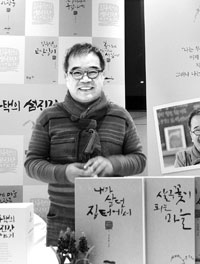
Poet Kim Yong-taek, who is also known as the “Seomjin River Poet,” released “Kim Yong-taek’s Story of Seomjin River” series. / Yonhap
By Chung Ah-young
He was born in a small countryside village near the Seomjin River in Imsil, North Jeolla Province, where he grew up watching his neighbors work, play and eat together. Many things were shared in this community and villagers were intimate like a family.
It’s no wonder that poet and writer Kim Yong-taek is nicknamed the “Seomjin River Poet,” because the riverside Jinme Village is a microcosm in which he crafts his ideas and finds energy and inspiration. It is a place where nature and people once coexisted in the true spirit of romanticism. But now, this is just a distant memory because the villagers have gone or have died and much of the beautiful natural background has been ruined by a development project.
For over 30 years, the village has been a continuous source of inspiration for his writing, ever since Kim made his debut with “Seomjin River 1” in 1982. He recently published an eight-volume “Kim Yong-taek’s Story of Seomjin River” series which encompasses his major works including prose, essays and poems written from 1948 to 2012. The first two volumes are the newest and six others include his past writings, all featuring Jinme, its villagers and its beautiful nature.
When he began his writing career, the village was barely a community, but pretty with some 35 households. But now some 20 are left and most of these are elderly.
Life was tiresome and households were poor but the author says their shared humanity bonded people together and there were often hilarious moments.
In this open rural community, there was little privacy even though there were doors and fences. There was no division between personal and shared property. In the middle of this fast changing society, the poet raises a fundamental question over whether we are going in the right direction and whether we are genuinely happy.
He portrays rural life as a thing of the past and romantic, the antipathy of urbanity and modernity. Almost nothing remains the same because industrialization and modernization have destroyed peaceful landscapes and the traditional communal system of rural society. The series reflects his strong affection toward his hometown shown by his trademark folksy words.
“The time of dividing a city and a country has gone. It is hard to find a rural community in the traditional sense. The greedy face of capitalism has destroyed rural community, its people and its work along with nature and even its soul. I stood firmly with all my best in the middle of it,” he said in the preface of the first volume “Where I Used to Live.”
“I was a lone poet in a falling village. I was exiled from the village. I now belong to the interim government. But I will not forget the beautiful government (in the past),” he writes.
Now he lives in Jeonju, a city, after retiring from teaching children at an elementary school in his village in 2008.
His pieces are full of nostalgia and are eulogies for the rural community and even anger at modernity and urbanization. His words are a mixture of his spiritual wounds caused by social change and a sense of deprivation.
In the series, he introduces an individual resident and a brief history or a famous place in the village. Anything — for example, an old tree, native fish, rock, bird or legend — can be a subject for his works. At the same time, Kim reveals a critical spirit that accompanies his intimate portrayals of rural life, condemning modernity through his strong provincial dialect in poetic forms. The native dialects, proverbs, and unique colloquial words vividly support his ideas and literary prowess, creating traditional rhythms and mixing rage and humor together.
“I am hurt. The land (village) is deserted from the world and only exploitation and destruction remain,” he writes.
The series consists of “Where I Used to Live”; “Village Where Apricot Flowers Bloom”; “500 Li from Seomjin River”; “Jinme Village, Jinme People”; “Eating, Working, Playing Together”; “Chang-woo, Dae-hee, Come to School Tomorrow”; “Teaching Diary of Kim Yong-taek”; and “I Was Standing Below Mountain Where Flowers Bloom.”