'Earth in danger' but there is hope
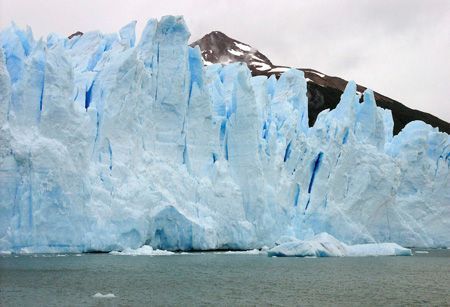
A general view of the leading edge of Perito Moreno glacier in Patagonia, Argentina, Jan. 3, 2009. While most of the world’s glaciers are melting away because of warmer temperatures, scientists say the Perito Moreno ice field, known as “The White Giant,” is gaining as much as 3 meters a day in some parts, pushed forward by heavy snowfalls in the Patagonia region. / Yonhap-Reuters
.jpg)
“Earth in Danger: Toward a New Planet,” edited by Park Eung-kyuk and published by the Korea Institute of Public Administration
By Nho Joon-hun
The book “Earth in Danger: Toward a New Planet” is not actually a pessimistic portrayal of where we live. It is about finding solutions to environmental problems that we face.
The Korea Institute of Public Administration (KIPA) collaborated with The Korea Times in publishing a series of 50 full-page articles concerning the state of our Earth and what is described on the cover of the book as “50 Great Stories to Save the Planet” came to life.
Edited by KIPA President Park Eung-kyuk, the 340-page hard cover contains contributions from prominent figures in a wide range of fields, including politics, society, government and academia.
In the prologue, Park talks about the fact that there is no denying that “the Earth, as we know it, is in danger. The entire planet is suffering from environmental devastation, including climate change and every conceivable type of ecological destruction and depletion of natural resources.”
Through elaborate arrangements made between KIPA and The Korea Times, the series was able to attract contributions from a who’s who in the field of the environment and environment protection.
One of the highlights of the series and the book was green growth, a point emphasized by President Lee Myung-bak in his series-ending article titled “Green growth essential to saving ‘Earth in danger.’”
In it, he said, “The conclusion I arrived after much hard thought was that we should not pass on an Earth in danger to our posterity. Novel ways of thinking and behavior are needed.”
United Nations Secretary General Ban Ki-moon, who received the Seoul Peace Prize here early this week, noted, “Our aim is to ensure universal access to modern energy services for the one in five people who lack them; to reduce energy efficiency; and double the share of renewable in the global energy mix.”
Prof. Jeffrey Sachs, head of the Earth Institute at Columbia University in New York City, said in his contribution, “I have one basic message, which is not exactly a surprise and that is why we are in this deep trouble. Things are not working and the international system is not solving problems that humanity has never had to solve together.”
For his part, Jeremy Rifkin, president of the Foundation on Economic Trends in Washington, D.C. and teacher at the Wharton School, talked about “the dramatic rise in carbon dioxide emissions from the burning of fossil fuels,” raising the earth’s temperature and threatening an unprecedented change in the chemistry of the planet and global climate.
The book contains writings from Dr. Han Seung-soo, a former Prime Minister and a member of the U.N. Secretary General’s Advisory Board on Water and Sanitation and chairman of the High-Level Expert Panel on Water and Disasters, and until recently board chairman of the Global Green Growth Institute (GGGI), which has since been recognized as an international institution at the Rio+20 Gobal Summit in Rio de Janeiro.
Other contributors include Environment Minister Yoo Young-sook, who wrote about “New ways to meet the environment” in locations like the Upo Wetlands in Changnyeong County, and Kwon Do-youp, minister of land, transport and maritime affairs, who emphasized the importance of the convergence of people and Korea’s four rivers which are undergoing major transformations.
“The book and the series in The Korea Times carry a certain amount of significance in that it covers a wide range of perspectives on what is happening in the sphere of the environment,” said KIPA President Park.
Other writers include Christian Friis Bach, Danish Minister for Development and Cooperation; J.C. Gillard, a senior lecturer at the School of Environment of the University of Auckland; Amb. Torbjorn Holthe of Norway to Korea; Brindusa Fidenza of the Climate Change Initiative of the World Economic Forum; Richard Samans, executive director of GGGI; Margaret Arnold of the World Bank; Martin Kruse of the Copenhagen Institute for Future Studies; and Leena Ilmela, a senior researcher in the International Institute for Applied Systems Analysis in Vienna.
At home, Seoul Mayor Park Won-soon; Young Soo-gil, chairman of the Presidential Committee on Green Growth; former Environment Minister Lee Kyoo-yong; SK chairman Chey Tae-won; Choi Yul, president of the Korea Green Foundation; and Kim Joong-kyum, president of KEPCO, contributed articles.
The book is not for sale but is available at most university and school libraries. Information about obtaining a copy of the publication can be accessed at KIPA at kipa@re.kr.
jakenho@koreatimes.co.kr