INTERVIEW From marriage migrants to dispatched nurses, photographer captures diasporic women's stories in portraits

Kim Ok-sun's "bsp_ahs130" (2023), left, and "bsp_dnr937" (2023) from her "Brides, Sara" series / Courtesy of the artist
By Park Han-sol
In November 1910, the year Korea fell under Japanese colonial occupation, 23-year-old Choi Sara climbed aboard a ship en route to Hawaii. In her hand was a black-and-white photograph of a man, whom she had never spoken to or met in person.
The man in the picture was one of thousands of Korean immigrants who arrived in Honolulu years earlier as cheap labor to work on the sugarcane plantations. He was also Choi's husband-to-be.
The couple tied the knot shortly after her arrival. Choi thus became Korea's first “picture bride” ― a term referring to women who married immigrant laborers in Hawaii in the early 20th century after the prospective brides and grooms saw each other only through photographs exchanged via a matchmaker.
From 1910 to 1924, more than 1,000 Korean picture brides left their homes to begin a new life in a foreign land they knew nothing about. Some did so out of familial obligation or economic concerns, but there were others who hoped to gain freedom denied to them in patriarchal, Neo-Confucian society.
Although their lives as the first-generation Korean immigrants in America were far from romantic, the women played a key role in building systemic communities among themselves and even raising money for independence fighters to help liberate their homeland from Japanese rule.
These young, unnamed women, “who had the courage to throw themselves into the unknown and start anew,” were what inspired photographer Kim Ok-sun's latest project, “Brides, Sara” (2023), now on display at Sungkok Art Museum in central Seoul.
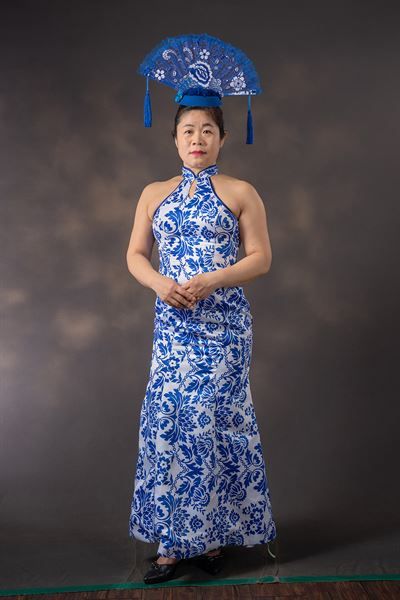
Kim Ok-sun's "bsp_wmm295" (2023) from her "Brides, Sara" series / Courtesy of the artist
But instead of simply reproducing the archival photographs from a century ago, Kim pays homage to the resilience and strength she saw in these spirited women through portraits of those whose lives today seem to resemble theirs in many ways ― marriage migrants from Southeast and Central Asia and China living in Korea.
Rather than remaining in their home countries that may have limited opportunities for them in terms of work or education, these migrant women came to Korea in search of new lives and strove to carve out a place for themselves in society despite cultural barriers, the photographer explained in a recent interview with The Korea Times at the museum.
She added, “Their conscious life decisions reminded me of those of the Korean picture brides, and this realization is what helped me understand them in a new light, especially beyond the usual sociopolitical narrative revolving around their resettlement.”
The sitters filmed in Kim's “Brides, Sara,” originally hailing from China, Vietnam and Mongolia, have lived in the greater Seoul area and Incheon for as long as 20 years.
Donning the traditional attire of their homeland, they are posing with confidence against the classically-lit, retro-styled background in an old studio tucked away in Hwanghak-dong, central Seoul. The images' stylistic compositions are a visual nod to the vintage photographs of picture brides, who were seen dressed up in laundered “hanbok” (traditional Korean clothing) with accessories like a folding fan or a floral bouquet.
“These photos also serve as a visual reminder and proof that, like the countless faces of Koreans who were once clients of the old Seoul studio, marriage migrants are the faces of diversity that make up our society today,” said the museum curator Jun Ji-hee.
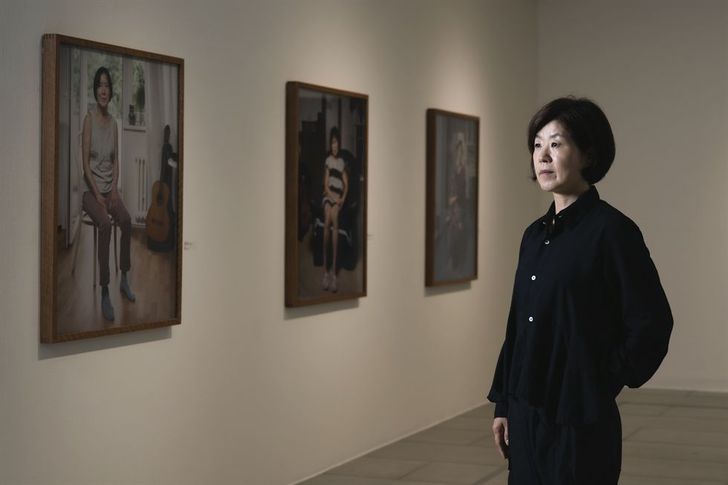
Photographer Kim Ok-sun poses at Sungkok Art Museum in central Seoul, July 11, where her solo exhibition, "Flatness of Things," is held. Korea Times photo by Choi Won-suk
Photographic journey to document personal histories of migration, diaspora
For over two decades, the 56-year-old has given “a visual voice” to the marginalized communities in Korea, especially those of women, whose personal histories embody the ideas of diaspora, migration and “foreignness."
Her ongoing solo exhibition, entitled “Flatness of Things,” traces this photographic pursuit in a nonlinear order. It puts her every major project on view, from the latest portrait series of marriage migrants to images of Korean nurses, who departed to West Germany en masse in the 1960s and 1970s after the two countries signed the 1963 labor recruitment agreement.
Photography, which she took up as a hobby at a college club, became her calling in the mid-1990s.
In her first project, “Woman in a Room” (1996-2001), the artist captured ordinary women in their 20s and 30s posing nude in their own spaces ― as a testament to the rapidly liberalizing and globalizing Seoul following the 1988 Summer Olympics.
“I could witness in real time how women's increasingly raw and bold self-expression reflected the sweeping societal and economic shifts taking place in the country at the time,” she said. “And as my friends began moving out of their family homes and getting a room of their own, I wanted to document their changing selves within that very space.”
In her series, the background, therefore, had as much to say as the subjects themselves ― a characteristic that would come to influence many of her subsequent projects.
“When I visited someone's home, it was fascinating to be able to identify their preferences, habits and cultural identity hinted through its interior. The room was more than just their living space; it was a materialization of their inner thoughts ― like a space of their mind,” she noted.
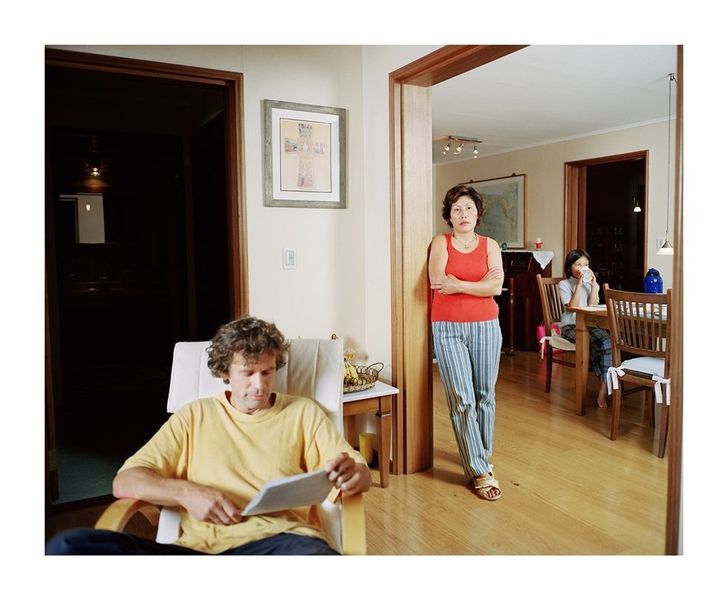
Kim Ok-sun's "Miryun and Stephan" (2002) from her "Happy Together" series / Courtesy of the artist
Then came the turning point in Kim's personal ― and evidently, professional ― life: her marriage to a German man and the couple's subsequent move from Seoul to Jeju Island.
“I was simply marrying the one I loved, but was shocked to find out how our union brought changes to my family's legal status and life afterward,” she recalled.
In accordance with the Nationality Act at the time, the acquisition of Korean citizenship for foreign spouses of Korean nationals was patrilineal.
This meant that a foreign wife of a Korean man was automatically granted citizenship upon registering their marriage, while a foreign husband of a Korean woman had to apply for naturalization after meeting all residency requirements. It was thus necessary for the foreign husbands, including Kim's, to independently obtain a work visa and figure out a way to stay in Korea.
What was more, children born to a Korean mother and a non-Korean father were not automatically eligible for Korean citizenship. (Such gender-based discrimination was not addressed until the law underwent a comprehensive revision in 1998 to ensure fairer citizenship rights for international families.)
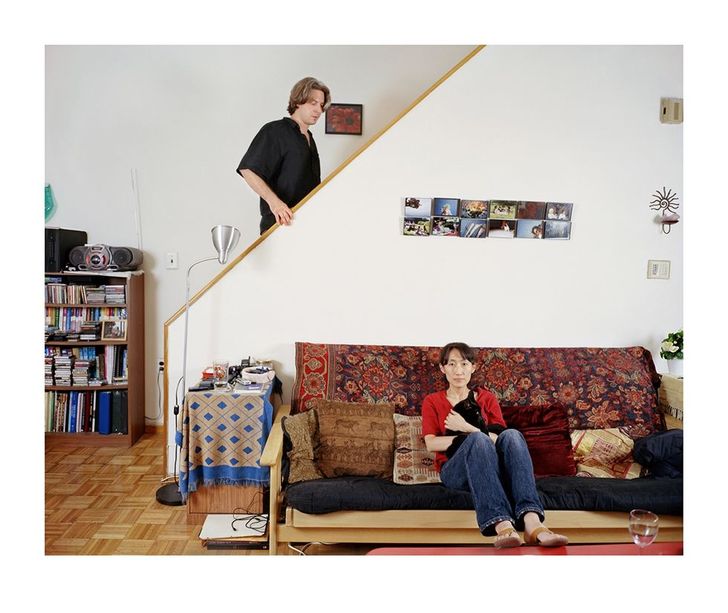
Kim Ok-sun's "Shihyun and Dan" (2004) from her "Happy Together" series / Courtesy of the artist
“So, even though I am a Korean citizen, if my husband's visa extension request were ever to be denied, both he and our daughter would have had to pack up and leave the country. My family was thus in a legally and emotionally precarious state at all times," the photographer said.
It was right then that a thought crossed her mind. Surely, there must be other women before her, whose families have been subject to a similar fate. How were they coping with such a living situation?
“I wanted to find out the answer to my question by meeting them and talking about our shared sense of frustration,” she added.
Thus began her “Happy Together” series (2002-05), which primarily zoomed in on the lives of binational couples comprising a Korean wife and her foreign spouse on Jeju Island.
In all the photos, only the women are looking straight into the camera, while their husbands are absorbed in everyday activities ― taking care of the baby or reading the paper, for example ― with their gaze averted.
“I felt like these women, who were being treated differently from their Korean male counterparts, must have much to say about their situation. So, I framed the shot as if they are directly engaged in a conversation with the viewers,” she said. “And by making them look in different directions, I also wanted to visualize how the two people living under the same roof had different cultural backgrounds and perspectives.”
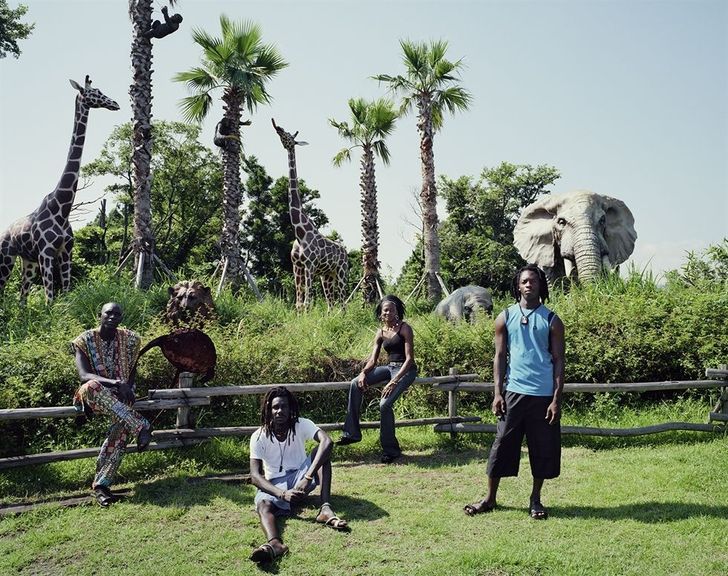
Kim Ok-sun's "The Performers" (2007) from her "Hamel's Boat" series / Courtesy of the artist
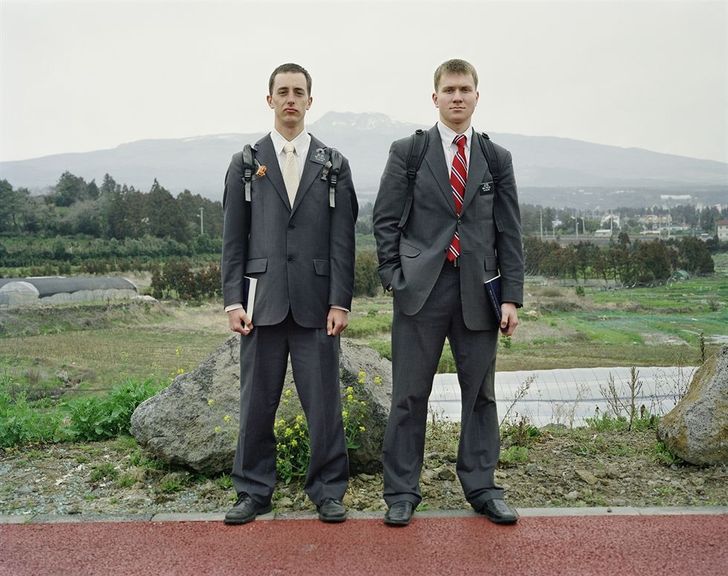
Kim Ok-sun's "The Elder Potter and Coon" (2008) from her "Hamel's Boat" series / Courtesy of the artist
As she continued to explore the ideas of migration and resettlement through such photographs, Kim eventually expanded her artistic focus to non-Korean residents from all walks of life who have come to live on Jeju ― from martial artists to performers, Mormons and self-described “nomads.”
She found that while most held day jobs as English teachers at schools or academies, they shared a desire to pursue their passions and a taste for adventure ― in whatever form it takes.
Sherrin Hibbard, a former fisherwoman from Australia, is one, Kim recalled. After becoming the first foreign “haenyeo” (female diver) in Korea, she went on to complete an unprecedented 160-kilometer swim nearly all the way around the island for over a month in 2010 to raise awareness of its water pollution.
In one project, Kim likened these individuals, who have carved out a place for themselves on Jeju and contributed to its growing population diversity, to non-native plants like palm trees that have blended into scenes of everyday life on the island.
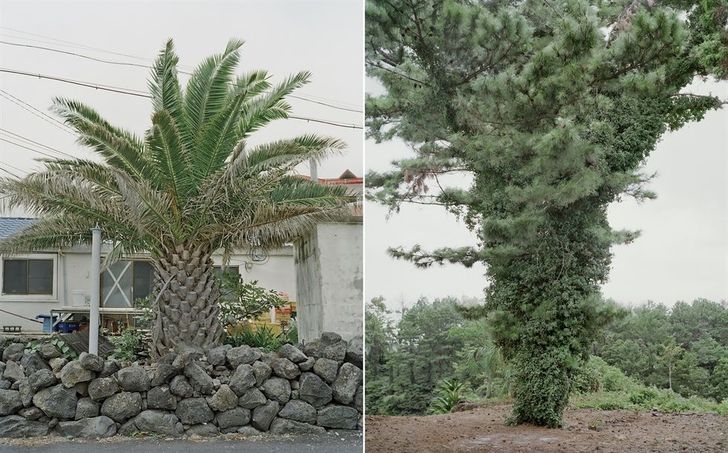
Kim Ok-sun's "Local_bupwhan2115" (2012), left, and "Untitled_hawon1695" (2013) from her "The Shining Things" series / Courtesy of the artist
One notable highlight of the exhibition at Sungkok Art Museum is Kim's “Berlin Portraits” (2018) a photographic series spotlighting women who traveled to Germany as temporary migrant nurses decades ago and settled down in the European nation. The project is a precursor to her portraits of marriage migrants in that the images reveal the diasporic women's often-overlooked tenacity and sense of agency that played a key part in their resettlement.
During the 1960s and 1970s, the Park Chung-hee government dispatched over 10,000 nurses (and nearly 8,000 mine workers) to West Germany to obtain much-needed foreign capital for the country that was still recovering from the 1950-53 Korean War.
While the discussion about these temporary labor migrants is often limited to their role played in Korea's “miraculous” economic rise, Kim's photos show that the women have many more stories to tell.
“They would tell me emphatically that they weren't just 'sent by' the Korean authorities,” the photographer noted. “The government simply provided the channel. They were the ones who voluntarily decided to go to Germany after paying their own expenses.”
There were various reasons behind this decision. Some wanted a chance to study abroad. Others wanted to escape from the country's patriarchal system. One former nurse recounted how her relative's defection to North Korea wreaked havoc on the reputation of the rest of her family members in the South, prompting her to seek out ways to be free from stigma.
“Whatever their goal was, these 20-somethings, who were all born around the time of the Korean War and spent their childhood in the battle-scarred nation, had that ambitious desire and determination to change their own lives. That was incredibly admirable,” she added.
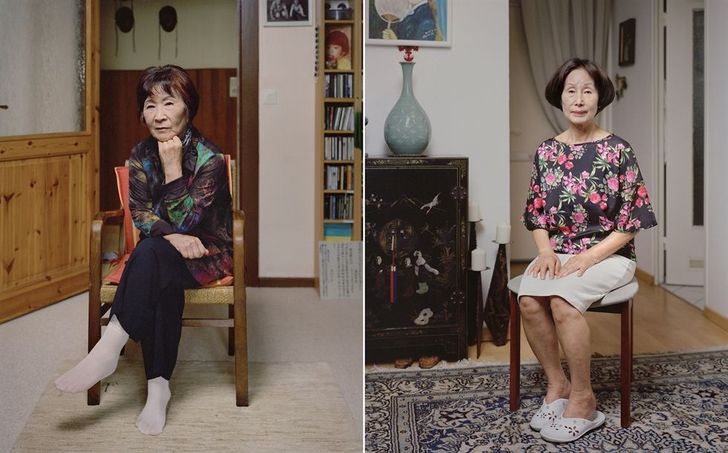
Kim Ok-sun's "BNP_8710CJ" (2018), left, and "BNP_8715EZ" (2018) from her "Berlin Portraits" series / Courtesy of the artist
What is even lesser known about these women's lives is the strides they made to resettle and redefine their identity as Korean Germans.
Upon their arrival, the nurses worked at a number of healthcare facilities based on temporary contracts. But in 1977, the German government began implementing their forced repatriation measures by denying their requests for work permit extensions. When one hospital in Munich collectively dismissed 17 nurses from Korea, hundreds decided to gather signatures and took to the streets to fight for their rights to extend their stay.
After they successfully gained support from the public, Munich was forced to scrap the order. The nurses were granted Permanent Residence Permits, which allowed them to reside in the country indefinitely without the need for periodic renewals.
“This was a milestone achievement made through the migrant workers' fight for their rights in Europe,” Kim explained.
The photographer said she hopes to continue to train her lens on ordinary, nameless women of Korea, who are a living testament to the country's tumultuous modern history yet have long been written out of the official, state-level narratives.
“The people who have lived through this tremendously challenging period ― from the country's liberation from Japanese rule to the Korean War, military dictatorship and democratization ― are still alive. I want to hear their stories,” she noted.
“Flatness of Things” runs through Aug. 13 at Sungkok Art Museum.
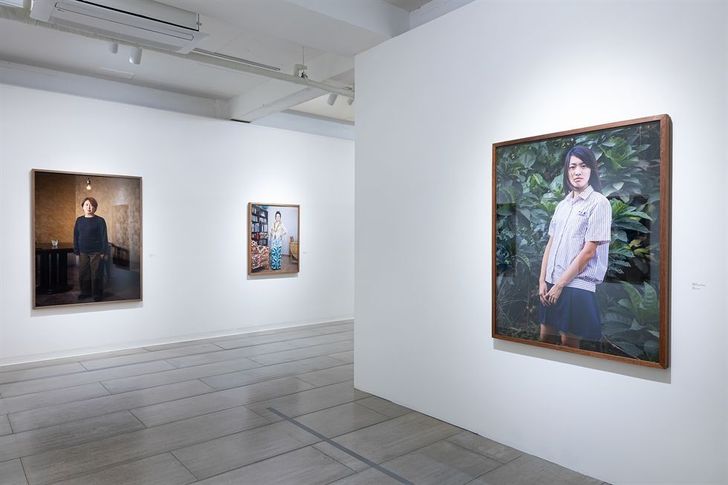
Installation view of Kim Ok-sun's solo exhibition, "Flatness of Things," at Sungkok Art Museum / Courtesy of Sungkok Art Museum