INTERVIEW Meet architectural visionary behind NYC's Korean art showcase at Rockefeller Center

Artist Lee Bae's “Issu du feu (From Fire),” a 6.5-meter-tall stack of pine charcoal on view at the Channel Gardens outside Rockefeller Center in New York City, is the first Korean piece ever to be featured in the city's iconic botanical promenade. It serves as a prelude to “Origin, Emergence, Return,” the group exhibition of three Korean artists ― Park Seo-bo, Lee and Jin Meyerson ― co-presented by the center and Busan-based Johyun Gallery. Photo by Victoria Macchi. Courtesy of studioMDA
Architect Markus Dochantschi of New York-based studioMDA reimagines blue-chip galleries' showrooms as flexible, inviting spaces
By Park Han-sol
At the Channel Gardens outside the landmark Rockefeller Center, amid a sea of skyscrapers in the heart of New York City, stands artist Lee Bae's towering stack of pine charcoal.
The 6.5-meter-tall wooden sculpture, “Issu du feu” (From Fire) ― the first Korean piece to be featured in the city's iconic botanical promenade ― is an ode to the profound spiritual symbolism embedded in this material, revered throughout East Asian culture as a guardian and purifier against malevolent forces. But it is also a commanding overture to “Origin, Emergence, Return,” the new exhibition of three generations of Korean art ― Park Seo-bo, Lee and Jin Meyerson ― co-presented by the center and Busan-based Johyun Gallery.
The project, which began at the initiative of the prominent real estate company Tishman Speyer, the owner of Rockefeller Center, is part of the first-ever celebration of Korean culture, cuisine and fashion at the historic New York City complex.
And in designing the show of around 70 paintings, sculptures and even augmented reality (AR) works that traces the country's art from the 20th century to the present, the architect Markus Dochantschi of New York-based studioMDA was the man for the job.
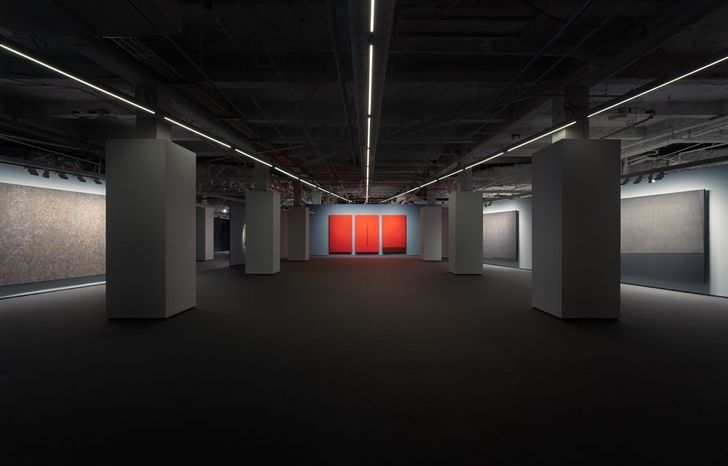
Installation view of “Origin, Emergence, Return,” mounted at Rockefeller Center's Rink Level Gallery / Courtesy of David Yong Hwan Lee
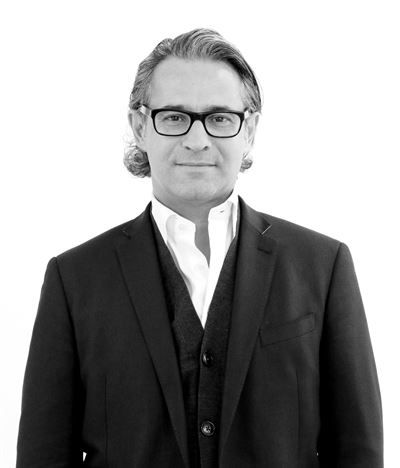
Architect Markus Dochantschi, founder of New York-based design firm studioMDA / Courtesy of studioMDA
With a design portfolio of 34 galleries, over a dozen exhibitions and more than 250 art fair booths under his belt, Dochantschi put his architectural philosophy of creating an inviting art presentation into practice at the center's underground Rink Level Gallery.
“The gallery has a windowed frontage and starting from there, we created a vanishing point (that leads visitors' eye toward) Park Seo-bo's pieces,” he told The Korea Times in a recent video interview. “So when you walk by, you actually see from a large distance the three red paintings of Park that really draw you in.”
Once the passers-by approach the paintings, they can witness the detailed texture of layered “hanji” (traditional Korean paper made from mulberry trees) with deep vertical ridges, produced through endless and meditative gestural strides by the “dansaekhwa” (monochrome painting) master.
It is from the 91-year-old Park's works in blazing red that the viewers' journey through modern Korean art begins. “Out of all three (featured artists), he really is sort of the father of them all, so to speak,” the architect said. “It was very important for me to understand each artist and their sensitivities to the space before trying to think how the three come together.”
Viewers are left to freely traverse neighboring rooms, each marked by distinctively colored flooring and walls, with Lee's paintings dominated by dynamic charcoal brushstrokes at one end and Meyerson's feverish canvas works featuring digital image manipulation and computer graphics at the other.
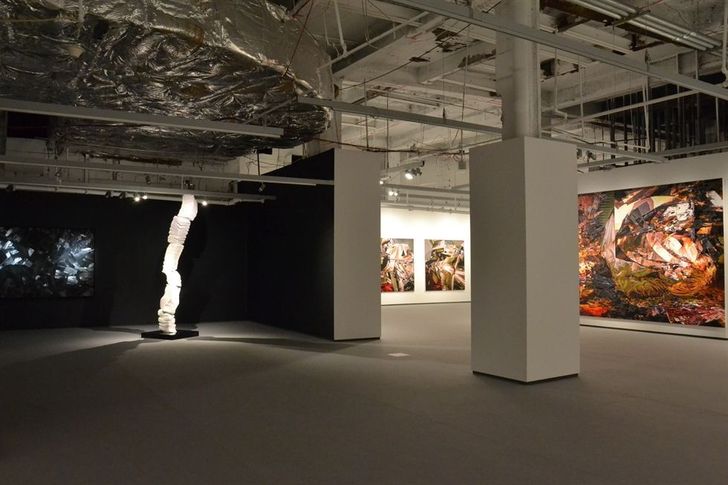
Installation view of “Origin, Emergence, Return,” mounted at Rockefeller Center's Rink Level Gallery. Photo by Victoria Macchi. Courtesy of studioMDA
And in Dochantschi's eyes, engaging in such a journey is made possible only when visitors feel welcomed into the space in the first place ― a quality that has largely been overlooked for decades within the confines of conventional “white cube-styled” galleries.
“There was always frosted glass that you couldn't look into … and a front desk that made you feel like you needed an appointment to get in,” he noted, recalling his multiple trips made in the late 1990s to a string of New York galleries while he was working for the late Pritzker-winning architect Zaha Hadid in London. (Hadid is best known in Korea as the mastermind behind the neo-futuristic design of Dongdaemun Design Plaza (DDP) in central Seoul.)
Since founding his own firm, studioMDA, in 2002, Dochantschi has been steadfast in his mission to reimagine the showroom experience. His architectural layouts have focused on creating spaces that even the uninitiated could simply walk in or look into without feeling intimidated.
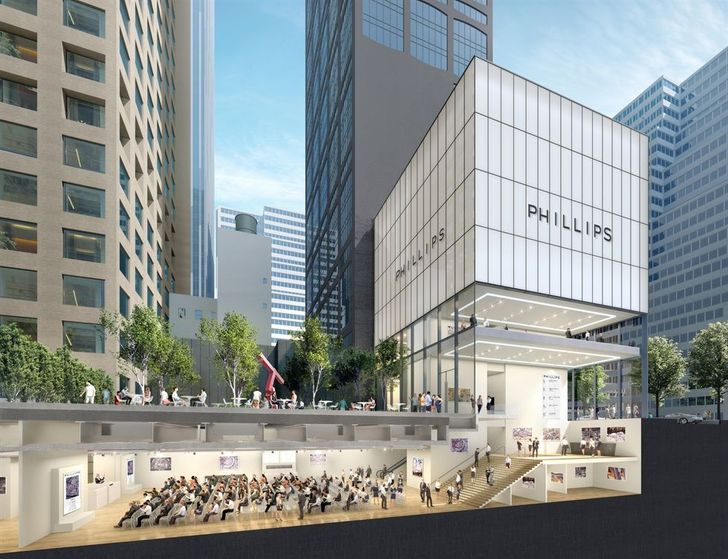
A rendering of the auction house Phillips' new headquarters in New York shows an underground concourse surrounded by large glass windows above, which allows any passer-by to watch the sales directly from the street. Courtesy of studioMDA
The studio's major renovation of the auction house Phillips' new headquarters in New York, for instance, features an underground concourse surrounded by large glass windows above, which allows any passer-by to observe the bidding process right from the street.
Such visual transparency ― still a rare quality in the high-octane art world ― thus sheds the classical image of auctions as being a place where behind-the-scenes deals are conducted.
“A lot of people feel like there's some mystery about auctions,” he said. “But I think it's something that the public should be invited to be a part of.” After all, auctions and their previews provide a chance for the people to witness an incredible Picasso or Rothko for a brief window of time before the prized piece moves from one private estate to another, the German-born architect added.
And that notion of promoting public engagement through transparent storefronts stays solid in many of his gallery designs as well ― the Lisson Gallery under New York's High Line and the Kasmin Gallery on 10th Avenue, to name but a few.
“I think this (visual) openness of galleries also really changes the vibrancy and fabric of the neighborhood,” he noted.
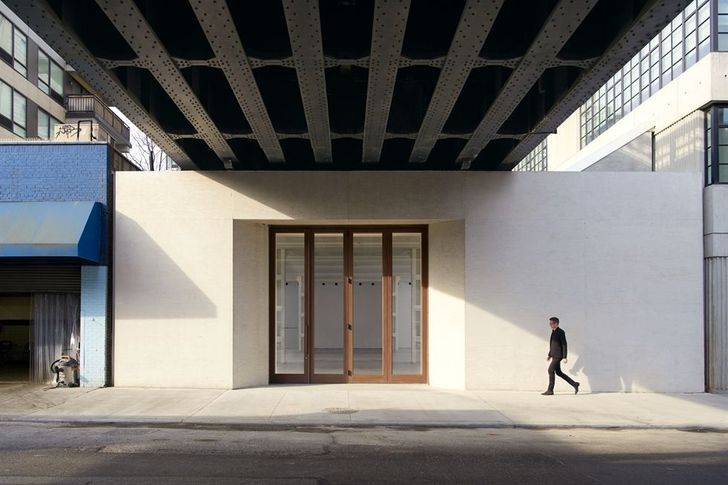
Exterior of the Lisson Gallery under New York's High Line, designed by studioMDA. Photo by Jason Schmidt. Courtesy of Lisson Gallery
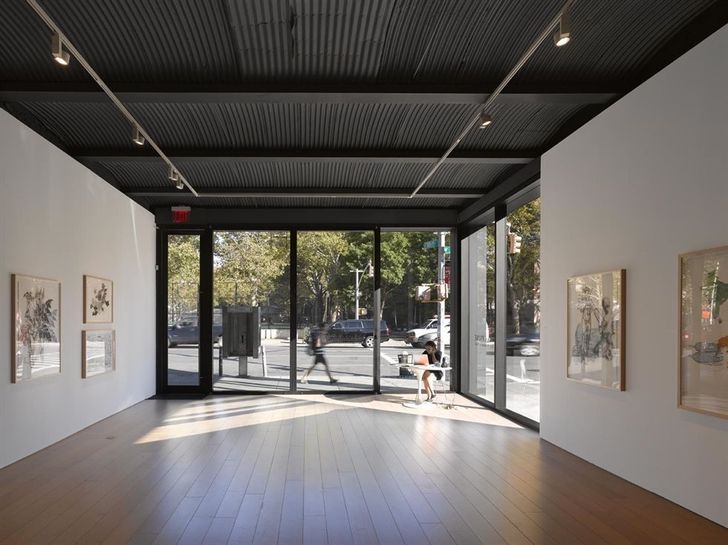
The Kasmin Gallery, located at 297 10th Avenue in New York, designed by studioMDA, with Roxy Paine's 2016 exhibition, “Thermoplastic Flux,” on display / Courtesy of Roland Halbe
However, as much as the galleries' showrooms are for viewers, they are also stages for the artists and their works to shine.
This is where he brings the element of flexibility into his layout so that each space can react specifically to the gallery's program and character.
“I'm a strong believer that a space is not, and should not, be neutral. Sure, it should be a well-proportioned space, but it doesn't have to be all white and neutral,” Dochantschi explained.
To create a space capable of accommodating artists working in diverse mediums and scales, the architect incorporates ingenious details like movable walls, skylights, track lighting and luminaires installed on ceiling grids.
In some cases, when he is tasked with refurbishing existing historic buildings, he keeps the structural features inherent to the site, such as old wooden floorboards, Georgian-style staircases from the 1930s townhouses and even exposed tin ceilings ― remnants of a more affordable building practice popular during the early 20th century in the U.S.
After all, the unexpected visual harmony between the old and new is sometimes what completes the picture.
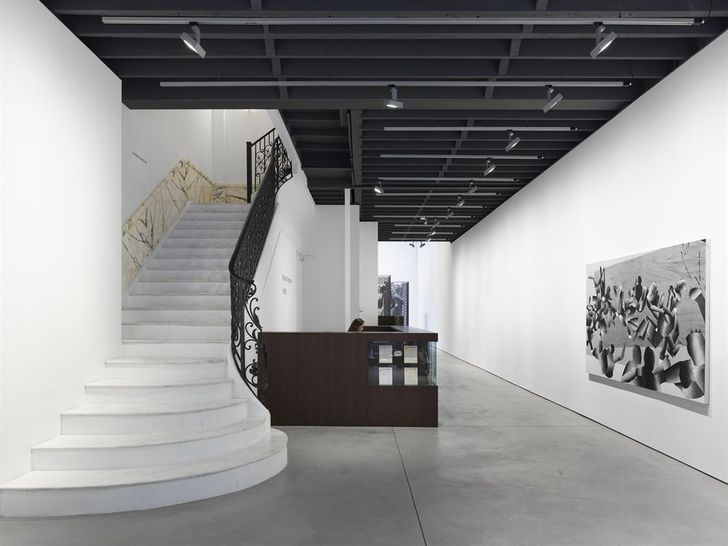
The Anton Kern Gallery, designed by studioMDA, with Matthew Monahan's 2018 exhibition, “frNMEz,” on display / Courtesy of Roland Halbe
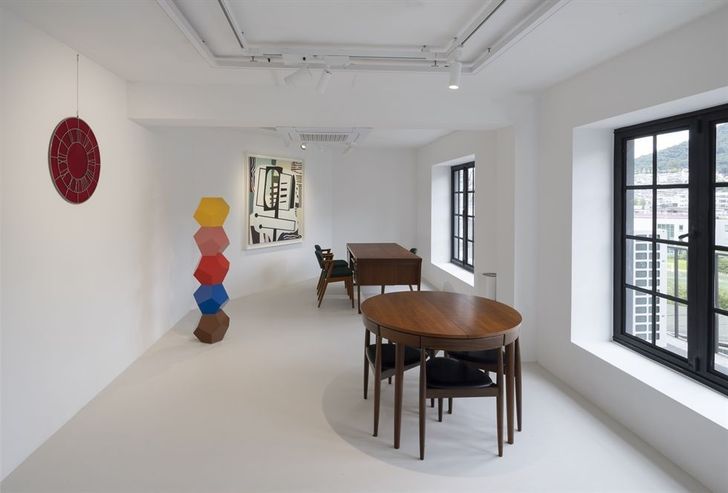
A view of Esther Schipper Seoul's offices and showroom, designed by studioMDA. Photo by Andrea Rossetti. Courtesy of the artists and Esther Schipper, Berlin/ Paris/Seoul
For those who cannot make it to New York City, where a majority of studioMDA's commissions are located, international art dealer Esther Schipper's Seoul outpost in Yongsan District is worth checking out.
Having opened its doors just last year, the office-turned-gallery is the first and only project that Dochantschi has realized in Korea, so far. The architect hinted that there's something currently “in the works” when asked about potential future partnerships with Korean galleries or showrooms.
“Every space should have its own character. So when you walk into any of our projects, it's not that you go, 'This is designed by studioMDA, because it's all white or because they only use copper,' but you're like, 'I wonder if this was designed by studioMDA,'” he said with a chuckle.
“And that's good, because I don't want to create an identifiable, predictable quality. Then it becomes boring for me and everyone else.”