Canvas becomes flower garden from artist's memories of childhood

Cho Sung-hee's "Red Garden with White" (2021), which will be on display throughout December at her solo exhibition, "Land of Imagination," at Hakgojae Gallery in central Seoul / Courtesy of Hakgojae Gallery
By Park Han-sol
Visual artist Cho Sung-hee's painting may look like a “Dansaekhwa” (“monochrome painting”) work from afar, awash with the vivid hues of red or snow white.
But a closer look reveals hundreds of thousands of flower petals and stems formed from hanji (traditional Korean paper made from the bark of mulberry trees) firmly placed onto the canvas by hand.
For the 72-year-old artist, the artwork becomes an imaginary flowerbed that summons specific memories from her own childhood ― when she grew up in a hanok (traditional Korean house) with its windows and doors pasted with hanji, surrounded by an idyllic garden tended by her father.
Eighteen of her paintings studded with constellations of hanji flowers and one recent wooden installation piece will be on view at the exhibition, “Land of Imagination,” throughout the month of December at Hakgojae Gallery in central Seoul.
Although Cho began her career as a painter, with her first solo exhibition held at the age of 23, it wasn't until she turned 61 that she began peppering her works with traditional Korean paper ― both an integral architectural material of her former home and her toy, as she grew up making cut-outs of Hangeul alphabets and geometric shapes with her mother.
It was a chance meeting for the artist, who has been creating abstract oil paintings for decades, but one that instantly drew her in. She said that as she placed the pieces of hanji onto a blank canvas, a flood of memories surrounding her childhood dreamland came back to her.
Since then, her pieces integrating her personal narrative with the traditional Korean material have been exhibited across the world in New York, Chicago, Paris, Milano, Singapore and Hong Kong.
In constructing the surface of her pieces, Cho first cuts out circles of different sizes from hanji as tiny flower petals. She then rolls up other small rectangular pieces into stalks and places them onto the canvas. After gluing each petal by hand to the stem, it is time to layer the “flowerbed” with oil paints diluted with turpentine ― an ingredient made from pine tree resins that is easily absorbed by the traditional paper.
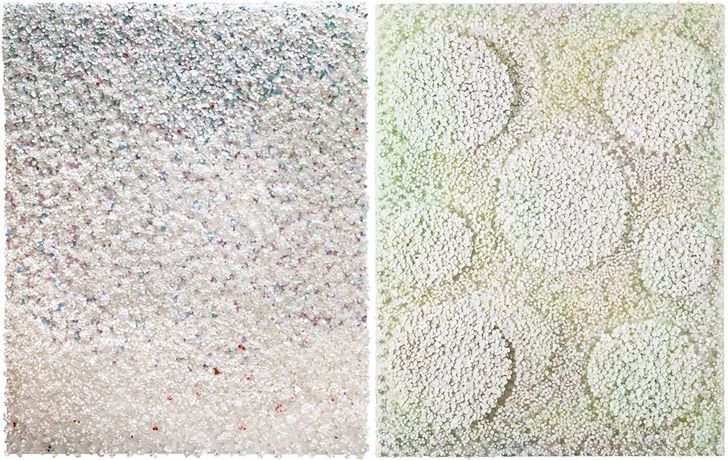
Cho's "Blossom Look Snow" (2019), left, and "Lovely Garden" (2021) / Courtesy of Hakgojae Gallery
She repeats this collage method again and again until the painting becomes a single imaginary garden encrusted with thousands of florets.
Many of the works on display at the gallery are monochrome, engulfed in the color red or white. But there are also pieces where the artist has added more visual variation by introducing different colored petals and raising or lowering the height of some of the stems to create an even stronger sense of depth.
Art critic Yoon Jin-sup referred to this labor-intensive, almost meditative, process as a trip back to “the artist's lost paradise.”
The exhibition, “Land of Imagination,” will run until the end of the year both at Hakgojae Gallery and its online viewing room.