Reexamining Choi Wook-kyung's many identities as multifaceted abstractionist

Installation view of the exhibition, “Wook-kyung Choi, Alice's Cat,” held at the MMCA Gwacheon in Gyeonggi Province / Courtesy of MMCA
By Park Han-sol

Painter Choi Wook-kyung / Courtesy of MMCA
Painter Choi Wook-kyung (1940-85) left a profound legacy on the Korean abstract art scene with her constant experimentations with colors, styles and compositions. She forged her own path, away from Dansaekhwa (monochrome painting) and Minjung art (People's Art, a pro-democracy and populist art movement) that prevailed in the domestic art community during the 1970s and 80s.
But like many other women artists of her time, she has been entangled in a mix of limiting labels put forth by reporters and critics that often downplayed her oeuvre itself.
During her lifetime, she was called “a maiden painter”; “a petite, young lady who created the largest drawing in Korea” and “a woman who paints… something that doesn't feel 'feminine' at all.” In the United States, where she studied and worked on and off for 15 years, her foreign nationality as an Asian artist became another modifier that followed her works.
But the most striking perception toward Choi that lingers to this day came in 1987, two years after her death at the young age of 45, when the National Museum of Modern and Contemporary Art, Korea (MMCA) held her first large-scale retrospective.
“Back then, perhaps due to the fact that it's been only a couple of years since Choi died at a young age, she was described as such a pessimistic and world-weary figure. What ended up happening was that these images began to overshadow the critical analysis carried out of her vibrant, dynamic pieces themselves,” said Jeon Yu-shin, curator of the artist's new, second retrospective at the museum in Gwacheon, Gyeonggi Province.
Titled “Wook-kyung Choi, Alice's Cat,” the exhibition sheds the outdated preconceptions about the artist's gender, race and her untimely death. Instead, it reexamines her extensive oeuvre of paintings, sculptures and installations spanning over two decades, including 10 artworks that are on display for the first time.
Another element of equal importance that the show highlights is the intersection between her paintings and her passion for literature ― her own published poems and essays, as well as her interest in Lewis Carroll's “Alice's Adventures in Wonderland” that affected the themes and visuals of a number of her pieces.
“Wook-kyung Choi, Alice's Cat” fittingly starts with Choi's 1965 painting, “Alice, Fragments of Memory” ― a piece that represents her own journey into the wonderland called the U.S in 1963 as she entered Cranbrook Academy of Art in Michigan to earn her master's degree, and the subsequent identity crisis she suffered in a foreign land. She later recalled the moment as “a shock that shook my very roots.”
While studying at Cranbrook Academy and later, Brooklyn Museum Art School, the artist was able to explore and interpret a wide variety of American contemporary art from Abstract Expressionism and Post-Painterly Abstraction to Pop Art and Neo-Dada.
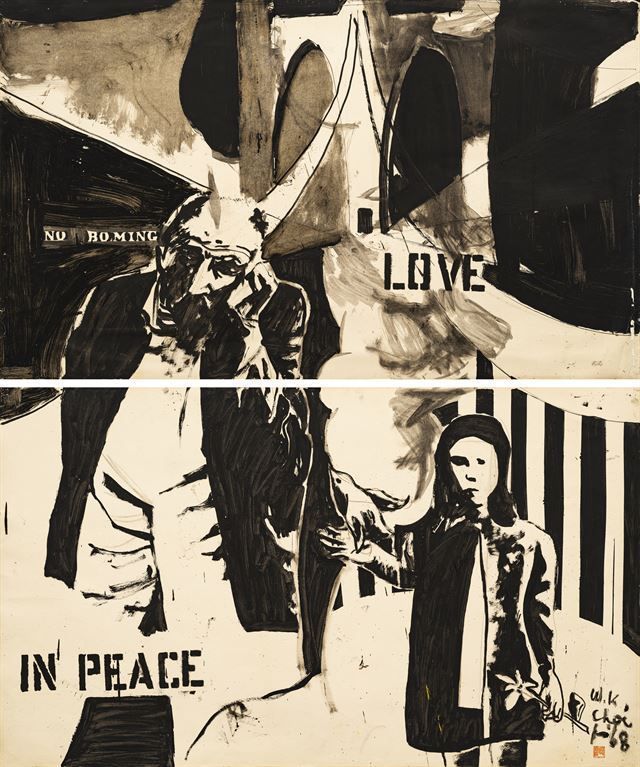
Choi's “In Peace” series (1968) / Courtesy of MMCA
Coupling such artistic influence with her perceived identity as an “exotic” Asian woman, Choi produced both colorful and black-and-white pieces, including “La Femme Fache” (1966), “Carless Bitch” (1960s) and “3 Eyes, I Do Have” (1966) ― marked by the stark color contrast, expressive strokes and the occasional appearance of text on the canvas.
The experience of painting, writing and teaching in universities as she traveled back and forth between Korea and America from 1963 to 1978 naturally came to bear an everlasting influence on her works. This is most evident in her pieces from the 1970s, often known as her most vibrant and largest paintings.
During this time, she was inspired both by the traditional East Asian aesthetics ― “dancheong” (decorative coloring on wooden structures), “minhwa” (folk painting) and Chinese calligraphy ― and the vast, natural landscape of New Mexico that was home to thousands of wildlife species. The resulting artworks visualized the organic shapes reminiscent of mountains, birds and animals dancing and soaring through the air.
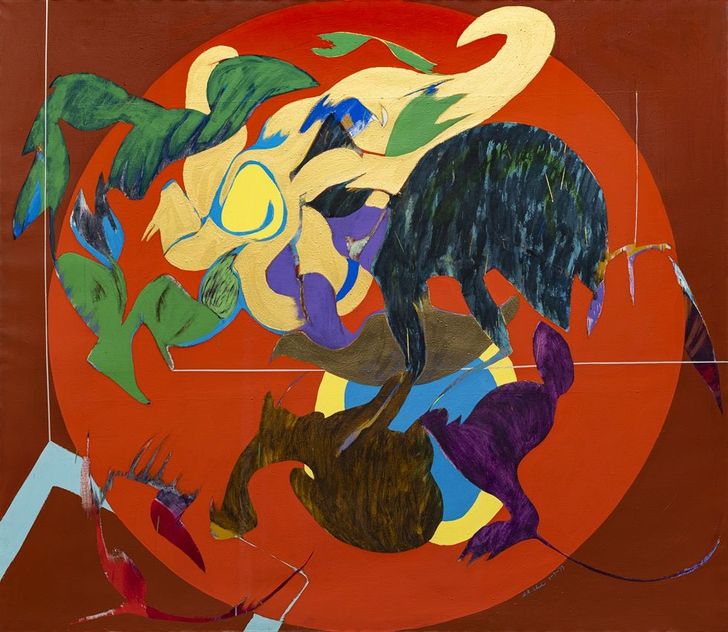
Choi's “Tightrope Walking” (1977) / Courtesy of MMCA
And nature continued to influence her when she returned to Korea for good in 1979 and taught at Yeungnam University in North Gyeongsang Province. As she featured the curvy ridges of the provincial mountains and the lapping waves of Geoje Island in the southern sea, she focused on the geometry and composition of each painting ― something that even affected her choice of the canvas' shape.

Choi's “Self-Portrait” series / Courtesy of MMCA
But while the retrospective predominantly sheds light on the chronological development of Choi's oeuvre, it is the last section, titled “Epilogue. Mirror Room: The Beginning of a New Story” that offers a glimpse into the artist herself.
Here, the walls are filled with a series of self-portraits that she drew from the 1950s during her high school years all the way to the 1970s. Rather than created for ornate display, they used to be hung in the artist's own room or studio as a visual encapsulation of each moment that she felt compelled to record.
The section also hints at Choi's personal thoughts about her own identity as a Korean female artist and “outsider” through her published poems, essays and columns.
In her poem “My Name is,” she describes her changing name as “a child with big eyes” during her childhood, “a mute child” when she couldn't utter a word surrounded by unfamiliar faces in America, “a lost child” during the 1970s as she hovered between Korea and the U.S. and “a nameless child” who became slowly forgotten.
“In just over 20 years, Choi managed to continuously experiment with different styles, materials, themes and colors ― she once even said that 200 colors were not enough for her painting. This fact alone makes her a highly reputable figure in the Korean art scene,” Jeon said.
The exhibition, “Wook-kyung Choi, Alice's Cat,” runs through Feb. 13, 2022, at the MMCA Gwacheon.