Dansaekhwa exhibition, book bring Yun Hyong-keun's unseen works to light

Dansaekhwa master Yun Hyong-keun in 1980 / Courtesy of PKM Gallery
By Park Han-sol
Dansaekhwa (monochrome painting) master Yun Hyong-keun (1928-2007) was often called “a painter of silence” when he was alive for his reserved nature. But that didn't mean he was unwilling to use his words or actions, especially when facing injustice.
In 1956, he served six months in Seodaemun Prison for remaining in Seoul instead of joining the mass evacuation when North Korea invaded the South during the 1950-53 Korean War. After the April 19 Revolution in 1960 ― a series of nationwide protests following President Syngman Rhee's vote-rigging scandal ― he was forced to resign from his teaching position at Cheongju Girls' High School in North Chungcheong Province, due to his openly critical remarks against the administration.
And in 1973, Yun was tortured and imprisoned yet again, while teaching at Sookmyung Girl's High School, for questioning the school's decision to illicitly enroll a student with the support of the then-head of the Korean Central Intelligence Agency. His “crime,” the authorities of the Park Chung-hee administration deemed, was having violated the Anti-Communist Act.
That year at the age of 45, after decades of struggle against the corrupt authorities that left him in despair, Yun turned to his canvas to express his pent-up frustrations and sorrows.
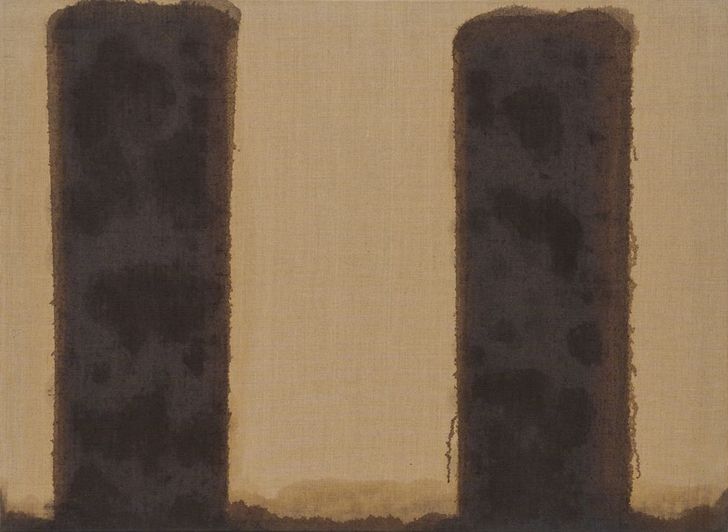
Yun's “Umber-Blue” (1980) / Courtesy of PKM Gallery
While a variety of bright colors filled his works until the late 1960s, his canvases started being dominated by thick, dark columns ― painted in a concentrated mixture of burnt umber and ultramarine paints that best represented his turbulent state of mind.
“My paintings portray a single, piercing cry without any needless words in the way,” he wrote in his diary in 1977. “What prompted me to resort to such drawings is far from being pristine or wholesome.”
His brushstrokes bled naturally across the linen or cotton raw canvas ― appearing light brown as its fabric was not bleached ― reminiscent of the traditional East Asian calligraphy or ink and wash paintings.
He declared his new series to be called, “Cheonjimun” (Gate of Heaven and Earth): “Blue is the color of Heaven, while umber symbolizes the color of the Earth. Hence, I call them Heaven and Earth, with the gate serving as the composition.”
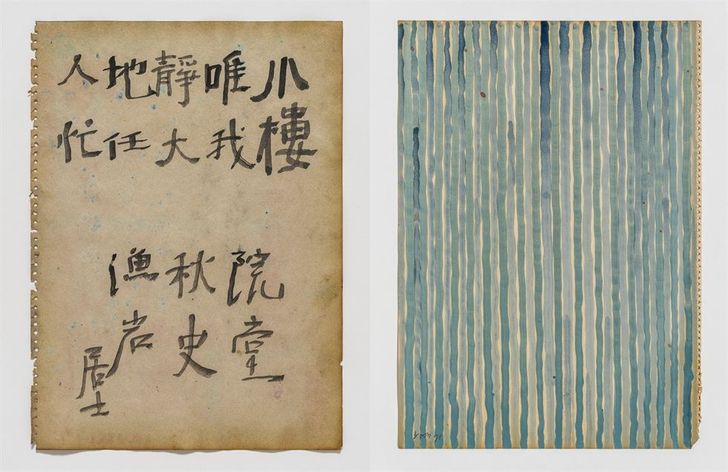
Yun's two pieces titled “Drawing” (1971) / Courtesy of PKM Gallery
Another medium that Yun resorted to expressing his thoughts and sentiments through in lieu of a gush of spoken words is writing ― in the form of notes scribbled quickly in his sketchbooks, diaries and letters to family and friends.
PKM Gallery in central Seoul has interpreted over 300 pieces of his texts gathered at his studio in Seogyo-dong, Mapo District. On Oct. 22, after a painstaking compilation process lasting more than two years, the gallery announced the publication of “Memories of Yun Hyong-keun,” offering a glimpse of the artist's recollections and sensibilities that were transferred onto his canvas.
The notable pieces include his detailed moments of contemplation regarding what constitutes art, as well as his travel accounts with some of Korea's greatest modern artists: Lee U-fan, Park Seo-bo and Kim Tschang-yeul.
His notes also hint at the strong bond he shared with the 20th-century abstract art master Kim Whan-ki, who was both his father-in-law and an influential mentor. Yun called Kim his own “father,” and was devastated by his death in 1974.
Six months after Kim's passing, the artist visited Kim's studio in New York and subsequently wrote in his diary: “It feels so empty to see his art without being able to see him.”
The amount of love he showed toward his wife and only child was equally great, indicated by the caring letters he sent whenever he was overseas.
Along with such texts, the book is sprinkled with photographs and memorable drawings from his sketchbooks. It also holds heartfelt essays written by his son, Yun Seong-ryeol, his longtime friend and sculptor Choi Jong-tae and National Museum of Modern and Contemporary Art (MMCA) director Youn Bum-mo in remembrance of the painter.
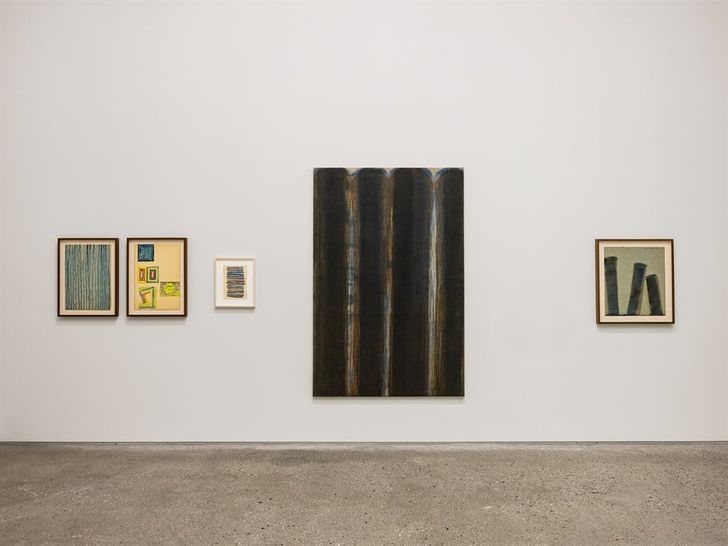
An installation view of the exhibition “Memories of Yun Hyong-keun” held at PKM Gallery in central Seoul / Courtesy of PKM Gallery
In celebration of the publication, PKM gallery is currently hosting an exhibition of the same title showing selected paintings, sketches and related archival materials, such as letters and photographs, which are on view for the general public for the first time.
“This is our way of reliving Yun's legacy through different mediums surrounding his art: an exhibition, book and the limited-edition reproduction of his notes,” the gallery's president, Park Kyung-mee, said during a press conference held on the opening day of the exhibition.
“I hope that the artist's personality, sensibility and thoughts about the field of art that pour out of every page of the book can be equally felt in viewers' bodies through this exhibition.”
“Memories of Yun Hyong-keun” runs through Nov. 14 at PKM Gallery.