Korea Artist Prize finalists present visions for contemporary art

Installation view of “60 Ho” (2020), front, and “qbit to adam” (2021) by Choi Chan-sook / Courtesy of the artist and MMCA, Photo by Hong Cheol-ki
By Park Han-sol
While staying in a small village of Yangji-ri, Gangwon Province, located in the border region of the Demilitarized Zone (DMZ), in 2019, artist Choi Chan-sook focused on the story of women who cannot claim ownership of village land, marked by the complex history of seizure and reclamation during the Korean War and the present-day problem of real estate speculation.
It was then she was gripped by the question of when and what prompted humans to transform the vast strip of natural land into a commodified property.
Her eyes soon turned to the Atacama Desert in Chile as one of the prime representations of the changing relationship between humans and land. The primitive desert plateau has, over the years, turned into sites of both the world's biggest copper mine, Minera Escondida, and the largest astronomical project, the ALMA telescope ― to satisfy mankind's unending economic and intellectual desires.
Choi's latest installation, “qbit to adam,” explores such themes surrounding the ownership of land ― a practice that is continued even in virtual reality and Metaverse ― in an exhibition featuring this year's four finalists of the Korea Artist Prize at the National Museum of Modern and Contemporary Art, Korea (MMCA) in Seoul.
Since 2012, the annual Korea Artist Prize, co-organized by the MMCA and SBS Foundation, has drawn up a shortlist of four individuals or teams of artists who present new visions for the country's contemporary art. This year's finalists are Choi, Bang Jeong-a, Kim Sang-jin and Oh Min.
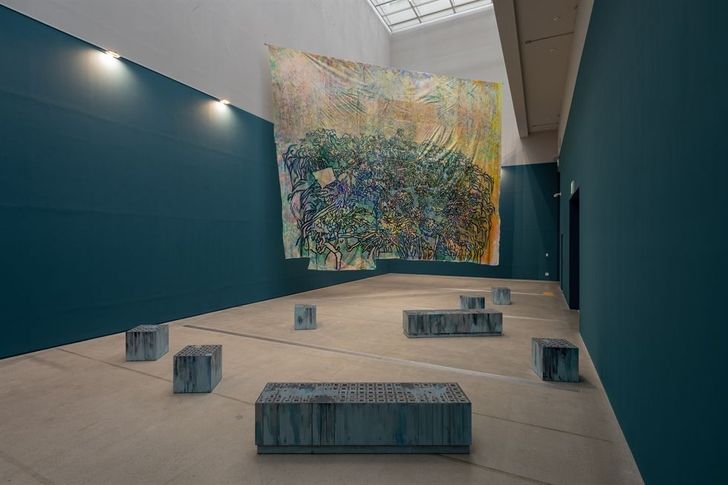
”A Plastic Ecosystem” (2021) by Bang Jeong-a / Courtesy of MMCA, Photo by Hong Cheol-ki
Bang is the only artist who has addressed the current political and ecological landscapes through the medium of painting this year. Her project applies the title “Heumul-heumul” (“becoming mushy and soft” in Korean) to a seemingly robust and hierarchical social system that is starting to be dismantled.
As a resident of Busan, she saw the southern port city as “a site dangerously close to the nuclear power plant and one of the centers of the alleged biological agent experiments carried out by U.S. troops who were stationed in Korea.”
“It's the truth that often goes forgotten, even among the locals themselves ― either consciously or unconsciously.”
From the USFK's biosurveillance project JUPITR ATD Project conducted in Busan to souring inter-Korean relations and the ecosystem that can no longer be described as pristine due to the constant human encroachment, Bang examines how her daily life as an ordinary member of the public and artist is intertwined with politics.
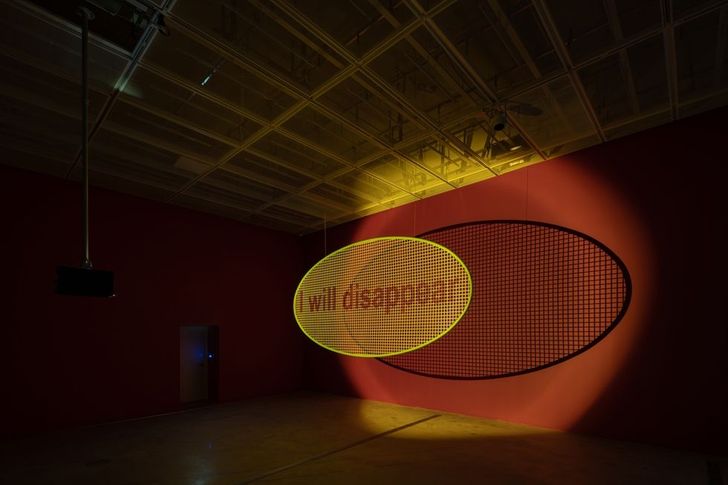
“I Will Disappear” (2021) by Kim Sang-jin / Courtesy of MMCA, Photo by Hong Cheol-ki
Whereas Choi and Bang's works stem from their specific experiences and personal sentiments, Kim and Oh's pieces turn to more abstract and philosophical musings.
Kim looks at how the constantly evolving, physical way of life of the modern humankind will eventually “disappear” into the virtual world and will be “reborn” with entirely new values and social structures.
His installation, “Lo-fi Manifesto_Cloud Flex,” presents an empty classroom, with student's torsos sucked into the gigantic LED screens on the ceiling. The only indication of human presence is their dangling legs. With an aim to visually represent how online classes have become the norm during the COVID-19 pandemic, the artwork further hints at the eventual disappearance of humans from the physical realm.
Oh poses a fundamental question on the interaction between the artistic medium and time ― specifically through videos, which she calls “time-based installations” and live performance.
In “Heterophony of Heterochrony,” by capturing on camera everything from the scenes of an actor performing a physical activity, technicians behind the camera and image metadata ― such as FPS, ISO and K value ― she focuses on how the notion of “here and now” is inherently understood to be different for performer, director and viewer.
The exhibition, “Korea Artist Prize 2021,” will run through March 20, 2022, at the MMCA. The prize's winner will be announced in the first half of next year.