'Refugees we met are just like us, far from being terrorists'

A Syrian woman changes her baby's diaper shortly after touching down on the shore of Lesbos ― an island of Greece ― in a photo taken in September 2015. Courtesy of Harry Chun
Two photographers share their experiences about walking alongside people on journeys to seek refuge abroad from their war-torn home countries
By Lee Gyu-lee
Driven by the fear of the Taliban's inhumane rule following its seizure of Kabul, Afghans have hurriedly fled the country searching for places to live and their exodus has triggered a debate about Afghan refugees around the world. Korea is no exception.
The debate over whether or not Korea should accept refugees has been escalating as the anti-foreigner sentiment is still prevalent among Korean citizens. The country welcomed about 390 Afghans, who worked for Korean governmental organizations there, under the banner of “persons of special merit” in an effort to avoid stirring negative sentiment among the public against these refugees.
Against the backdrop of the intensifying debate, two photojournalists ― Cho Jin-sub and Harry Chun ― hope to correct misconceptions of refugees in the country by sharing their experience of the lives of refugees and to bring the discussion to the table. Their work with refugees was put on display at the photo exhibition “You Could Have Been Me,” which was recently held offline in Insa-dong, central Seoul from Aug. 19 to 29. The exhibition, supported by the United Nations High Commissioner for Refugees (UNHCR), has also been held online since last December.
“I wanted to capture their daily lives: eating, sleeping, and carrying on with their life the next day, This is about the same as our own lives, only that we are in different environments. I wanted to capture them and tell their stories which are not any different from ours,” Cho said during the interview with The Korea Times, at the exhibition, Thursday.
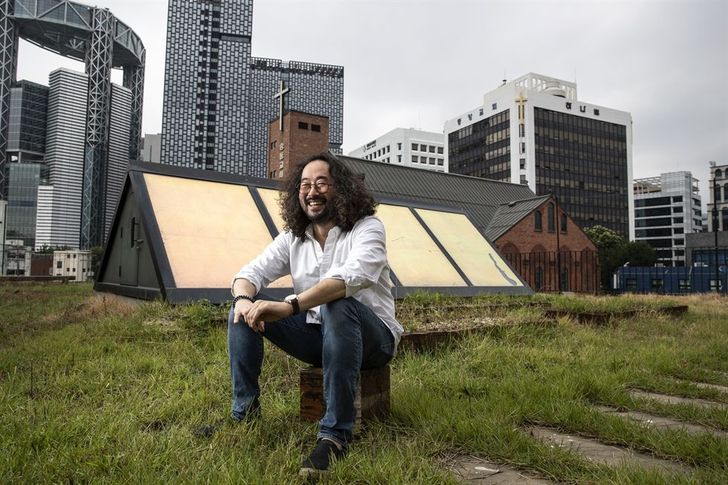
Photographer Cho Jin-sub smiles during an interview with The Korea Times, held in Insa-dong, central Seoul, Thursday. Korea Times photo by Choi Won-suk
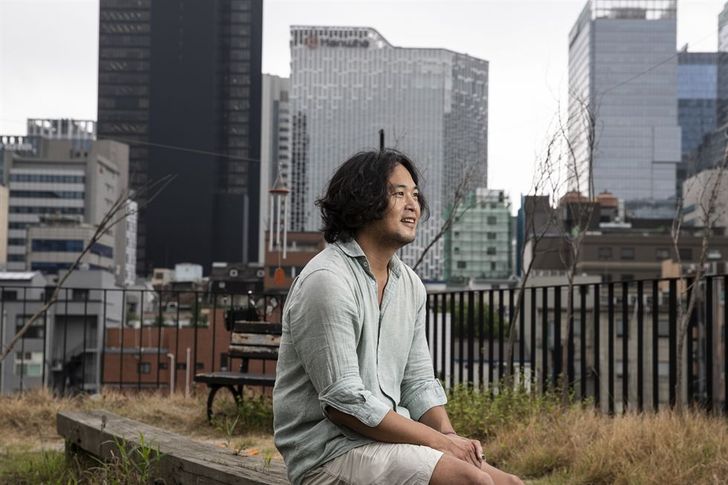
Photographer Harry Chun poses for pictures during an interview at the photo exhibition “You Could Have Been Me,” which was held from Aug. 19 to 29. Korea Times photo by Choi Won-suk
The two independent photographers, currently based in Korea, have spent years tracing and delving into the lives of asylum seekers.
Cho, who studied at Icart Photo in Paris, covered refugee crises and followed their path along with checkpoints and camps in countries like Turkey and Croatia, as well as their settlement in Germany and France, since 2014.
Cho said that he first took interest in refugees and the underprivileged groups as he tried to find an answer to what it means to be happy.
“I've always asked that question since I was young. And that somewhat selfish question was the start of my career; a vague idea that I will realize how happy I am when I meet people who are in a less privileged environment than I am,” he said.
“But when I met them, I realized they were not unhappy people. It's just that they are in bad circumstances. Refugees probably live with the biggest hope of their life, a hope for their tomorrow.”
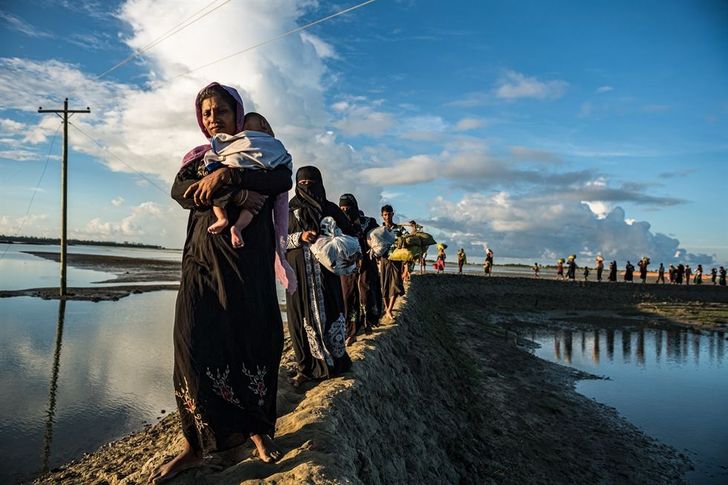
Rohingya refugees are making their way into Bangladesh, in this photo taken in the coastal town Shah Porir Dwip in Teknaf, Bangladesh, Oct. 14, 2017. Courtesy of Cho Jin-sub
And as they carry on with their life, Cho stayed by, not only photographing them but also lending a helping hand with their bags and with building shelters together. “It's too much to say I've become part of their life, but they gave me credit for trying, which led them to loosen up in front of cameras and get more comfortable with me being around each other,” he said.
Chun, who graduated from the Corcoran School of the Arts and Design, has had a main focus on refugees and conflict zones, including Iraq where he was ambushed by ISIS, and contributed his works to major outlets like NBC and National Geographic.
He noted that curiosity had drawn him to cover dynamic scenes and the people in them.
“I was not aware of what's going on around the world. And when I saw all the surprising images and realized they are contemporary, I was shocked to find how different it is from where I live. I got curious and started to learn, and was slowly drawn into this kind of work,” he said.
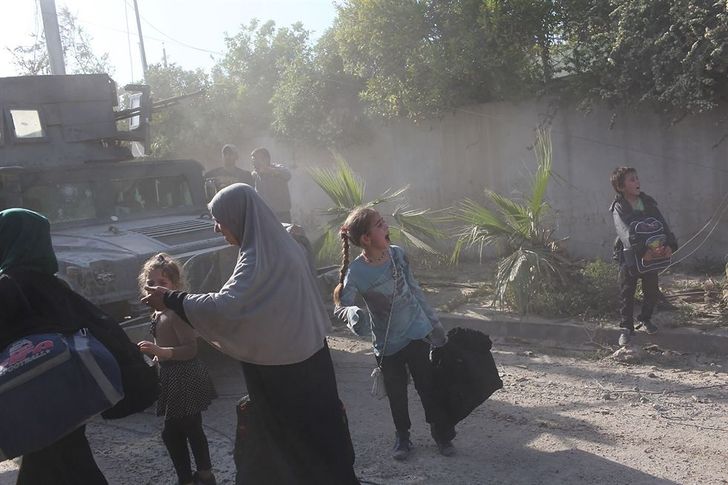
During ISIS's retreat from Iraq, ISIS used civilians as human shields and took dozens as prisoners. Families were separated during these chaotic moments and were left searching, sometimes in vain, for their loved ones. Courtesy of Harry Chun
In 2015, he traveled with Syrian and Iraqi refugees on a boat across the Aegean Sea from Turkey to Greece and photographed their journey to Germany.
“At first, I tried to document from one side and meet up at another point,” he said. “But the big question was how was I going to get in touch with the people (when they go from one point to another) and know when will they arrive. Because I didn't want to miss the moment of them arriving.”
Adding that the two weeks spent on the trip is still one of the best experiences he had as a photojournalist, embarking on that journey has offered him a chance to see the world from the refugees' perspective.
“I set only one rule: I will only go when they go. So if they get stuck or stop, I'll stop. That way, I'll really see from their point of view on what it's like to be on this road,” he said, adding that it made it easier for him to become part of the group.
“There was a lot of drama and emotional moments, especially after we crossed the sea ... there was the one moment I got to see Muslim women ― oftentimes difficult to photograph ― freed from their culture. They were so glad that they made it and actually wanted to be photographed once they saw my camera. They were all full of joy, which of course only lasted for a few minutes until the unpredictable reality of being on foreign soil hit.”
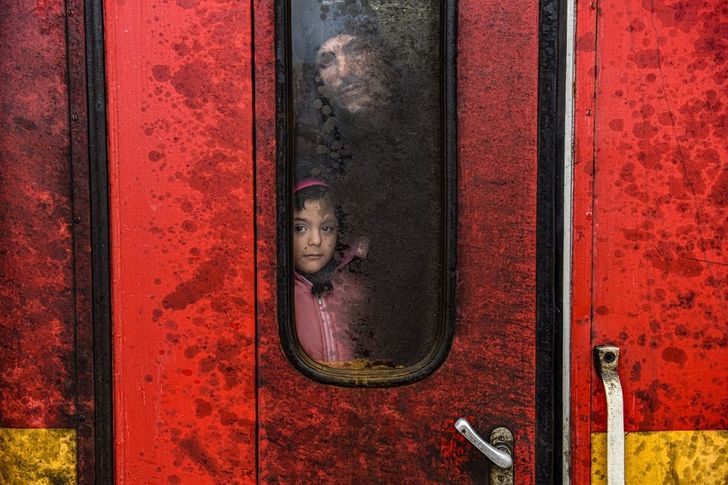
Refugees on a train stare at a camera during a stop at a station in Slavonski Brod, Croatia, Feb. 4, 2016. The refugees received a brief medical checkup before heading to the village of Botovo. Courtesy of Cho Jin-sub
When asked if they ever regretted putting themselves in such dynamic scenes, risking lives, Cho and Chun emphasized the experience was worth much more than the danger faces, which they also felt wasn't significant.
“Even though I was in a completely foreign environment with people I've never met and there was a language barrier, we formed a connection through genuine interactions, which could have not been possible if I was in Korea,” he said. “It's not really a sense of duty, but I'm just curious to go back and be with them … they are just human beings wanting to survive.”
Adding that he's happiest when in the field, Chun said he never regretted seeking first-hand experience of the scenes.
“I'll prepare everything I can. But about things that I cannot control there's no point worrying about them,” he said.
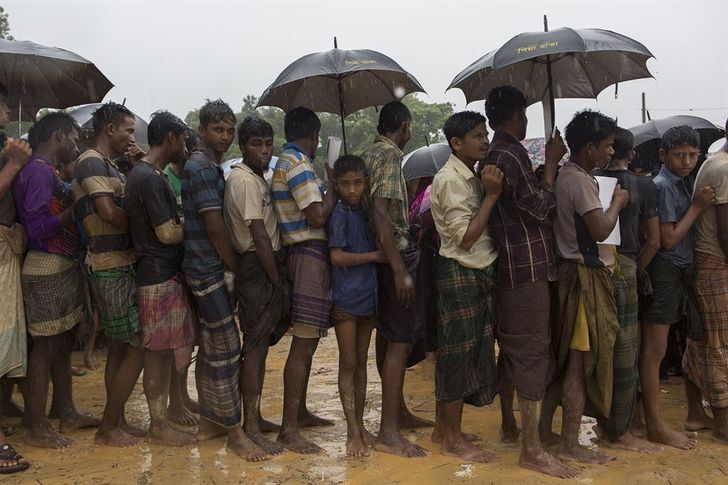
In this July 2018 photo, refugees queue to receive food rations and other necessities provided by UNHCR at Kutupalong camp in Cox's Bazar, Bangladesh, which was established for Rohingyas escaping oppression in Myanmar. Courtesy of Harry Chun
Spending time with refugees has left a huge imprint on the two photographers' lives and careers. And as it affected them, they hope to utilize their experience to stir the similar impact and emotions in other people and help change their perception of refugees.
“I totally understand the point of those people who are against them. But, I believe even those people who are strongly against them, if they really see what people go through on the ground, they are not going be as harsh,” Chun said.
“Maybe they will put it in different ways. Maybe they will say 'yeah we want to help but our situations' like this.' That's a bit more what I'm hoping that could've happened here. Instead of having all these excuses as to why they should be banned from coming here especially for religious reasons.”
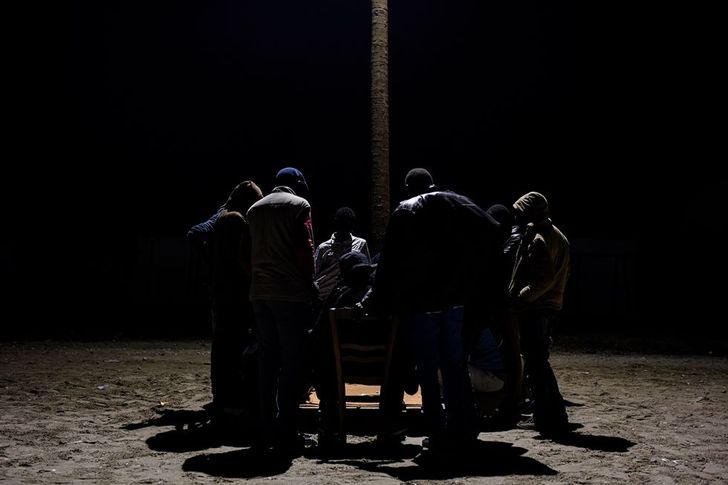
African refugees play games with dice under a streetlight, near the camp named the Calais Jungle in France. The photo was taken on Aug. 12, 2015. Courtesy of Cho Jin-sub
In a survey conducted by Hankook Research and UNHCR on 1,016 Korean adults late last year, 53 percent of the respondents answered they were against accepting asylum seekers, whereas 33 percent said they were in favor. Among those in opposition, economic burden and concerns over crimes were the top two reasons.
“Koreans tend to link Middle Eastern refugees with Muslim terrorists and people who suppress women's rights. This could be true but it's not the case most of the time. But Koreans generalize,” Cho said. “They only bring up the news highlighting negatives and establish that perception, which is very unfortunate.”
Pointing out the public backlash against Yemenis asylum seekers coming to the country in 2018, Chun added that people should not be fixated only on the negatives.
“Maybe we are finally seeing a chance to have a bit more diversity and have an understanding of what it's like to be in this world. We are so connected nowadays, so why are we so stuck with the idea of being a homogeneous or monoethnic,” he said.
“We should be able to open up especially coming from a country that only about 70 years ago when its people themselves were refugees. Because you went through and know what it's like to be refugees can you be a little more understanding and feel at least sympathetic and not try to find reasons to ostracize them.”
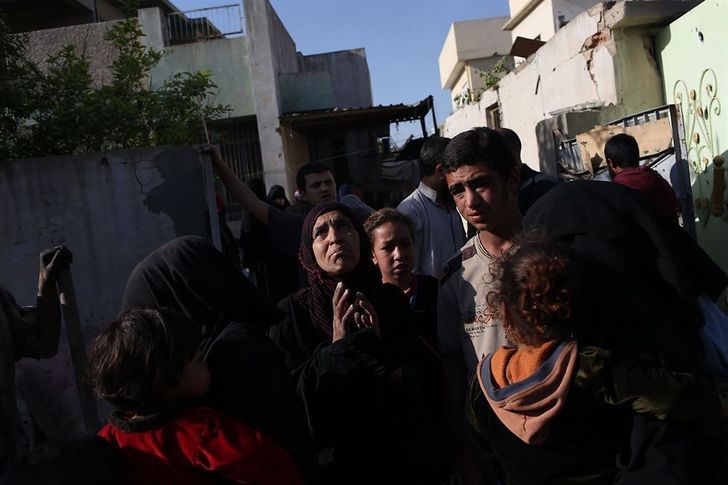
Iraqi women in Mosul pray immediately after being released from ISIS captivity in this photo taken in April 2017. Courtesy of Harry Chun
Both Cho and Chun expressed their work will serve the purpose if the audiences can find even small relevance and curiosity towards refugee issues.
“What I want from them is not to dismiss this reality after looking at the photos. If it can raise some questions in themselves, that would be the best thing,” Chun said, noting that's the first step in opening up more dialogue to improve the issue.
“People don't have to experience every single moment of others' lives. But at least if I can provide that option with their stories, and if you can find some common elements, despite their religion, situations ― as humans ― and link your life to them, that would be the takeaway that I'd hope.”
Taking his family and surroundings as an example, Cho explained that people around him, who were unfamiliar with the refugee crisis, came to learn about the issues through his work, which accomplished the purpose of his work.
“It is too bad how the changes are not as dramatic, but I'm still satisfied that it is changing even at a slow pace,” he said.
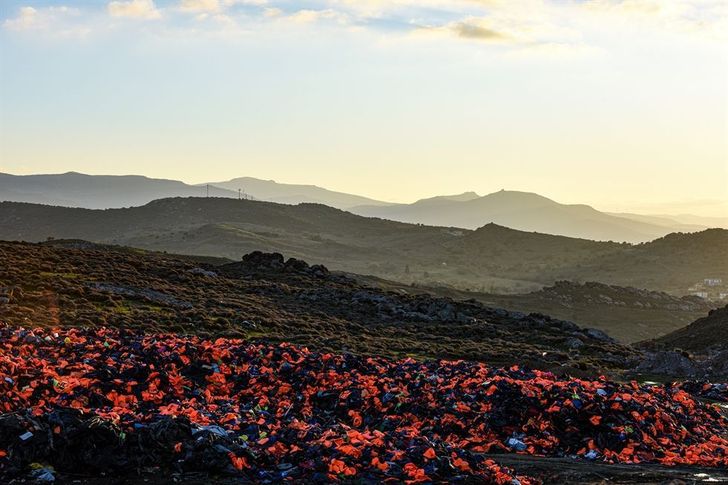
A photo taken in Lesbos, Greece, on Feb. 9, 2016. Life vests that had been worn by refugees are piled up across the land. Courtesy of Cho Jin-sub
The photographers, who had been unable to leave Korea due to the COVID-19 pandemic, are planning to carry on their projects abroad ― carrying on with Rohingya community coverage in Myanmar for Cho and heading to the Democratic Republic of the Congo, this week, to cover conflict and labor exploitation for Chun.
Cho is also holding a joint exhibition from Aug. 26 to Sept. 8 at KT&G Sangsangmadang in Hongdae, Seoul, where he presented his work on a Liberian refugee girl, who has been living in Korea for about a decade.
“Many people are not familiar with the refugees settling in Korea, and I was also surprised when I first came across such cases here… So I plan on making a book with the story of that girl and what she went through in Korea, along with my photographs,” he said, adding that he also still has many refugee crises and minority groups he would like to cover around the world.
The online exhibition of “You Could Have Been Me” is being shown on the Dialogue Factory website.