Changgeuk 'Tree, Fish, Moon' seeks inner peace through Asian tales

A scene from "Fish, Tree, Moon" by the National Changgeuk Company of Korea / Courtesy of National Theater of Korea
By Kwon Mee-yoo
“Tree, Fish, Moon,” a new changgeuk (Korean traditional opera) by the National Changgeuk Company of Korea (NCCK), follows the journey of an unlikely group of peopling hoping to have their wishes granted in a fairytale style ― but with a philosophical twist.
Directed by Bae Yo-sup, written by Kim Chun-bong and pansori and music composed by Lee Ja-ram, "Tree, Fish, Moon" interprets the old narrative of a wish-fulfilling being from the perspective of self-realization.
Bae is a member and director of the Performance Group Tuida and this is his first collaboration with the NCCK. He is best known for "Human Fuga," a stage adaptation of Han Kang's novel "Human Acts."
Playwright Kim is, in fact, an alter ego of director Bae.
The changgeuk combines various folk tales of different Asian countries to tell stories of different people on their way to the Wishing Tree and how they are changed on their journey.
The story has three narrators and six characters who have their own reasons for going in search of the Wishing Tree ― a fish originally from Mount Meru where the Wishing Tree is; a girl who wants to eat her fill; a shepherd boy looking for true family; a pilgrim seeking truth; a couple-turned-tree in hope of blossoming a flower.
"The characters are inspired by cultural symbols of seeking spirituality in Asian countries. It does not necessarily come from a religious background, but includes various ascetic characters in Asian tales and myths," Bae said during a guest visit session, Saturday.
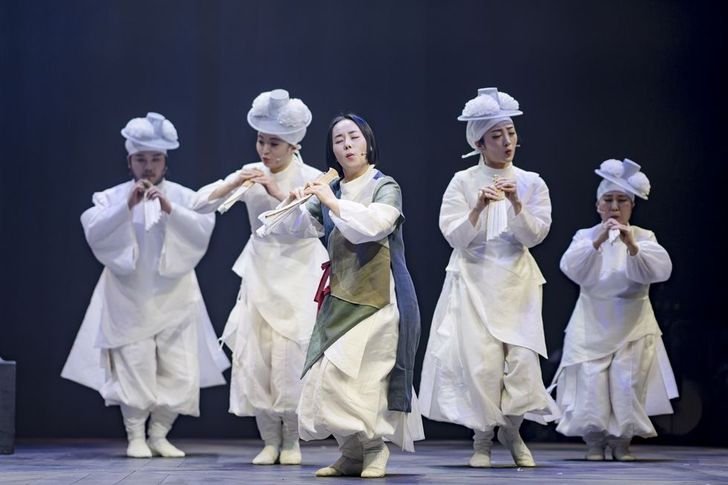
A scene from "Fish, Tree, Moon" by the National Changgeuk Company of Korea / Courtesy of National Theater of Korea
The main plot of the Wishing Tree comes from the Indian folklore of Kalpataru, or Kalpavriksha, and other elements from "Woncheongang Bonpuri," an oral folktale of Jeju Island, and Yue Lao, god of marriage and love in Chinese mythology, are also incorporated in the story.
The motley crew finally reach the sacred Mount Meru and find the Wish Tree. This would be the happy ending for a traditional didactic tale. Instead of everyone living happily ever after with their wishes granted, “Tree, Fish, Moon” takes an unexpected turn here as the tree reflects and reveals its dark thoughts as well as their wishes.
The moonkeepers, or the narrators, sing to the ragtag bunch, overwhelmed by their dark thoughts, that “this too shall pass" and "everything is in the mind."
"'You are nothing,' say the moonkeepers. It's like a greeting between them. When you look straight into fearful thoughts and recognize that they are nothing, the thoughts disappear. I expanded the concept to life as a whole. There are joys and sorrows, which shall pass, but at the moment, it seems like everything," Bae said.
This is Bae's first attempt to direct a changgeuk.
"The boundary between the spoken and the sung is not clear. It was interesting for me how pansori performers switched from speaking to singing and vice versa. A song can easily express something that cannot easily be shown through acting. The power of music in changgeuk was intriguing," Bae said.
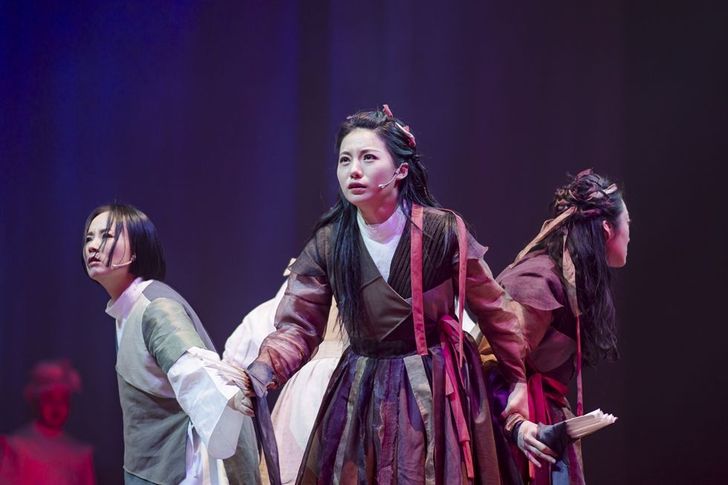
A scene from "Fish, Tree, Moon" by the National Changgeuk Company of Korea / Courtesy of National Theater of Korea
Lee, a renowned pansori performer and leader of indie band Amado Lee Jaram Band, said the power that drives her to compose music and pansori comes from the script.
"I have to catch the inspirations from the text. I asked many questions to the playwright to completely understand the story," Lee said.
As the show incorporates elements from tales of different countries, Lee brought in musical elements from the countries as well as Korean traditional instruments.
"I tried to use each instrument to help describing the characters and the situation. For example, there is a piano-like instrument named harmonium with 44 keys in India. I used this instrument to make the sound symbolizing the Wishing Tree. Chinese instrument Yunluo produces the sound when the pilgrim opens his magical pouch," Lee said.
NCCK members Seo Jung-kum, Yi So-yeon and Yu Tae-pyung-yang star as the moonkeepers.
“Fish, Tree, Moon” runs through March 21.