Exquisite hunting scene folding screen returns from US

This "Eight-Panel Folding Screen with Hunting Scene," created in the late 18th century, returned from the States and is now on display at the National Palace Museum of Korea. Courtesy of Cultural Heritage Administration
By Kwon Mee-yoo
An "Eight-Panel Folding Screen with Hunting Scene," created during Joseon Dynasty King Jeongjo's reign in the late 18th century, was returned from the United States and went on display at the National Palace Museum of Korea starting Thursday.
The Overseas Korean Cultural Heritage Foundation, an affiliate of the Cultural Heritage Administration, purchased the artwork at Christie's auction house in New York last September for $930,000 (1.1 billion won).
Chong Pyong-mo, a visiting professor at Gyeongju University, said that the returned “Hunting Scene” is of the highest artistic quality among remaining hunting scene paintings.
"The folding screen painting provides a glimpse into the politics and national defense between the Joseon Kingdom and Qing Empire, raising its historical value," Chong said.
“Hunting Scene” is also known as "Horyeodo" in Korean, which means, “northern barbarian people hunting.” It depicts China's Qing emperor hunting. The subject is closely related to the political situation during King Jeongjo's reign (1776-1800).
Joseon was invaded twice by Manchu forces in 1627 and 1636 when the Qing Dynasty (1616-1912) gained control of China from the Ming Dynasty (1368-1644) and hostility against the Qing was prevalent. However, Chinese culture flowed into Joseon in the late 18th century, resulting in growing interest in Qing culture. Along with Jeongjo's pragmatic diplomatic policy, paintings of hunting scenes began to be produced in Joseon.
The eight silk-backed panels stretch 385 centimeters wide and 154 centimeters in height.
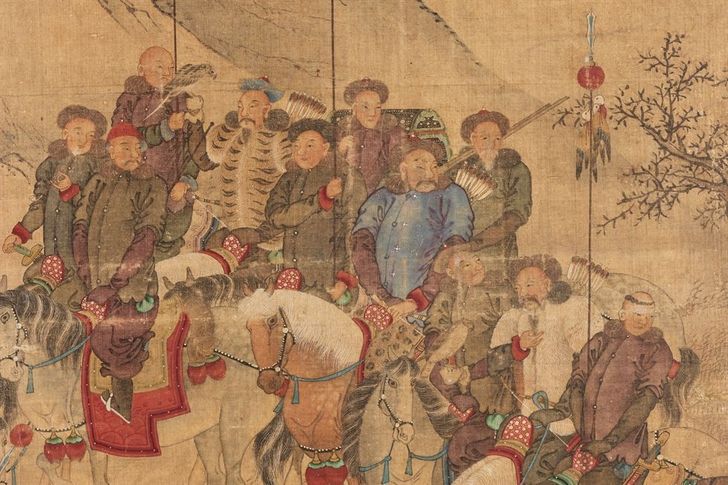
Part of the "Eight-Panel Folding Screen with Hunting Scene" returned from the U.S. / Courtesy of Cultural Heritage Administration
Chong said typical hunting scene painting consists of hunting scene only, but this one features the procession of the Qing emperor and royal ladies takes up panels 1 through 6 with the hunting scene depicted on panels 7 and 8.
"The man wearing blue leather robe adorned with white dragon in the fifth panel is the Qing emperor. The women in royal family are in a palanquin," Chong explained.
The folding screen is from the property of Kathleen J. Crane, a missionary and former Ewha Womans University professor who resided in Korea from 1952 to 1987 and a private collector who purchased it from her family put it up for auction.
There is a seal of renowned Joseon era painter Kim Hong-do in the eighth panel, but Chong said it is likely to be painted by a court painter in the late 18th century, influenced by Kim Hong-do. Kim Hong-do is said to have painted the first Hunting Scene painting in Joseon, but his version failed to survive and only mentioned in Seo Yu-gu's essay “Essays on Rural Life and Economy.”
"The backdrop in the first and second panels is similar to Kim Hong-do's landscape paintings. However, the depicting style of drapery is different from Kim, so we estimate that it is from a painter influence by Kim's style," Chong said.
Most of the extant hunting scene folding screen paintings are in folk painting style, but the returned one is in high-quality court painting style with exquisite expression of the landscape and detailed depiction of human figures in the procession.
"The returned Hunting Scene is expected to broaden the scope of research into paintings on this theme, which has thus far been focused mainly on folk painting, and will be utilized for diverse purposes including exhibition and education," the CHA said in a statement.