Jenny Holzer rings alarm on political issues through art

An installation view of Jenny Holzer's solo exhibition “It's Crucial to Have an Active Fantasy Life," featuring her latest watercolor pieces, at Kukje Gallery in central Seoul. / Courtesy of Kukje Gallery
By Kwon Mee-yoo
Jenny Holzer, the American artist best-known for her text-based LED sign installations, brings a new range of work to her solo exhibition at Kukje Gallery in central Seoul ― watercolors.
The exhibition is titled "It's Crucial to Have an Active Fantasy Life."
"I believe it is crucial to have an active fantasy life, so it's important to have a title that you believe, that you think is true," the artist said in a video message.
A total of 68 artworks are on view and have been created using various mediums ― watercolor, oil painting with metal leaf, marble and LED.
Due to the worldwide pandemic, the artist could not come to Korea to install her art pieces at the National Museum of Modern and Contemporary Art (MMCA), Seoul.
"I've been in isolation in a farmhouse ... We've had to move the studio and it has been very difficult, practically speaking, but the worst was watching people suffer and die," she said.
"There is no COVID-specific work in this exhibition, but I want to believe some of the work is empathetic, sympathetic. More of the work is questioning. This is the time for questioning."
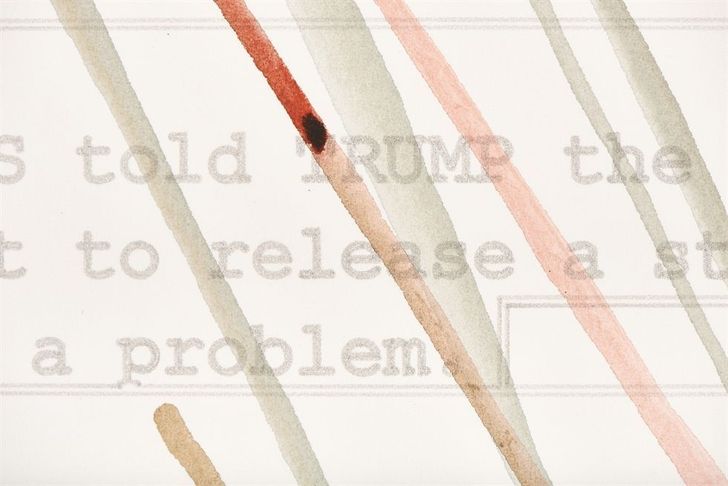
Detail of Jenny Holzer's watercolor "ultimate sin" (2020) / Courtesy of the artist and Kukje Gallery
At K2, paintings about political issues on sensitive or formerly classified documents and marble benches and stools are on view. The most notable are Holzer's new experiments in watercolor, which is not her typical medium.
"I've always wanted to be a painter, but I've been intimidated to do it since I failed so miserably in the '70s. So late in life I've decided to go ahead anyway," the 70-year-old artist said.
The watercolor series brings politics into art, but in a subtle way. She reproduced and silk-screened enlargements of the U.S. government's "Report on the Investigation into Russian Interference in the 2016 Presidential Election," also known as the “Mueller Report,” and painted with watercolor on them, expressing what she felt from the obscurity of the report.
"The Mueller Report was frustrating in a significant way, so I decided to paint on it while I waited for a result," she said.
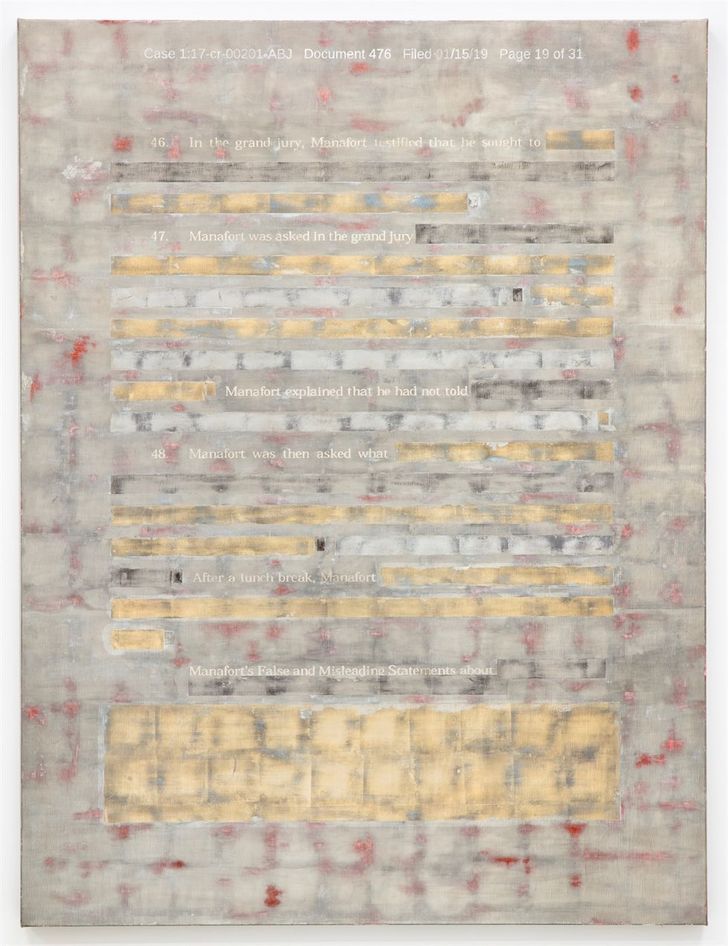
Jenny Holzer's "False and Misleading Statements" (2020). / Courtesy of the artist and Kukje Gallery
The "Redaction Paintings" series is the artist's interpretation of classified information and politics. The documents used in her painting are once-confidential, but now released under the Freedom of Information Act. Many of the documents are still heavily redacted despite being open to the public.
Without the redacted parts containing sensitive information, the disclosed documents remain vague and Holzer interpreted them into abstract paintings. She transfers the documents to the linens by hand, before turning them into paintings with palladium, gold and platinum leaf.
Some of the oil paintings with metal leaf are created on her older works. According to a gallery official, Holzer asked for one of her paintings from the gallery's storage and later returned a renewed version with metal leaf.
"The leafed paintings have something to say, especially when sunlight hits them," she said.
The centerpiece at K3 will be her latest LED piece "Truisms." This is an evolved version from last year's "For You," commissioned by MMCA. It has a choreography controlling speed and movement of the vertical LED piece, rotating and moving up and down.
Holzer said the long, vertical electronic sign is "intricately programmed both in terms of its physical motion and its content.”
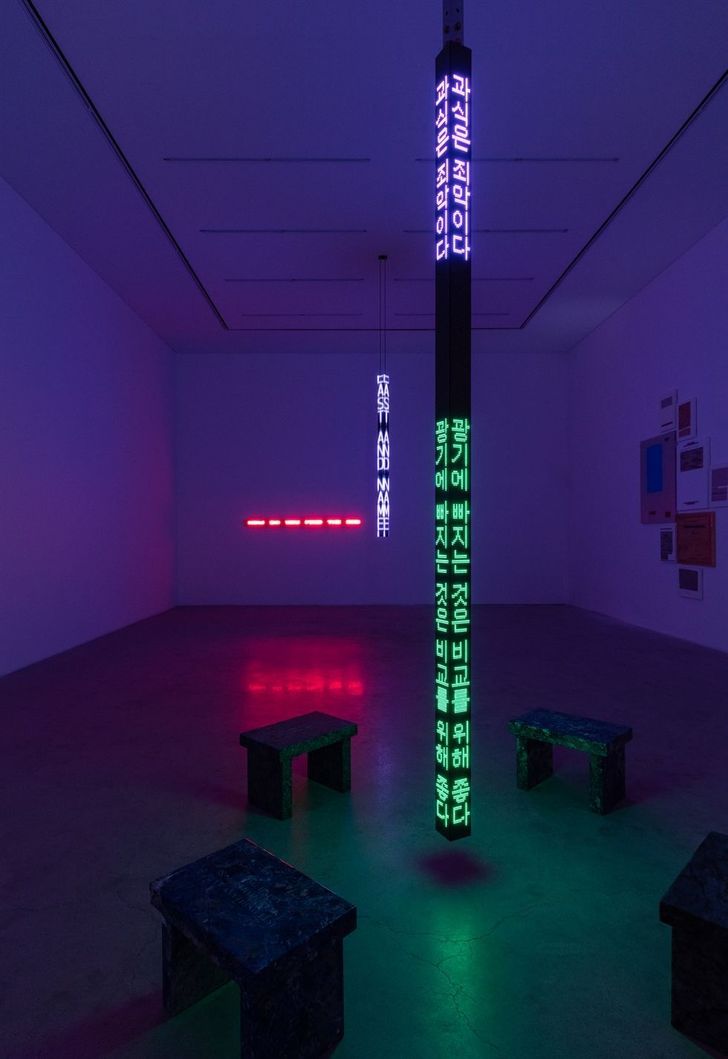
An installation view of Jenny Holzer's solo exhibition “It's Crucial to Have an Active Fantasy Life," featuring her LED sculpture “Truisms,” at Kukje Gallery in central Seoul. / Courtesy of Kukje Gallery
The LED sculpture rotates through English and Korean text from her “Truisms” series, featuring quotes such as “All things are delicately interconnected,” and “Manual labor can be refreshing and wholesome.”
Though she does not know the Korean language, she uses it with assistance from professional translators who helped her find the right nuance in translated sentences.
Her marble footstools engraved with the sentences from “Truisms” are displayed alongside an LED column, showcasing a stark contrast between the sense of touch versus sight, nature versus artificiality and static versus dynamic.
The exhibition runs through Jan. 31.