From trauma to injustice: Exhibition pays tribute to women in patriarchal society

“Black Project 2020” (1998-2020) by Chang Hae-hong, left, and “Seeding of Light - 999” (1998) by Yun Suk-nam / Courtesy of Suwon Museum of Art
By Park Han-sol
Stuck in the crevices of history, women have often been overlooked and had stories of their experiences and contributions minimized.
The exhibition, “Born, A Woman” at the Suwon Museum of Art, presents 48 works of art inspired by the doomed fate of Lady Hyegyeonggung Hong, a royal family member whose life was torn apart by power struggles and ensuing bloody revenge.
Hong (1735-1815), a major figure in Suwon city's local history, was the mother of the Joseon Kingdom's 22nd King Jeongjo and wife of the Crown Prince Sado.
Her life was difficult from the beginning. In her memoir “Hanjeungrok,” she recalls how her long-awaited birth, preceded by her father's dream of a black dragon ― taken as a sign of a baby boy ― came as a great disappointment to the family.
“The other night my father saw a black dragon coiling around the study ceiling in a portent dream, yet I was born a girl, to the grief of those who were confounded by the mis-carriage of the dream's auspicious signs.”
Her marriage was cut short with an unprecedentedly violent historical event. Crown Prince Sado was put into a wooden rice chest and left to die on the orders of his father. He perished after his cries for help and attempts to escape failed to save him. Hong's parents also collaborated with other powerful figures in the killing of the Crown Prince.
Hong's life after her son Jeongjo ascended to the throne was mired by a bloody revenge. King Jeongjo, the son born to the deceased Crown Prince and Hong, cracked down on the figures who conspired in the killing of his father, leading to the demise of Hong's parents and relatives. Hong's life, full of grief and traumatic experiences, was written in great detail in her memoir published in 1795.
Such feelings of sorrow and remorse in the context of Joseon's androcentric society became a spiritual foundation for the exhibition featuring artworks produced mainly by female creators and teams. The works will be displayed from Sept. 8 to Jan. 10 next year.
Artists across different generations, from their 30s to 80s, illustrate in their paintings, sculptures and installations the multiple layers of womanhood, questioning the status quo and its deep-rooted gender norms and suggesting a new way to view and understand women's roles.
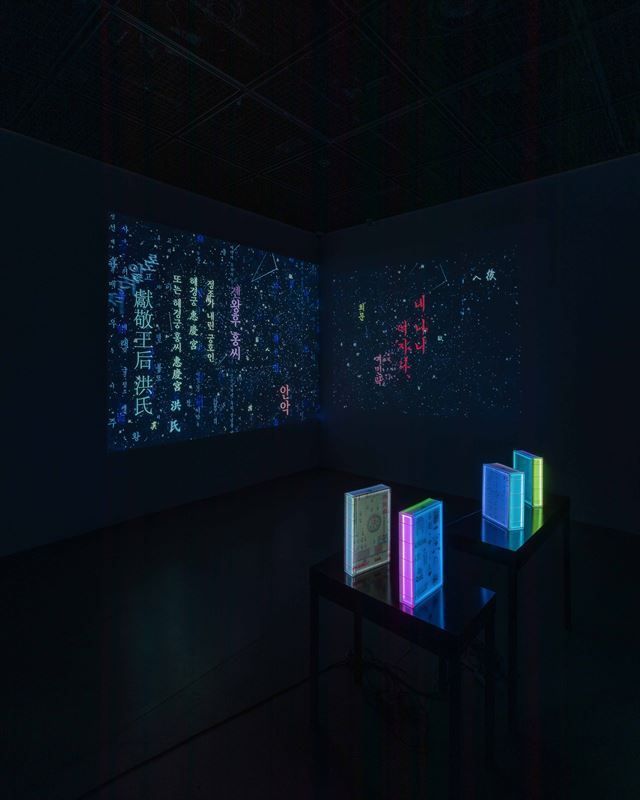
“Luminous Day of Queen Heongyeong” (2020) by Kang Ai-ran / Courtesy of Suwon Museum of Art
“Seeding of Light - 999,” created by Yun Suk-nam in 1998, is made up of 999 colorful wooden sculptures each depicting unique female characters. One of the pioneers of feminist art in Korea's contemporary history, Yun sharply points to the incompleteness of women's narratives strewn in history through the number 999, just one short of what is considered a perfect number in the Buddhist doctrine: 1,000.
Another of her works, “We Are Matrilineal Family” (2018), portrays her own mother, sisters, herself, her daughter and her dog posing for a portrait. By highlighting the female figures typically hidden in family history, Yun challenges the predominantly paternal tradition and reinstates women's importance.
In the series “Night Freaks,” (2018-2020), artist Lee Eun-sae confronts the problematic objectification of intoxicated women as passive, feeble individuals who become an easy target of sexual harassment. By depicting drunk women freely running around, fighting, hanging onto a bar and vomiting in quick, harsh brushstrokes, she dismantles the conventional ideas associated with femininity.
Kang Ai-ran's interactive artwork “Luminous Day of Queen Heongyeong” (2020) juxtaposes past and present by portraying visual records of history in colorfully illuminated electronic and virtual books. Through such an effort, she revives faded bits and pieces of Lady Hong's life in Suwon city in a sensory way.
The exhibition also showcases illustrations and paintings by Rha Hye-seok (1896-1948), Korea's first female Western-style painter, writer and advocate for women's rights. Rha was an idiosyncratic artist of her time amid the wave of clashes between tradition and modernization. She spoke up against the social pressures placed upon women and sought for their liberation from institutionalized norms, which can be seen in some quotes from her writing:
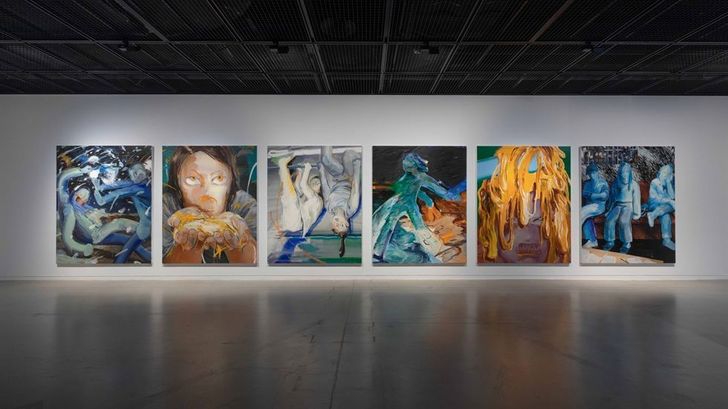
“Night Freaks” (2018) by Lee Eun-sae / Courtesy of Suwon Museum of Art
“A woman is small. But she is big. A woman is weak. But she is strong.”
“My four children, do not resent your mother but the social system, morals, law and old customs. Your mother is a pioneer in the period of transition and a victim of such a rope of fate.”
Both written in 1935 in the-then popular magazine “Samcheon-ri,” Rha's message along with her plea to be viewed as a human before she is seen as a woman remains pertinent to this day, resonating with viewers who continue to fight to be heard and properly represented.