Museum unveils national treasure trove

"Samguk sagi" (History of the Three Kingdoms), left, and "Samguk yusa” (Memorabilia of the Three Kingdoms) are on display at "The New National Treasures of Korea 2017-2019" exhibition at the National Museum of Korea in Seoul, Monday. Yonhap
Gigantic exhibition puts an end to 55-day COVID-19 hiatus
By Kwon Mee-yoo
Those who are interested in Korean history would have heard of "Samguk sagi" (History of the Three Kingdoms) and "Samguk yusa” (Memorabilia of the Three Kingdoms), the two most important books about Korea's ancient history.
"Samguk sagi," compiled by Kim Bu-sik in 1145 during Goryeo Kingdom (918-1392), is the oldest surviving official historical document of Korea, and "Samguk yusa," compiled by Buddhist monk Iryeon during the 13th century, is another collection of historical accounts of the Three Kingdoms period (57 B.C. to 668 AD) and it focuses mainly on legends and folktales.
Despite the public knowledge of the books, few people have actually seen the authentic editions.
These books are on view at the National Museum of Korea (NMK), which reopens from a 55-day hiatus due to COVID-19 Wednesday with its "The New National Treasures of Korea 2017-2019" exhibition.
The exhibition showcases some of the nation's most celebrated cultural properties such as the smiling "Roof-end Tile with Human Face Design" from the Silla era and Joseon painter Shin Yun-bok's "Shin Yun-bok's Portrait of a Beauty," which inspired the 2008 drama "Painter of the Wind."
Co-organized by the museum and the Cultural Heritage Administration, which manages designation of national treasures, the exhibit is one of the largest among those introducing new treasures.
"The museum finally opens up after 55 days of closure Wednesday. This exhibition, which was delayed twice due to the COVID-19 closure, is the largest-ever public display of National Treasures From Korea and abroad. We hope this would provide cultural delight for people who feel depressed by the prolonged COVID-19 pandemic," Cultural Heritage Administrator Chung Jae-suk said.
Currently, Korea has 2,188 Treasures and 342 National Treasures. The Cultural Heritage Committee reviews the value of Treasures and the Cultural Heritage Administrator grants the designation. A National Treasure is selected among the rare objects that pass the criteria of Treasure having extraordinary historical, academic and artistic value. The number of a National Treasure or Treasure is based on the order of designation, not in the order of its value.
The exhibit features 83 entries among the 157 newly designated National Treasures and Treasures from 2017 to 2019, excluding architectural and other immovable properties.
Organized in three parts ― “Preserving History,” “Artistic Expression” and “Opening the Heart” ― the exhibit sheds light on newly recognized cultural properties in various fields.
Copies of "Samguk sagi,” National Treasure No. 322-1, and "Samguk yusa,” National Treasure No. 306-3, open up the "Preserving History" section, introducing the importance of documenting history. The two books were promoted from Treasure to National Treasure status in 2018.
"Joseon wangjosillok" (The Annals of the Joseon Kingdom) is the thousands-of-volumes collection of books detailing the history of the Joseon Kingdom. The annals were designated as National Treasure No. 151 in 1973, but some editions omitted in 1973 were added last year, thus making their way into this exhibit.
In the early years of Joseon, the king was not allowed to read the annals as it was only available to historians. Later, a special supplement edition summarizing the lives of previous kings was added for the king's reading and the blue silk-covered edition is on public view for the first time.
The annals are displayed with a media table to help understand the artifact's creation process, in which the first draft was scrubbed to erase sensitive materials.
"Gisa gyecheop" (Album of Paintings of the Gathering of the Elderly) is the National Treasure No. 324 and illustrates a royal event and banquet.
"This painting portrays Cheoyongmu, a type of traditional court dance inspired by the legend of Cheoyong, who wards off the spirit of plague. We picked this scene to reflect our hope of overcoming COVID-19," curator Kang Kyung-nam said. "Another notable aspect in this painting is that the court record paintings do not include the figures of the king and prince."
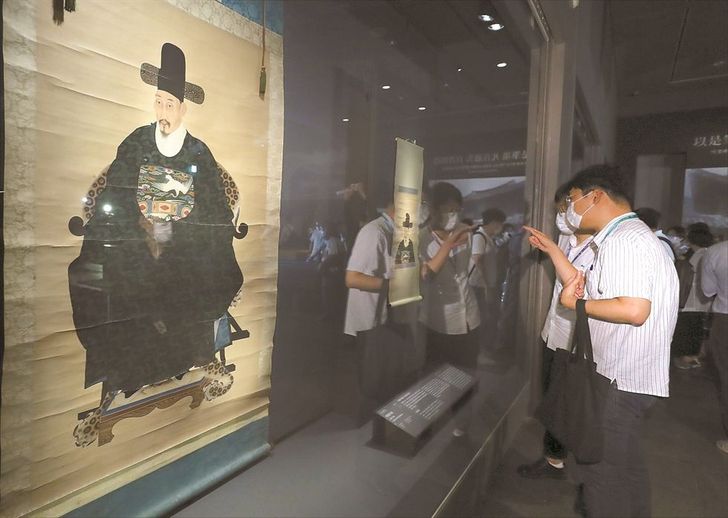
Visitors look at Joseon-era portraits on view at "The New National Treasures of Korea 2017-2019" exhibition at the National Museum of Korea in Seoul. Yonhap
"Artistic Expression" showcases various aspects of Korean aesthetics.
The celadon jar with the inscription of "fourth Sunhwa year" National Treasure No. 326, is attributed to the early Goryeo era and is a great example presenting the development of the famed Goryeo pottery. The inscription on the bottom indicates exactly when and where the pottery was fired, heightening its value.
The Kansong Art Culture and Culture Foundation, founded in 1938 by collector Chun Hyung-pil, loaned a handful of rare paintings that had been designated as Treasures in recent years.
Sim Sa-jeong's 1768 landscape painting "Chokjandogwon" (The Rough Road to Shu) from the foundation's collection is displayed by the side of Sim's student Yi In-mun's "Gangsan mujindo" (Endless Mountains and Rivers) owned by the NMK.
"Yi's 8.5-meter painting depicts the ideal world of which Joseon-era people dreamed. It would be interesting to compare Sim's and Yi's works," curator Kang explained.
Jeong Seon's 18th century painting "Pungak Naesan Chongnamdo" (General View of Inner Geumgang Mountain) features a panoramic view of the autumnal landscape, containing various sites that cannot actually be seen together from a single perspective.
Kim Deuk-sin and Kim Hong-do's genre paintings give a glimpse of people's lives during Joseon Kingdom. Shin's famous "Portrait of a Beauty" will be on view from Aug. 12 to Sept. 3.
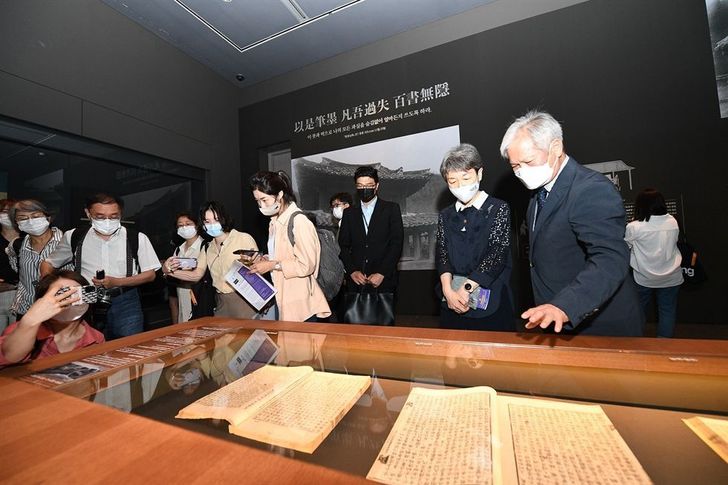
Bae Ki-dong, first from right, director general of the National Museum of Korea, and Chung Jae-suk, second from right, Cultural Heritage Administrator, look at "Joseon wangjosillok" (The Annals of the Joseon Kingdom) on display for "The New National Treasures of Korea 2017-2019" exhibition at the National Museum of Korea in Seoul, Monday. Yonhap
The “Opening the Heart” section is dedicated to Buddhist artifacts, which account for more than a half of the entire body of National Treasures and Treasures, as Buddhism had provided spiritual support for society for centuries.
The reliquaries excavated from the site of Wangheung Temple site in Buyeo were designated as National Treasure No. 327.
"Known as the oldest surviving Buddhist reliquaries in Korea, the sacred relics are encased in layers ― in a gold bottle in a silver jar in a bronze case in a stone placing of a wooden pagoda. This style of reliquary is typically found in East Asia," Kang said.
The 19 Buddhist images excavated from the Three-Story Stone Pagoda of Pyochung Temple in Miryang, South Gyeongsang Province, were designated as Treasure No. 1,944 for its uniqueness of including statues from different periods from Unified Silla to Goryeo era.
"Painting of Thousand-Hand Avalokitesvara Bodhisattva," Treasure No. 2015, is a rare example of a Buddhist painting from the Goryeo era.
The exhibit runs through Sept. 27, but some of the artifacts on loan will be displayed for a certain time. The "Samguk sagi" must return to its home Oksan Seowon on Sept. 18. Those from Kansong Foundation will also rotate.
Advance online reservation is required as the museum applies social distancing rules.