National Theater of Korea celebrates 70th anniversary

The National Theater of Korea (NTOK) celebrates its 70th anniversary Wednesday. Courtesy of NTOK
By Kwon Mee-yoo
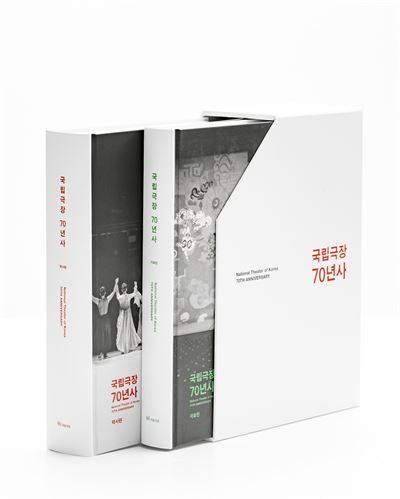
The National Theater of Korea published a two-volume book on its 70-year history. Courtesy of NTOK
The National Theater of Korea (NTOK) celebrates its 70th anniversary Wednesday, but the ceremony and all other events have been canceled or postponed due to the COVID-19 pandemic.
The theater announced ambitious projects including a ceremony, an international symposium and a series of performances by national troupes during the first half of the year. Despite all the preparations, the state-run theater has been affected by the COVID-19 outbreak and has been shut down since late February to help prevent the spread of the coronavirus.
With the events canceled, the theater published a commemorative book on its 70-year history as well. The 1,510-page book covers the history of the theater from the perspective of art history and sheds light on each national troupe which is currently, or has previously been, affiliated with the NTOK.
NTOK CEO Kim Cheol-ho said the book focuses on stories regarding people of the theater throughout its history.
"We pay tribute to the performing artists who devoted themselves to advancement of performing arts and the audiences who patronized the NTOK in this commemorative book," Kim said.
The theater's history shares its fate with Korean modern history's ups and downs.
The NTOK is the first national theater in Asia as Korea's thespians campaigned for its necessity after the country's liberation from Japanese colonial rule in 1945.
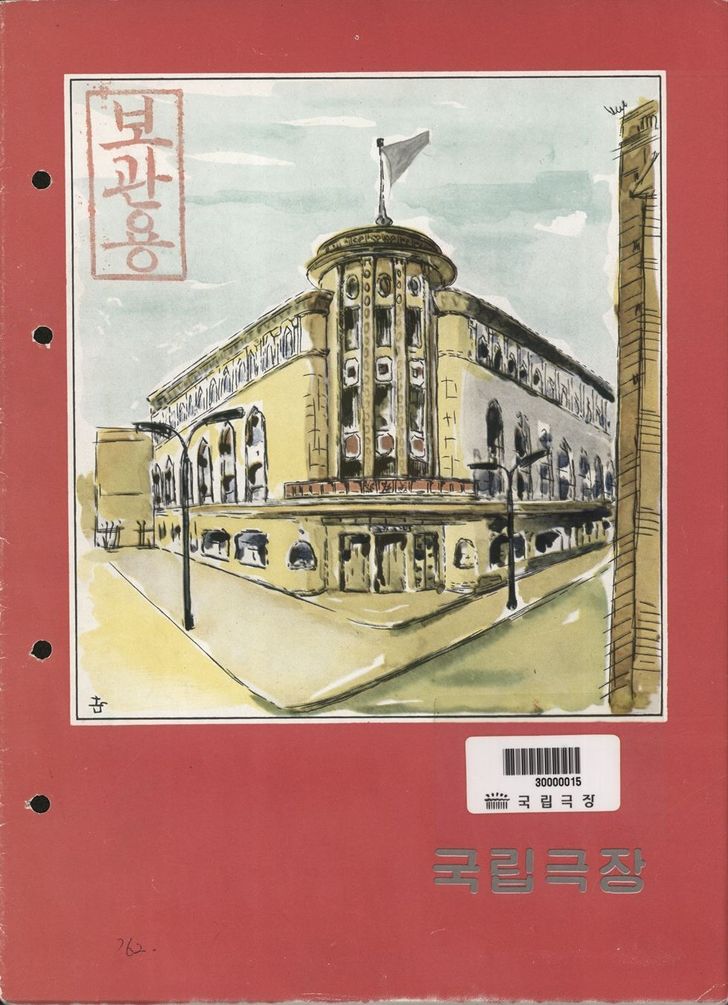
Cover of the script of "Chunhyang-jeon," the first performance by the National Gukgeuk Company of Korea, now National Changgeuk Company of Korea, in 1962, featuring a painting of the Seoul Public Hall, now the Myeongdong Theater / Courtesy of NTOK
The theater was first located at Bumingwan, currently used as the Seoul Municipal Assembly Building, in central Seoul, on April 29, 1950.
Renowned playwright and the first president of the NTOK, Yoo Chi-jin, wrote the opening play "Wonsulrang," which revolved around Kim Won-sul, the second son of the Silla General Kim Yu-sin. The opening show was a big hit, which attracted 50,000 theatregoers in a week. Back then, the population of Seoul was approximately 400,000, so the play made history.
However, the 1950-53 Korean War broke out only 58 days after the theater's opening and operations were suspended.
The theater strived to offer performing arts to people even during the later period of the Korean War by temporarily moving to the Daegu Cultural Theater in the southeastern city of Daegu in 1953.
After the war, the NTOK moved back to the capital in 1957, settling at the Seoul Public Hall, now the Myeongdong Theater. It took four years for the theater to return to Seoul as it was difficult to find the right venue as the former Bumingwan space was taken by the National Assembly.
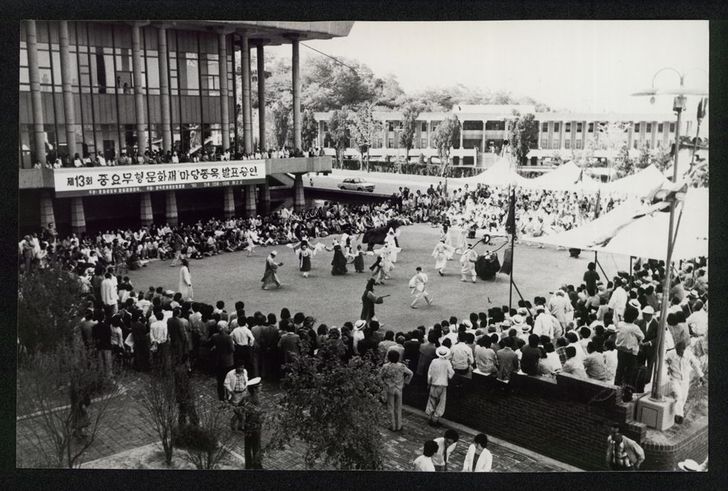
The National Theater of Korea opened its open-air theater Noleuimadang in May 1982. Courtesy of NTOK
In 1973, the theater finally opened its own building at its current Mount Nam location with a 1,500-seat main theater and 330-seat small theater. Eight national troupes operated under the NTOK back then, but five of them became independent and the National Orchestra of Korea, the National Dance Company of Korea and the National Changgeuk Company of Korea are currently affiliated with the NTOK.
Lee Sang-woo, professor of the Department of Korean Language and Literature at Korea University, is one of the writers of the 70th anniversary book.
As a specialist in Korean modern drama, Lee emphasized the public role of the national theater.
"Not all countries have a national theater. Plays and other types of performing arts are less popular than other genres of art and they might fall behind under a complete market principle. Yet, public theaters such as the NTOK play an important role in fostering the performing arts," Lee said.
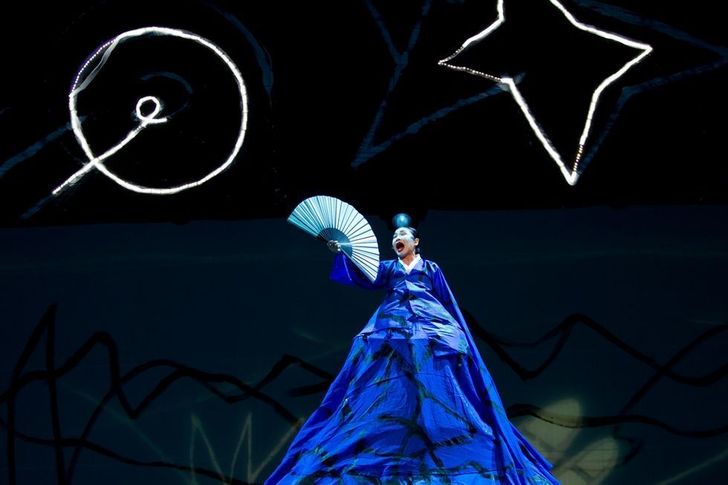
The National Theater of Korea launched its Repertory Season with “Sugung-ga” in 2012. Courtesy of NTOK
While reviewing the theater's history, Lee noted that after the first president Yoo Chi-jin and second Seo Hang-seok, both thespians, the NTOK was mostly under the helm of civil servants from the culture ministry until the 1990s.
"I think it is desirable for a performing artist to administer the theater. I also think the rank of the NTOK CEO should be raised to the same level as other national museums and institutions. Currently, the NTOK CEO position is a step down, which reflects the tendency on looking down on the theater and performing art," Lee said.
As the nation eases social distancing measures, the NTOK plans to resume in May with extra care. The National Changgeuk Company of Korea's “Chunhyang” directed by Kim Myung-gon will mark the reopening of the theater from COVID-19 hiatus on May 14.