Lee Ja-ram catches audiences in 'Old Man and Sea'

Lee Ja-ram performs “The Old Man and the Sea,” a new pansori piece based on Hemingway's novel, at Doosan Art Center. Courtesy of Doosan Art Center
By Kwon Mee-yoo
Pansori performer Lee Ja-ram is a natural born storyteller. She has a rare talent, allowing her to balance the upholding of tradition and re-creating the genre for the 21st century.
Trained for pansori, or traditional Korean narrative music, from childhood, Lee is known for singing the complete version of traditional stories "Simcheong-ga" and "Chunhyang-ga" when she was still in high school.
Aside from her successful career in the traditional music field, Lee also serves as a vocalist for indie band ?Amado Lee Jaram Band.
From 2007, she took up a new challenge of making original pansori pieces using contemporary language, making a leap from her five existing traditional pieces. Her original pansori works include “Sacheon-ga” and “Ukchuk-ga,” based on Bertolt Brecht's "The Good Woman of Szechuan" and "Mother Courage and Her Children," respectively; "Stranger,” based on Gabriel Garcia Marquez's "Bon Voyage, Mr. President;” and "An Ugly Person/Murder" based on Joo Yo-seop's novellas of the same name.
This time, Lee takes audiences from Jongno 5-ga to the Gulf of Mexico for a thrilling, epic battle between an old man and a giant marlin in her latest piece "The Old Man and the Sea” at Doosan Art Center in central Seoul.
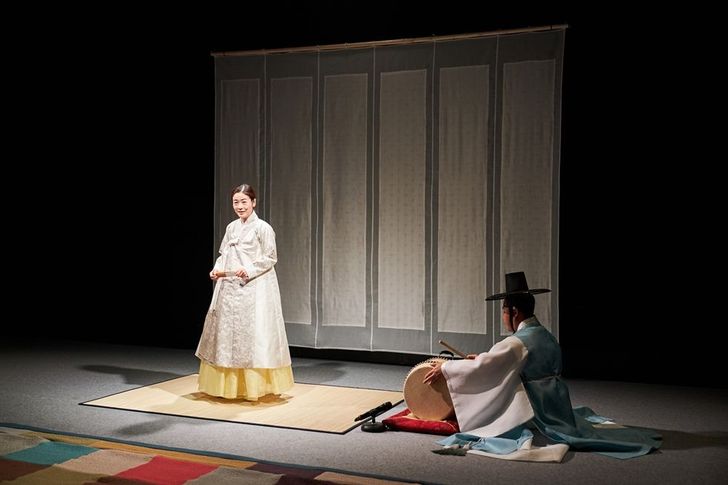
Lee Ja-ram, left, and percussionist Lee Jun-hyung / Courtesy of Doosan Art Center
Everyone knows Ernest Hemingway's 1951 novella "The Old Man and the Sea" and sums it up as the simple story of an aging fisherman's struggle to catch a large marlin and his fight with sharks after he captures it.
Lee reinvents this household tale as a tantalizing experience as the performer and audience altogether join the old fisherman Santiago on a small boat floating on the Gulf Stream off the coast of Cuba aiming for the 800-kilogram marlin.
Directed by Park Ji-hye of the Yangson Project, the pieces goes back to the basics of pansori, in which only a sorikkun (singer) and a gosu (percussionist) perform. The stripped-down set includes a white "byeongpung" (Korean traditional screen) and Lee sings on a "hwamunseok" (figured sedge mat).
In the beginning, she humorously describes Santiago's tough appearance and his fishing journey. However, as the struggle between the fisherman and the marlin gets fierce and tedious, Lee's voice and movements also grow intense.
Lee emphasizes how the audiences' reaction feeds her energy during the performance. She teaches how to put “chuimsae,” or word of exclamation, and “jajinmori,” a specific rhythm in Korean traditional music during the show.
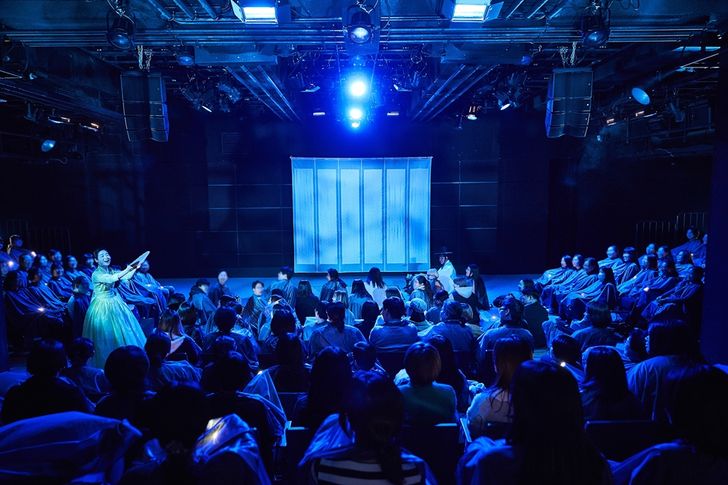
A scene from Lee Ja-ram's “The Old Man and the Sea” / Courtesy of Doosan Art Center
As the story goes into the deep sea, Lee asks the audience to put on blue capes to become the sea. Audience members have to surge up and down like waves and become seaweed or squids following Lee's gestures and Lee becomes radiant with joy as she communicates with the audience.
The stream of times and the thoughts of the creators are reflected in the adaptation from the original novel. A notable aspect is Manolin, a 16-year-old boy who is the old man's fishing student and pal, changed into Nicole.
Though not explicitly called a girl in the piece, the creators set the character as an aspiring fisherwoman working with Santiago.
"We have researched a lot and when we found that a fisherwoman named Molly Palmer caught a record 460 kilogram marlin after four hours of struggle. We thought that she could be the Santiago's disciple who inherited his spirit," director Park explained.
Lee said that some of the lines reflected their prejudice and called the villagers using masculine pronouns.
"So we changed those to gender neutral pronouns and also took out masculine or feminine descriptions of Nicole, leaving the decision to the audiences," Lee said.
Lee is the recipient of the sixth Doosan Artist Award in 2015 and the Doosan Art Center sponsored Lee's new work.
The pansori, which ran from Nov. 26 to Dec. 1 at Doosan Art Center, will travel to Junggu Arts Center in southeastern city of Ulsan for Dec. 13-14.