'Matilda' brings strong female characters forward

A scene from musical "Matilda" / Courtesy of Seensee Company
By Kwon Mee-yoo
It has been 30 years since Roald Dahl's quirky yet funny young rebel Matilda made her debut. However, the children's literature character still lives on in the pages of the book as well as on the stage of theaters around the world in a musical adaptation, including a recently opened Seoul production.
The Korean production is receiving standing ovations every night as audiences travel Matilda's whimsical journey through her apathetic family and ghastly school, standing up against absurdity.
Catherine Mallyon, executive director of the Royal Shakespeare Company (RSC) which produced the musical rendition of "Matilda," said a good musical like “Matilda” does not happen overnight.
The RSC began as the Shakespeare Memorial Theatre and still Shakespeare's works take up about 60 percent of the troupe's repertoire, but the company also presents works of Shakespeare's contemporaries and today's writers. Some of the notable non-Shakespeare works produced by the RSC include "Les Miserables," "Wolf Hall" and "Matilda the Musical."
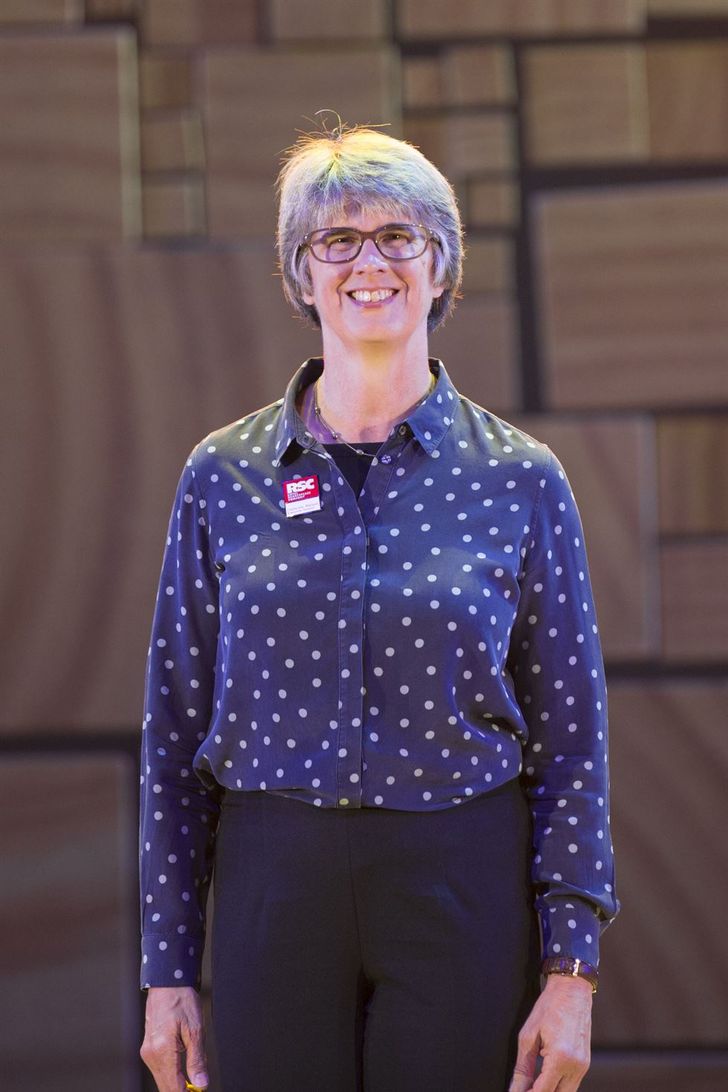
Catherine Mallyon, executive director of the Royal Shakespeare Company / Courtesy of Seensee Company
Mallyon has been in charge of the company's business side since 2012 and works with artistic director Gregory Doran.
"He and I work alongside each other to run the company. I look after finances, marketing and fundraising _ the commercial side of the operation. We overlap quite a lot and I often go to meetings to discuss artistic programs and he attends budget meetings, but basically I am responsible for business," Mallyon said.
The musical adaptation of Matilda began over a decade ago.
"About 15 years ago, the Roald Dahl Literary Estate approached the RSC asking would we like to develop a musical based on the book Matilda. I think they came to the RSC because of our experience in producing theater works, including musicals," Mallyon said. "And then there was a seven-year development period to produce the musical before being first presented in Stratford-upon-Avon."
It premiered at the company's home ground Stratford-upon-Avon in 2010 then transferred to London's West End in 2011. Mallyon said it's been a long journey for "Matilda" to arrive in Korea, with the talks with Korean partner Seensee Company began about two years ago.
"It took a long time to develop because there are so many elements in it and they work so well. But it takes time to make that. Initially, for example, (headmistress) Miss Trunchbull wasn't going to be played by a man and the child characters were played by adults. We did a lot of workshops to see what would work the best and ended up with the version you see here."
With the feminist movement at a higher-than-ever profile across the globe, "Matilda" arrived in Seoul just in time. The show has the plucky Matilda as the protagonist and Matilda fights against her school's tyrannical mistress Miss Trunchbull, ironically played by a male actor, with help from her teacher Miss Honey, making the musical's principal roles all female.
"From the very start, Matilda's father Mr. Wormwood clearly states he wants a son and calls Matilda a son until the glorious moment in the end. It is quite important to understand that Matilda is quite confident in herself, even though all people around her want her to be something different. I think Roald Dahl wrote the story wanting a strong female character, but I don't know if he wrote in the context we have all around now," Mallyon said.
When the Korean cast for Matilda was announced, there was a stir among theatergoers complaining about a male actor playing a female character, stripping away opportunities for women.
"The director decided it worked well for a male through the workshop process. I think it has something to do with the physicality of the role ― a tall man with small children is visually more striking. If you look across the casting, it's pretty equal with unprecedented strong female characters," the executive director explained.
Mallyon watched the Korean production and was impressed by the performance and how it connected with audiences here.
"It was performed really beautifully and looked great in this theater," she said.
Matilda's famous "School Song," which describes her first day of school sung through the alphabet, is translated into Korean with words matching the English pronunciation of each letter. "To me, it sort of sounded right, though I have no idea about the Korean lyrics. It sounds very different, but I hear the sound of letters. The song is a stunning piece of theater with its visual, choreography and music," she said.
The company already has an abundance of repertoire in store, but continues to develop new pieces.
"About 60 percent of our productions are not new at all. We could do that again and again but people want to create something new all the time, providing contemporary perspective. It is human instinct to write new things and few will remain after 100 years," Mallyon said. "So we have writers on commission. Some are musicals while the others are plays. About one out of four goes through the workshop and makes way to stage."
Mallyon said continuous investment is key for the future of the company.
"We always like to have 'Matilda' every year, but it is a very special thing. We have produced good musicals and will have more international success like 'Matilda' in the future," she said.
The Korean production of “Matilda” runs through Feb. 10, 2019 at LG Arts Center in southern Seoul. Visit iseensee.com for more information.