German photographer Candida Hofer takes portraits of empty spaces

Candida Hofer poses in front of her work on display at Kukje Gallery in central Seoul. / Courtesy of the artist and Kukje Galler
By Kwon Mee-yoo
German photographer Candida Hofer explores how humans and space influence each other and interprets the relationship from a contemporary perspective.
The most notable characteristics of Hofer's photographic works are that she captures the empty interior of public spaces. The absence of humans highlights what people do in those spaces and what spaces do to them.
Works displayed on the first floor of the Kukje Gallery K2 for the artist's fourth solo exhibition, "Spaces of Enlightenment," in Seoul mainly feature theaters and opera houses, which represent the change in social status in modernization.
The spatial composition and use of a theater is closely related to the dissolution of the class-based society and the philosophy of enlightenment.
From ancient times until the 18th century, music was possessed and enjoyed by churches in the center. Composers transacted music personally with patrons and they were the main audiences for music. So, back then, private theaters needed sponsorship from aristocrats, and box seats were exclusively provided for those patrons, with separate entrances. Some of the theaters were open to members only, reinforcing exclusiveness.
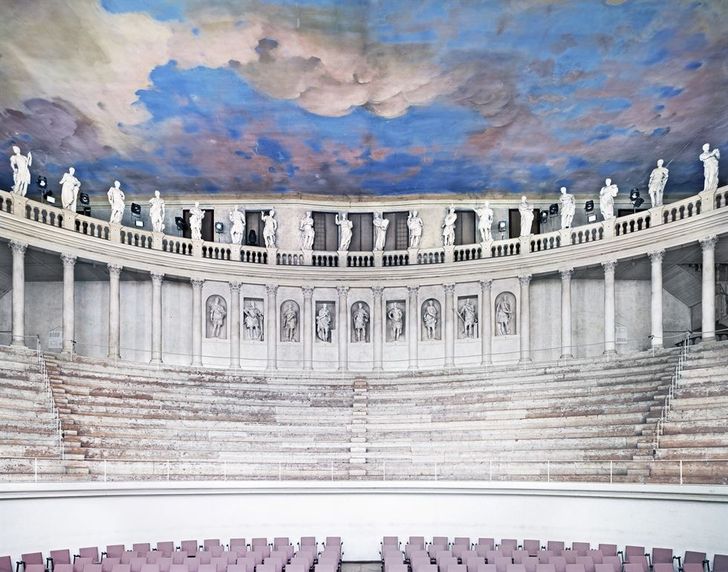
Candida Hofer's "Teatro Olimpico Vicenza I" / Courtesy of the artist and Kukje Gallery
Hofer's "Teatro Olimpico Vicenza I," which portrays Teatro Olimpico in Vicenza, Italy, reminds of how theaters evolved from being open air to an enclosed space.
Around the turn of the 20th century, the social class system collapsed and public theaters began to appear, with a structure for the public as audiences, not some privileged group.
“Teatro Communale di Bologna” showcases how the design of a theater changed to install seats in the parterre area, now the stall seating on the same level as the stage, which was occupied by standing audiences separated from high-class people seated in boxes.
On the second floor are photographic captures of different public spaces such as a library and museum. From a baroque-style library attached to an abbey, to bookshelves of the Academy of Art in Dusseldorf, where she studied, Hofer presents how this social and humanistic space evolved from being reserved for the privileged to a more democratic space.
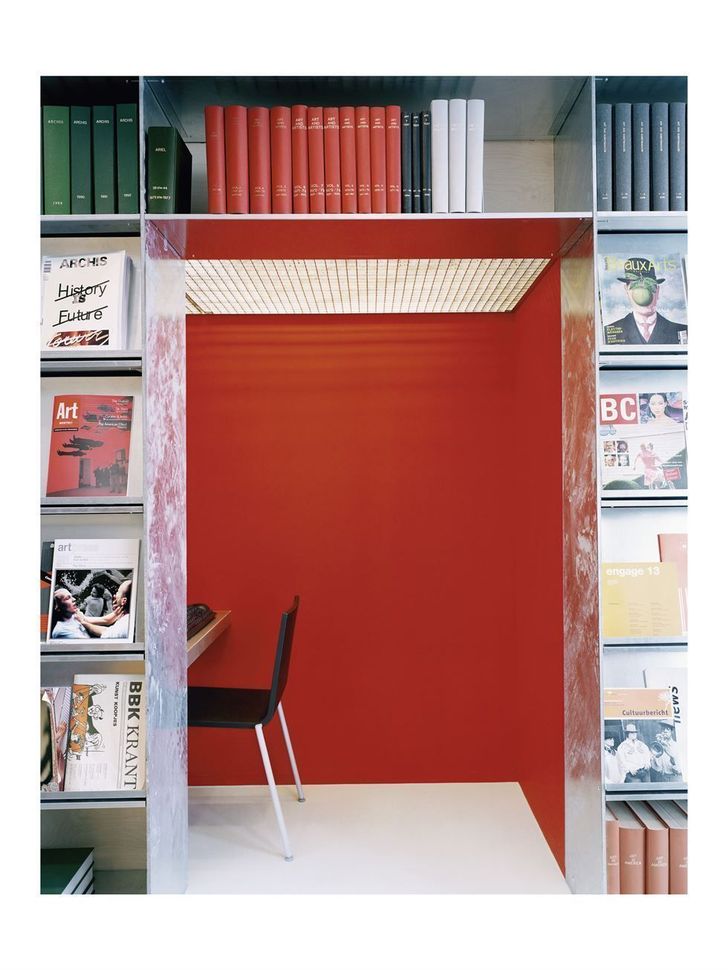
Candida Hofer's "Van Abbemuseum Eindhoven VI" / Courtesy of the artist and Kukje Gallery
"I was interested in how humans organize and relate to a space," Hofer said during a press preview of her Seoul exhibition on July 26.
She is known for large-format images and the size is related to the main subjects of her work ― public and semi-public spaces.
"I have to visit each place to find the right position to take the photo,” she said. “It has to have a certain sense of space, not too large or too small. I am both interested in historic buildings and contemporary architecture. Historic ones reflect the time it was built and encompasses the history, while contemporary structures are still empty from the perspective of history.”
Hofer's project on the Elbphilharmonie concert hall in Hamburg was initiated by the director of the concert hall and she was able to explore the building's architectural traits through miniature models and samples of materials.
"It was a new building and I did not know anything about it” she said. “There are certain expectations from something not known."
A few photos included in this exhibit, taken at the Bibliotheque Nationale de France, the first library to open its doors to the public, feature people ― a rare case for Hofer. The artist said it was due to real-world constraints.
"I exclude the human presence in my photographs because I don't want to interrupt people and we can perceive the space as it is when there is no human,” she said. “I only use ambient lighting, and when you can take photographs of a public space without being interfered by the human presence is before or after operating hours. Due to such time constraints, I sometimes have to include people."
The exhibit runs through Aug. 26. For more information, visit www.kukjegallery.com.