Shin Mee-kyoung's world made of soap

Shin Mee-kyoung's “Ruinscape” on display at Arko Art Center in central Seoul for the artist's solo exhibit “The Abyss of Time” / Courtesy of Arts Council Korea
By Kwon Mee-yoo
Soap is a material that eventually disappears. Artist Shin Mee-kyoung uses soap in making paintings, sculptures and even structures at her solo exhibition "The Abyss of Time" held at Arko Art Center in central Seoul.
The exhibit features Shin's latest works as well as some of the London-based artist's earlier works on public view for the first time.
Upon entering the gallery, visitors will encounter ruins that vaguely remind them of an ancient Greek temple, collapsed with the clean and crisp scent of soap.
This is Shin's latest work "Ruinscape," consisting of soap bricks and columns, some still intact, some collapsed.
"It reflects a universal image of ruins I saw in different places. It's a symbol for the relics," the artist said. "For me, ruins are between existence and disappearance."
The scent of soap is part of Shin's exhibition as well. "What visitors feel from seeing and smelling works made of soap here are different from what they just see in pictures.”
The artist has been working with this vanishing material for over 20 years.
"I originally made works of resin in Korea. However, I could not use the material any more when I went to London, so I had to find a substitute," Shin said.
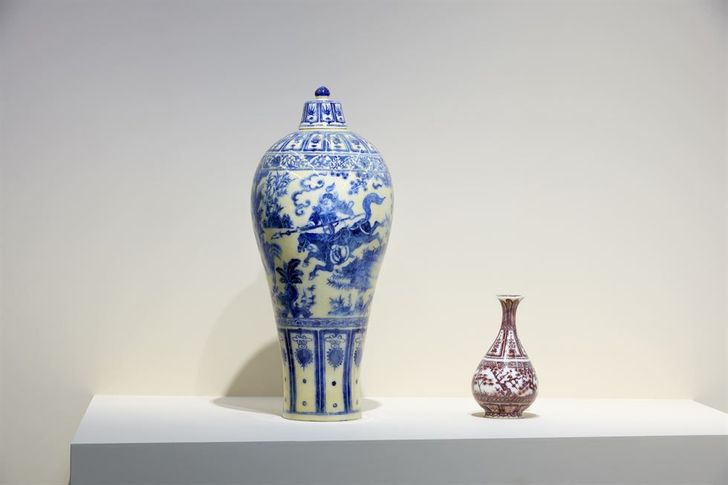
Shin Mee-kyoung's “Translation Series”
For Shin, soap is not just something that will be lathered down to nothing, though her works evoke vulnerability. She was attracted to the characteristics of soap which reflects aging faster than other materials.
"Soap visualizes the accumulation of time. It's like fast-forwarding a video. The environment surrounding soap sculptures permeates and is recorded in the soap. Each of my soap pieces has its history," the artist said.
At first she made large soap chunks and carved them into sculptures and vases. Later she found another type of soap that can be boiled and cast into molds, which blazed a trail in diversity in her work.
Two soap relief sculptures modeled after a 14th century relief on display on the first and second floor of the museum showcase how the artist's working method evolved.
"They both use two types soaps ― soap dough and casting soap. But my working techniques using soap evolved and the same sculpture turned out differently."
She is well-known for her "Translation" series and "Ghost" series, in which Shin created vases with soap.
Translation between different cultural areas has been Shin's longtime concern as she studied in England.
"I took inspiration from cultural exchanges through ceramic trades along the Silk Road. Something from a culture cannot be perfectly translated into another culture and the soap vases represent the gap that can never be filled," she said.
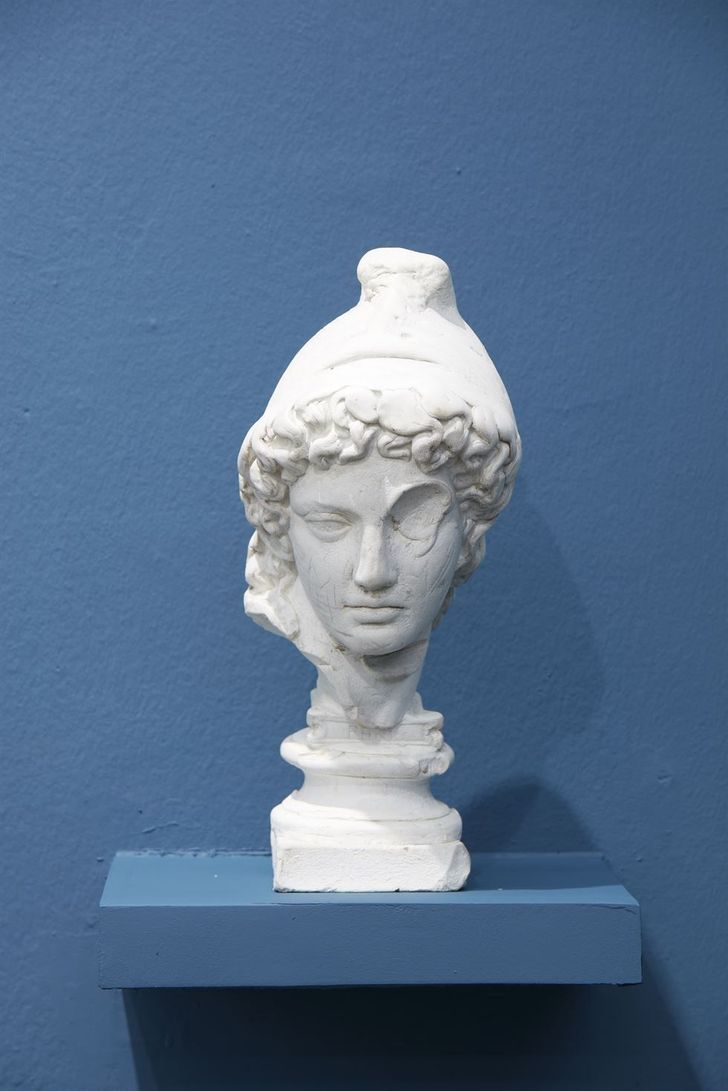
Shin Mee-kyoung's “Toilet Project”
Visitors to the museum can take part in modification of Shin's sculptures through "Toilet Project." A few Greek-style soap busts are placed at public toilets of the art museum and visitors can actually use them to wash their hands. Some are reluctant to touch the delicate sculptures, but the details soon smudge out as people rub them. These worn, altered bust sculptures will be displayed as finished products in her later exhibitions.
For this exhibition, Shin installed three soap busts outside the museum. The soap Venus sculptures are "sweating" in the harsh scorching heat of the Korean summer. The artist said it is natural for the soap sculptures to sweat since they don't include any preservatives. This glycerin soap absorbs moisture from air."
It has been over two decades since Shin has been working with soap and the artist said she still has things to do with the material.
"I hope to make an architectural sculpture with soap bricks outdoors next time that passers-by can interact with," she said.
The exhibit runs through Sept. 9. Admission is free. For more information, visit www.arko.or.kr or call 02-760-4626.