Joseon flower paintings inspire modern abstract art

“Painting of Pleasure,” an eight-panel folding screen from the late 19th to early 20th century / Courtesy of Gallery Hyundai
By Kwon Mee-yoo
An exhibition at Gallery Hyundai sheds light on the flower paintings from last century of the Joseon Kingdom (1392-1910) as the origin of Korean modern art.
Flowers and birds were the most popular subjects of "minhwa" (Korean folk painting) in the 19th century as they symbolized wealth, honor and conjugal harmony. Despite their artistic value, these paintings were considered originating from the lower class and not researched much.
Do Hyung-teh, CEO of Gallery Hyundai said he found the answer to one of the most frequent questions when he promoted Korean art overseas ― what is the root of Korean abstract art _ from the flower and animal paintings.
Many modern Korean artists, including Lee U-fan, Chang Uc-chin, Kim Chong-hak and the above mentioned Kim Gi-chang, loved minhwa and collected these flower paintings and this hints at the influence of Korean minhwa on modern Korean painting, especially abstract art.
Gallery Hyundai will display minhwa, antique furniture pieces and Korean porcelain with modern Korean abstract paintings during the Frieze Masters art fair in London in October.
Titled "Flower Paintings from the Joseon Dynasty," the exhibition features flower paintings mainly from the 19th century. The exhibit is held at three venues of Gallery Hyundai ― Flowers and Small Animal paintings in the Main Space, Peony and other Flower paintings in the New Space and works of embroidery in the Dugahun Gallery.
Though the Korean title of the exhibit indicates these paintings are minhwa, often translated as folk art, Professor Kho Youen-hee of Sungkyunkwan University, who co-curated the exhibit, pointed out that the paintings originated from the court and were popular among "yangban," or noblemen, during Joseon Kingdom, differentiating them from other folk paintings.
"Most of the existing flower paintings were created by court painters or aristocrats. Though they are called 'folk painting,' few of them were actually made by ordinary people," Kho said. "But such an art-loving culture was passed down from above and each Korean household had paintings of flowers and books of the past. Many of the artworks, though, were destroyed during the Korean War (1950-53) and taken away during the Saemaul Undong in the 1970s because they were considered old and outdated."
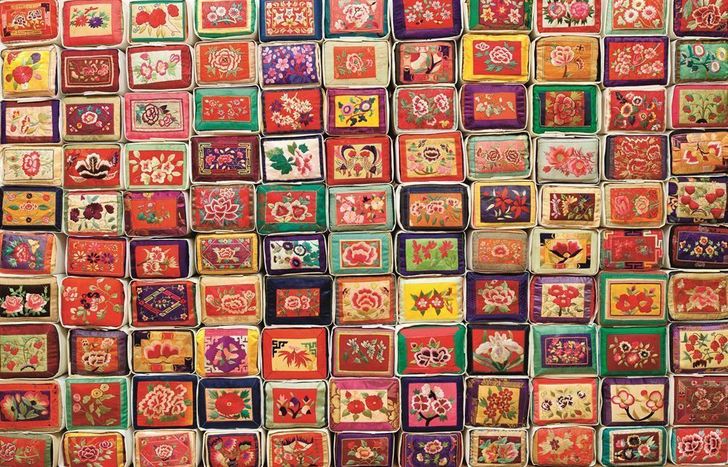
Embroidered pillow ends on view at the Dugahun Gallery / Courtesy of Gallery Hyundai
Kho said most of the paintings currently on view, borrowed from private collectors such as the late renowned painter Kim Gi-chang and private museums including the OCI Museum of Art and Onyang Folk Museum, are likely to have been originally displayed at homes of high ranking officials or even the palace.
"These are often looked down on as folk paintings, but some of them are assumed to be from court painters who sold their works for expensive prices outside the palace walls," Kho explained.
The most common style of these flower paintings are in vertical form as they were used for screens. Paintings for a screen originally existed as a set, but some of them are disassembled and now exist in the form of a single scroll.
"Most screens are four- or eight-fold, but there are larger ones up to 12-fold. Imagine how big the room has to be to put up a 12-fold screen," the professor said.
Most of the painters of the flower paintings are unknown, but Kho said talent shines even without names.
"It is our art historians' job to discover and group works of these unnamed artists of distinct style," Kho said.
Kho emphasized how much culturally advanced our ancestors were.
“There were people in the 18th century who collected and appreciated these flower paintings. They were much closer to art than we are nowadays,” Kho said.
"However, unlike these elaborate and radiant paintings of peonies, Joseon was a land of simple gardening. Even in palaces, gardens were not luxurious and the king would not have many chances to see peonies in person. Instead, people of Joseon enjoyed the image of flamboyant flowers through paintings regardless of rank, from the bottom to the top. I think the importance of Joseon flower paintings lies in the culture of enjoying flowers in all classes.”
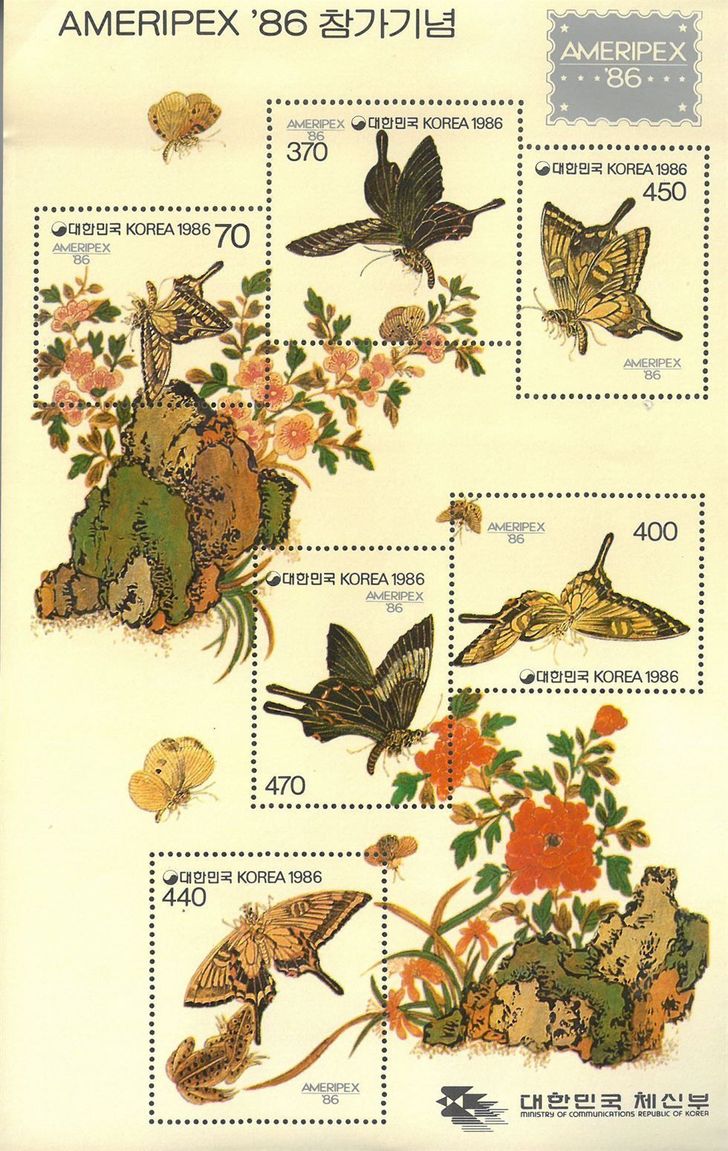
A set of postage stamps featuring flower and butterfly painting published in 19866 on the occasion of Ameripex 86 / Courtesy of Gallery Hyundai
Some of the flower paintings are in realistic detail, while others are patterned flowers and leaves similar to contemporary graphic design.
"This patternized style of flower paintings is little-known. We wanted to show how minhwa artists manifested creativity and originality," said Chung Byung-mo, another curator of the exhibit and a professor at the department of Cultural Assets of Gyeongju University.
A painting of two rabbits pounding grain in a mortar was turned into post stamp in 1980. Chung said minhwa was a popular subject for postage stamps in the 1980s.
"Thanks to the 1986 Asian Games and the 1988 Olympics held in Seoul, Korean folk painting was rediscovered," Chung said. "These grotesque yet humorous animals appear in a somewhat abstract form in flower paintings. It showcases how imaginative Joseon minhwa painters were."
This is the second minhwa exhibition co-organized by Gallery Hyundai and the Seoul Arts Center (SAC), following "Minhwa and Court Painting of the Joseon Dynasty: Munja-do and Chaekgeori" exhibit in 2016. The exhibit received favorable reaction and toured the Charles B. Wang Center at Stony Brook University in New York, Western Kentucky University and Cleveland Museum of Art.
A conjunctive exhibition "Masterpieces of Joseon Minhwa: Kim Sejong Collection" will be held at the SAC's Seoul Calligraphy Art Museum from July 18 to Aug. 26. The exhibit will consist of paintings from major minhwa collector Kim Se-jong's collection.
The exhibit runs through Aug. 19. Admission is 8,000 won for adults. For more information, visit www.galleryhyundai.com or call 02-2287-3500.