Exhibition redefines identity of Asia

Kamata Yusuke's "The House" is on view at the "How Little You Know About Me" exhibition at the National Museum of Modern and Contemporary Art, Seoul through July 8. / Courtesy of MMCA
By Kwon Mee-yoo
Korea belongs to Asia, the largest and most populous continent in the world. However, few think about what exactly Asia is about.
The National Museum of Modern and Contemporary Art (MMCA) Seoul offers a rare opportunity to think about the continent. Titled "How Little You Know About Me," the exhibit features works of 15 artists from eight countries in Asia.
MMCA curator Park Joo-won, who organized the exhibit, said the exhibition begins with questions about where Asia is and how people perceive it.
"I began with unfolding a world map and defining the boundaries of Asia. Soon I realized that we have been trying to define Asia with a specific word and it is so difficult to stipulate what Asia is about," Park said. "We came up with new methodologies from critical thinking."
The exhibition provides diverse perspectives on Asia, centering on individual voices. As the curator traveled around Asia and met a variety of artists from each region, she said she noticed the importance of personal experiences.
"As I spoke to the artists, I found that there are regional values and voices hidden under big, major historical events and artists are storytellers. The artists unravel their stories here," the curator said. “The title of the exhibit embodies how ignorant we are regarding our environment.”
The exhibition opens with Filipino artist Mark Salvatus's "Gate," a video art piece that shows an endless loop of gates opening and closing. The gates are taken from the artist's neighborhood in Manila and Salvatus raises a question on the two sides of a gate ― ensuring safety and drawing boundaries to exclude at the same time.
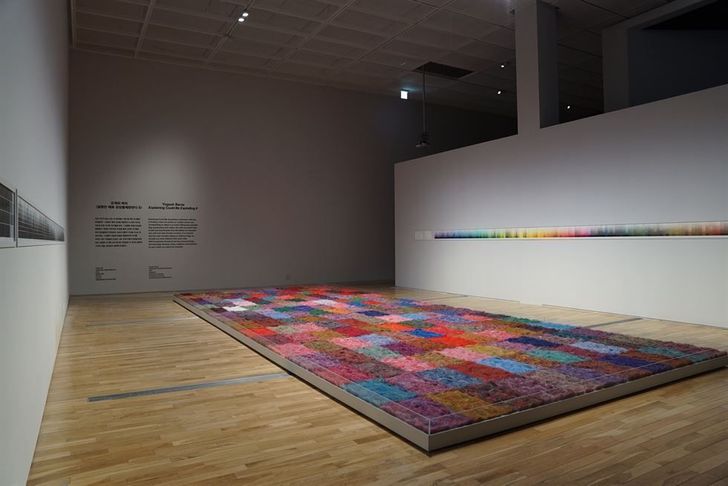
Indian artist Yogesh Barve's " Explaining Could Be Exploiting II" is on view at the "How Little You Know About Me" exhibition at the National Museum of Modern and Contemporary Art, Seoul through July 8. / Courtesy of MMCA
Indian artist Yogesh Barve blurs the boundaries of nationality by unweaving 177 national flags into threads in "Explaining Could Be Exploiting II." Colorful and iconic flags have become unidentifiable balls of threads and they mostly look similar, their identity removed.
Timoteus Kusno's "The Death of a Tiger and Other Empty Seats" reflects social and political issues of Indonesia in the 1990s through a fictional tiger hunting ritual.
Korean artist Yeom Ji-hye presents "Future Fever," a two-channel video projection that reviews what development in technology gives us. Fujii Hikaru's "Playing Japanese" documents a workshop looking for a real Japanese person among those who are pretending to be Japanese, reviving the imperialist gaze that Japan imported from Europe and imposed on other Asian countries.
Chinese artist Tao Hui's new work "Double Talk" reflects the artist's interest in "hallyu," or the Korean wave. The artist interprets K-pop culture through an idol singer who has risen from the dead and how popular culture and mass media influence individuals.
Zhang Xu Zhan explores life and death through a paper doll animation and dioramas featuring little mice. It comes from the artist's childhood memories and family business of making paper effigies for funerals. An Yu-ri's video "Rogue Stars" features "joseonjok" (ethnic Koreans in China) and questions the meaning of nationality and ethnicity in the 21st century.
Visitors can walk inside of Kamata Yusuke's "The House," which is a combination of frames of three Japanese style houses ― one in Korea, one in Brazil and one in Japan. The installation examines how history and culture influences architectural style.
MMCA Seoul is located right next to the Gyeongbok Palace, one of the most popular tourist attractions in Korea.
"But when those tourists who take selfies in rental "hanbok" (Korean traditional costume) come to the art museum, they become rather stiff and uncomfortable. So we transformed the museum into a platform, emphasizing its characteristics as an intersectional space," curator Park said.
On weekends, Taiwanese artist Po-Chih Huang invites visitors to the museum to sample lemon spirits made by the artist in the "500 Lemon Trees: Lemon Wine Bar" project. His other work "Production Line" documents the life of his mother, who worked as a seamstress for a long time, and reflects how economy and labor condition transformed in Taiwan.
Elia Nurvista's "Possibility of Inauthentic Recipe" is about a fictional discussion to trace origin and designate the protector of a recipe to be hailed as an intangible cultural heritage ― a curry burger. Representatives from India, Japan, the United States, the United Kingdom and Germany argue for their legitimacy in the fusion food.
For more information, visit www.mmca.go.kr or call (02) 3701-9500.