Ong Keng Sen bridges tradition with contemporary

Ong Keng Sen, director of changgeuk “The Trojan Women” / Courtesy of National Changgeuk Company of Korea
By Kwon Mee-yoo
The National Changgeuk Company of Korea’s (NCCK) “Trojan Women” is an interesting blend of Korean and Western elements ― the tale of Trojan women after the war told through the traditional Korean storytelling form of “pansori.”
The “changgeuk” is led by Singaporean director Ong Keng Sen, who has shown much interest in Asia’s diverse traditions for decades.
Ong is known for international collaborations, combining traditional art with modern theatrical forms, from “Lear” in Japan in 1997 and “Desdemona” in Australia in 2000 to more recently “Diaspora” at the Edinburgh Festival in 2009 and “Richard III” in Tokyo in 2016.
When the NCCK was looking for international directors to collaborate with, Ong came into their radar.
“I’m interested in traditional art in relation to contemporary art. In other words, tradition reinvented for contemporary times,” Ong said in an interview with The Korea Times, Wednesday, ahead of the first performance in Seoul. “Pansori is extremely spectacular, a great voice coming from this small body. And it is handmade with human beings at the center. I am always thrilled to work with human beings and imagine the whole world.”
Ong’s first encounter with pansori dates back to the late 1990s when he visited Korea to study its traditional culture. He was fascinated by Ahn Sook-sun singing “Chunhyang-ga.”
“To me, pansori is a very naive yet profound art form. Being naive and sophisticated at the same time is a difficult blend,” he said. “In the traditional form, pansori was basically a wandering storyteller with an accompanying musician. It was like telling bedtime stories to children. However, it is very sophisticated all the same ― there is a belief in human beings and the master storyteller tells the story for hours and changes the world through the story. It’s like a manmade cinema, all imagined within the brain.”
However, Ong is more interested in arousing a new sense of tradition and making something contemporary, instead of just preserving tradition as is.
“A lot of these traditional systems have wisdom and profundity. I don’t want them to be lost because we would be poorer without them. For me, working with tradition is not about the form, but the core.”
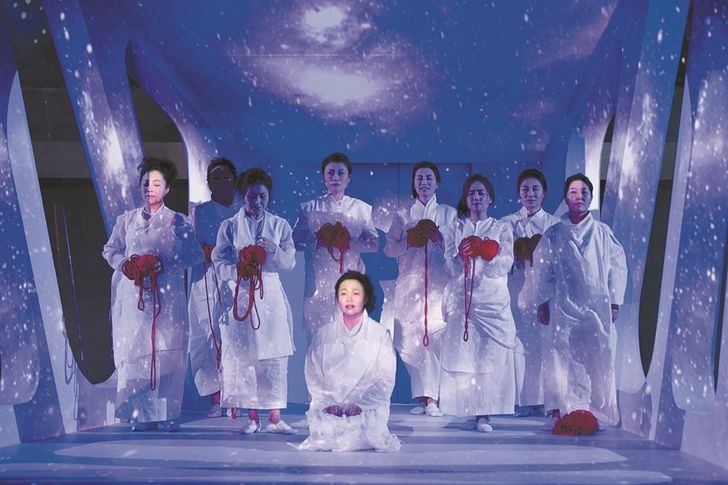
A scene from changgeuk “The Trojan Women,” which runs through Dec. 3 at the National Theater of Korea / Courtesy of National Changgeuk Company of Korea
'Trojan Women' in changgeuk
In this changgeuk, foreign names such as Hecuba, Cassandra and Andromache are sung through pansori and yet they go well with each other. The lamentation of war still resonates with the contemporary world as ordinary people suffer from the aftermath of war.
“I thought Trojan Women could speak through changgeuk, because it’s a women’s story and fits the strong, resilient and committed women of Korea,” the director said.
Ong said the changgeuk is an adaptation of Jean-Paul Sartre’s 1965 novel “The Trojan Women,” which also is an adaptation of Euripedes’ Greek classic of the same name.
“Sartre’s adaptation was written 2,000 years after the Euripides version and has references to the post-colonial stance from European imperialism in Asia,” he said. “When we reduce it and relate it to Korean issues such as comfort women, it would be too specific. Women in war are all over the world and the idea of expansion is my interest.
“Korean culture is deeply pure and has an archetypal quality and Greek theater too. The han could be found in Trojan women who are defeated and about to leave their home with all the men already gone.”
The changgeuk remains loyal to Euripedes in the form, but playwright Bae Sam-sik’s work is more modern.
“The dialogue between mother-in-law Hecuba and daughter-in-law Andromache is quite usual, despite they were originally written over 2,000 years ago,” Ong said.
Changgeuk is a genre derived from pansori. While pansori is a one-person performance accompanied by a drummer, changgeuk is a more theatrical form in which different performers play different roles, singing in the pansori style.
Still, Ong believes the essence of changgeuk lies in pansori and he asked master pansori singer Ahn to compose pansori for this changgeuk.
Returning to the essence of pansori, Ong eliminated complex harmonies and matched each solo singer with a single instrument. The Trojan queen Hecuba is matched with geomungo (six-string zither), Cassandra with daegeum (bamboo flute), and Andromache with ajaeng (seven-stringed bowed zither).
The only main role matched with a Western instrument, the piano, is Helen, wife of Spartan king Menelaus who eloped with Trojan prince Paris and brought about the Trojan War. Helen is played by a male singer to portray the character who is in-between.
Composer Jung Jae-il’s music, which inclines to K-pop style, is given to the eight-member chorus who represent the grassroots of Troy.
“Ahn is a vessel of wisdom and done so much for this production. Her pansori has poetic quality with endurance and resilience,” Ong said. “But it would’ve been very different if we had only one composer. Doing it in cotemporary times needed something different and I thought of bringing K-pop into changgeuk.”
Ong said the changgeuk was a Beaujolais Nouveau last year when it premiered in Seoul. “It was raw but had exciting new flavors. In Singapore, it was more polished for international debut,” he said. “It’s like a more mature wine this year. The performers get under the skin of their characters more and inhabit the story more. Individual detail is very strong as well.”
The most noticeable change in the second Seoul production is the portrayal of the Trojan prince Paris. In the premiere last year, composer and music director Jung made an appearance on the stage with his piano and Helen leaning on him.
During the Singapore performances, some audiences found the appearance of Paris and the piano too distracting and Ong took Paris and his piano off the stage.
Now without the abrupt appearance of the bulky black piano, audiences can concentrate more on Helen and Menelaus’ relationship while the sound of the piano reaches the audience clearer than ever.
Reaching beyond Korea
The changgeuk went abroad for the first time in September, to the Singapore International Festival of Arts (SIFA) where Ong is serving his last year as the festival director.
The Korean traditional music succeeded to resonate with the audiences there and the Strait Times said the performance was “mesmerizing, haunting, unforgettable.”
“Before the performance, Singaporean journalists said they were unclear about pansori. They could’ve seen pansori clips on YouTube, but it is out of context. Unlike Japanese Kabuki or traditional Chinese opera, pansori is not exported much and still quite unimaginable,” Ong said. “Pansori is still hermitically closed and I thought it was important to take it outside. My approach to traditional pansori is not destructive, but finding the universality in it.”
Ong thinks the power of pansori is strong. “You can feel that people are truly affected by what they see and hear. There’s so much potency in the voice and it can sweep audiences away, even if presented in very minimal yet evocative form.”
The Singapore tour was the beginning for “Trojan Women” and it will travel to European cities of London, Vienna and Amsterdam next year. First up is London in June, as part of the UK/KOREA Creative Futures 2017-18 program.
Ong also has high expectations for the invitations from Vienna and Amsterdam.
“Vienna is the home of Western opera. Changgeuk has a complete different form of singing, but it is real opera. I want to wow Western audiences with something very different from the Italian opera, so it’s going to be a major achievement,” Ong said. “Trojan Women is very different from heritage showcases. It represents transformation of art in which we rethink the world we live in. It is going to be a new classic.”