Dresden state treasure galore at national museum

"Goblet in the form of a Maiden" from the Green Vault in Dresden / Courtesy of Green Vault and National Museum of Korea
By Kwon Mee-yoo
Germany is a country known for its practicality, but some rulers appreciated the beauty of art and collected some of the world's most glamorous treasures.
An exhibition at the National Museum of Korea introduces some of the highlights from the Dresden State Art Collection.
Titled "The Dream of a King," the exhibit centers around Augustus II (1670-1733), who was the Elector of Saxony, elected King of Poland and Grand Duke of Lithuania, had one of the finest treasure collections in Europe.
Also known as Augustus the Strong, the Elector was an avid patron of the arts and architecture. He built beautiful castles in the Saxon capital of Dresden and displayed his prized collections at one of the palaces. He even gave limited access to the collection for the general public and made an inventory of the items in the collection to systematically prevent treasures from going missing, which makes the Green Vault the first museum in Europe.
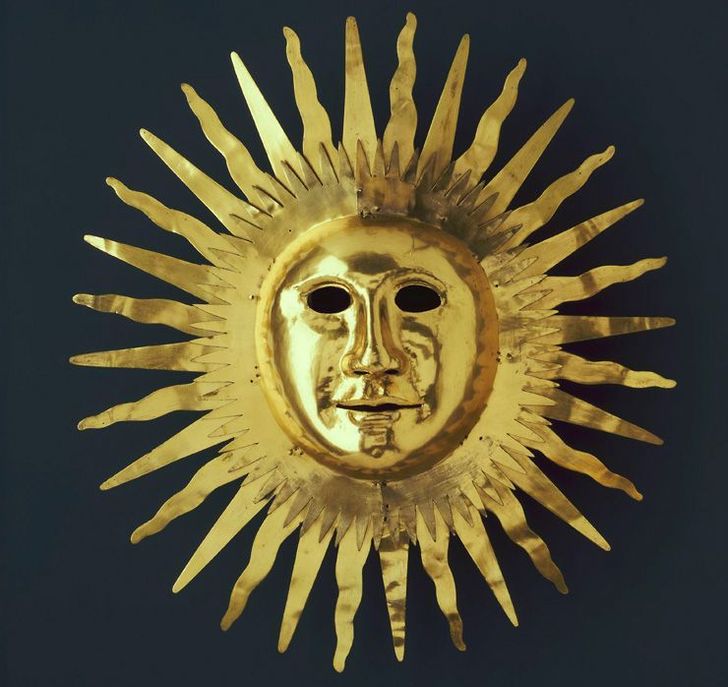
"Sun Mask with the Likeness of Augustus the Strong" / Courtesy of Green Vault and National Museum of Korea
Augustus II had strong sovereign authority and boasted of his power through lavish Baroque-style palaces and his treasured art collection.
He threw many balls and invited guests from all over Europe. Augustus II admired the absolute monarchy of the Sun King, Louis XIV of France, and made a mask customized for him in the shape of the sun. He engraved the Augustus Rex monogram (AR) on his possessions such as his hunting sword and other court objects, wielding his power.
The Green Vault has themed exhibition rooms such as the Ivory Room, the Bronze Room, the Silver Room and the Jewel Room. The Seoul exhibition is also organized by the rooms and tries to give a peek of the luxurious atmosphere of the Green Vault in Dresden and placed photos of the museum and magnified objects on the wall.
The Gilded Silver Room showcases the highlight of Saxon metalwork. It is interesting that makers of each piece are noted, sometimes separated into metal work, stone work and jewel work. Elias Geyer, who made "Cup in the Form of a Sea Unicorn," was an innovative goldsmith who combined natural objects such as nautilus and coral with metalwork.
"Goblet in the Form of a Maiden" was a popular type of cup in the 16th century and suspected to be used during wedding ceremonies, when the bride drank from the top cup and the groom from bell-shaped bottom cup.
The Jewel Room is at the height of glittery delights. Augustus collected jewels and adorned various objects to display his dignity. "Small Sword with Scabbard" has 911 pieces of diamonds decorated on it.
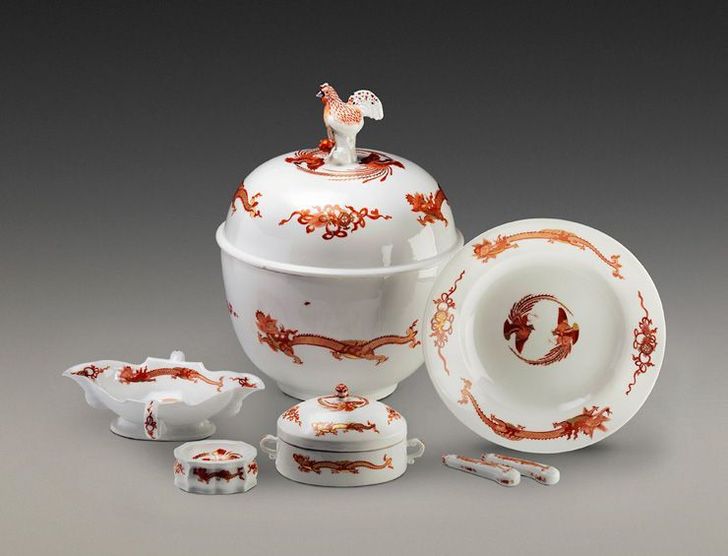
"Red Dragon" Service / Courtesy of Green Vault and National Museum of Korea
Augustus II is also known as a lover of porcelain. He collected a large amount of porcelain from China and Japan and later became the first to manufacture porcelain in Europe, which was known as “white gold” back then.
Meissen porcelain at first copied the style of Asian porcelain, but later produced tableware sets for the European courts.
The exhibit runs through Nov. 26 at the Seoul Museum and then travels to the Gwangju National Museum from Dec. 19 to April 8, 2018. Admission is 9,000 won for adults. For more information, visit www.museum.go.kr or call 02-2077-9000.