Artists navigate capitalism of ocean

Installation view of "Gridded Currents" curated by Kim Hyun-jin at Kukje Gallery in central Seoul / Courtesy of Kukje Gallery
By Kwon Mee-yoo
The sea is part of nature, but nowadays the ocean is dominated by capitalistic exploitation. It has become an object of colonization and divided by border-making as a side effect of modernization.
"Gridded Currents," an exhibition held at Kukje Gallery in downtown Seoul, approaches the sea seen through a capitalistic perspective in a critical way.
"The exhibition provides an opportunity to see how we divide and deal with the sea, consumed by modernist ways of thinking," said Kim Hyun-jin, the independent curator who organized the exhibition.
The exhibition encompasses works of four artists from various backgrounds _ Nina Canell, Kim A-young, Runo Lagomarsino and Charles Lim Yi Yong. The videos, paintings and installations reveal colonial history and nationalism behind nature.
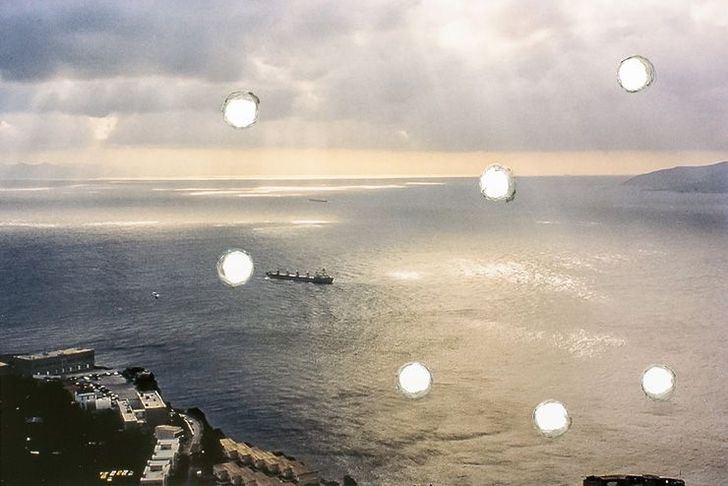
Runo Lagomarsino's "Sea Grammar" / Courtesy of the artist, Kukje Gallery and Nils Staerk
Swedish artist Lagomarsino's works present poetic imagery of the sea, but they rather reflect the irony deeply rooted in Eurocentrism.
He printed a 16th century ship fighting the sea monster Kraken on a large curtain, titled "Mare Nostrum Mare Mostrum" (Our Sea Our Monster). "Europe is Impossible to Defend" borrows an illustration from the famous story of the Egg of Columbus.
"It represents the historical legacy of colonial times in Latin America," he said.
Works on the second floor reflect more physicality. "Sea Grammar" is a slide projection of some 80 images of the Mediterranean Sea, punctured with holes by the artist. The number of holes increase as the projection progresses, hiding the original seascape. Lagomarsino raises the question of refugees and immigration as a large population of refugees from Africa and the Middle East are desperate to cross the Mediterranean.
Lim is from Singapore and has a unique background of being a former Olympian as a sailor. Being born in a city surrounded by water and sailing a yacht professionally, the sea was the living foundation for Lim.
His work "SEA STATE" literally divides the sea by grid and presents how the Singaporeans perceive the sea as a wall, not as an open space.
"The sea was present in everyone's lives, but it is going out of our mind. I wanted to bring this back," Lim said. "A lot of information I have is not from research, but what I have experienced from my past."
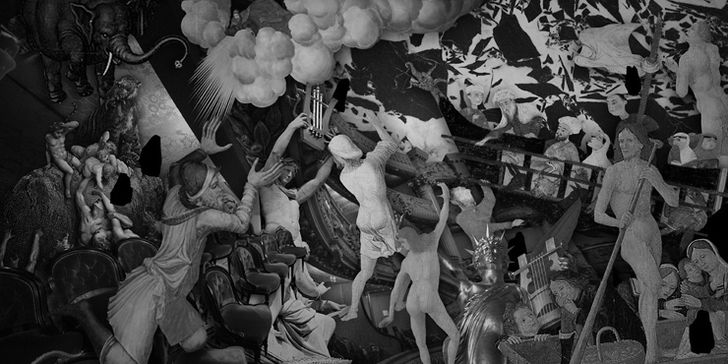
Detail of Kim A-young's "Grand deuil (Deep Mourning)" / Courtesy of the artist and Kukje Gallery
Korean artist Kim presents works she developed while she was at the Palais de Tokyo's research lab Pavillon Neuflize OBC in Paris from 2015 to 2016.
She was assigned to collaborate with the Palais Garnier, the gorgeous theater in Paris known for an underground lake beneath the venue, and Kim revives a long forgotten mythical flood through various methods.
"Grand Deuil (Deep Mourning)" is a mural featuring the images related to the Great Flood and the ark and the centerpiece of the project.
"In This Vessel We Shall Be Kept" is a video of a performance at the Palais Garnier and a diagram of her research on the Gilgamesh flood myth.
Swedish artist Canell's sculptures consist of recycled fiber-optic cable sheaths and concrete and scattered around the gallery. These "Shedding Sheaths" represent the cable body underlying the relationship between technology and physicality.
The exhibit is on view through Aug. 20. Admission is free. For more information, visit kukjegallery.com or call 02-735-8449.