Video art pioneer Park Hyun-ki explained through drawings
By Kwon Mee-yoo
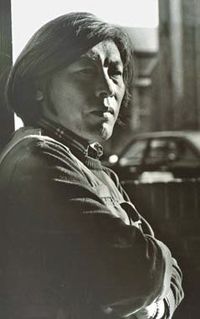
Park Hyun-ki / Courtesy of Gallery Hyundai
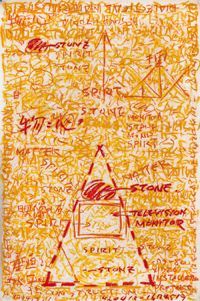
Park Hyun-ki's oil stick painting “Untitled.” / Courtesy of Gallery Hyundai
Park Hyun-ki (1942-2000) is mostly known for his trailblazing minimalist video art and installations, exploring philosophical themes such as yin-yang and materialism.
Gallery Hyundai presents "Park Hyunki ― Visible, Invisible" as an attempt to shed light on a pioneer of video art in Korea through his major video pieces as well as oil stick drawings, some of them open to the public for the first time.
Park installed television monitors with natural objects such as stones and wood and overlapped different images to create contemplative works.
Art critic and Park's close friend Shin Yong-deok referred to iconoclast Paik Nam-june as a huge mountain looming ahead of Park.
"Park had to avoid following in the footsteps of Paik. Park used TV monitors for his works just like Paik, but they spoke different artistic languages," Shin explained.
The oil stick drawings on display are from the 1990s, created not long before the artist passed away from stomach cancer in 2000.
The drawings range from purely abstract ones to those with more specific symbols and letters. Some of the drawings show words such as “utopia” and “spirit,” while others just consist of lines. This was initiated from the artist's effort to unravel his video works through painting.
"Though he worked as an architect and mainly created video installations, Park always had this thirst for painting and he found oil sticks, which were soft and suitable for free drawing," Shin said.
He used "hanji," or Korean traditional mulberry paper, instead of Western canvas. The combination of Western material oil sticks and Korean paper created a unique result, while revealing the artist's thoughts onto paper.
Park drew short and soft lines, which can be derived from architectural sketches, reflecting his background. He majored in painting at first, but transferred to architecture.
Though the exhibit centers on Park’s drawings, some of his most famous video works are also on display. On the first floor, visitors can see the "Mandala Series: Chaos #2" (1997), a video art piece superimposing images of Buddhist statues over cropped images from pornography. Park’s famous video installation of stones and television monitors is also on display.
Installation "Untitled" (1990) on the second floor presents railroad ties displayed along with filling blocks, both worn out from constant friction.
The exhibit runs through March 12. Admission is free. For more information, visit www.galleryhyundai.com or call 02-2287-3500.