Asia's ancient Buddhist statues on display in Seoul
.jpg?w=728)
Semi-seated “Pensive bodhisattva,” a late 6th century gilt bronze Buddhist sculpture during the Three Kingdom period of Korea is on display at the National Museum of Korea through November 15. / Courtesy of National Museum of Korea
By Baek Byung-yeul
For more than 2,500 years, Buddhism has been widely accepted in many Asian countries, providing spiritual guidance to the people in the region and inspiring the construction of many Buddhist statues.
On the occasion of the 10th anniversary of the relocation to its present Yongsan site, the state-run National Museum of Korea (NMK) provides a rare glimpse of ancient Buddhist statues created in different Asian countries.
Titled “Masterpieces of Early Buddhist Sculpture, 100 BCE-700 CE,” the exhibition features 210 Buddhist statues from India, China, Vietnam, Japan and Korea.
.jpg?w=728)
“Preaching Buddha,” a 2nd to 3rd century Buddhist statue in Kushan period in India is on display at the National Museum of Korea through November 15. / Courtesy of Museum of Asian Art, Berlin/NMK
Through the exhibition, visitors can not only compare many kinds of statues, but can also see the ways the religion has spread throughout Asia from its birthplace in northern India, and how each region has established its own Buddhist culture.
“Looking at the propagation of Buddhist sculpture from India to other regions, we can see that it is just like learning cooking techniques,” the NMK curator Yang Hee-jeong said during a press preview. “As we create our own know-how of cooking after learning from star chefs on TV, every region has its unique style in creating Buddhist statues as well.”
The exhibition comprises four sections, each focusing on the distinct approaches taken in respective Asian regions towards the creation and promulgation of Buddhist sculpture.
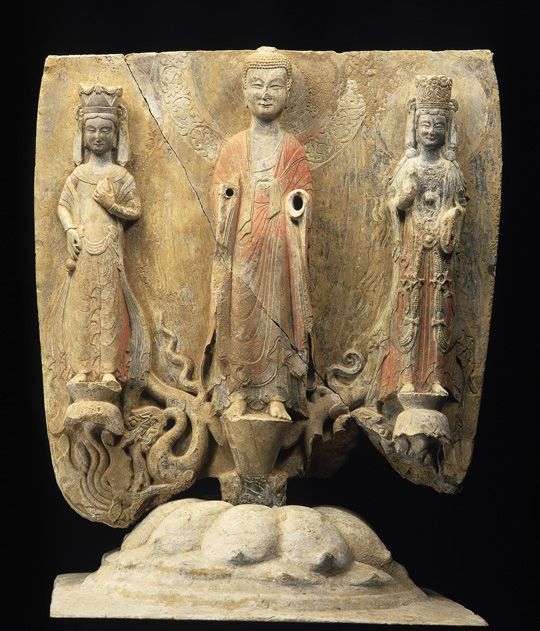
“Buddha Triad,” a 4th to 6th century Buddhist triad statue of China is on display at the National Museum of Korea through November 15. / Courtesy of Qingzhou Museum/NMK
The first section “Buddhist Sculpture of India: The Beginning of a Long History” focuses on the purpose of Buddhist sculpture in India. While Buddha was only represented through symbols at first, sculpture emerged in the first century with the Gandhara and Mathura region as its center.
The second section “Buddhist Sculpture of China: From Its Beginning to the Sui Period,” displays sculpture ranging from the Sixteen Kingdoms period (304-439) to the Sui Dynasty (581-618). Since Buddhism was introduced to China during the Han Dynasty, the Chinese began to craft their own Buddhist statues, reflecting their aesthetics while maintaining the essential iconography of the Indian originals. Visitors can also look at Buddhist sculpture from Vietnam in this section.
The third section “Buddhist Sculpture of the Three Kingdoms Period of Korea” offers examples of how the Koreans gradually developed their own style after the religion was introduced to the region from China.
The highlight of the exhibition is the last section that features Korea’s two pensive bodhisattva statues, which are designated as National Treasure Nos. 78 and 83. The semi-seated pensive bodhisattva statues are the most prolific form of Buddhist sculpture in Korea, the museum explained.
The exhibition runs through November 15. The NMK is near exit 4 of Ichon Station, subway line 4 and the Jungang Line. Tickets cost 3,000 won for children, 4,000 won for elementary school students, 5,000 won for middle and high school students and 6,000 won for adults. It is closed on Mondays. For more information, call (02) 2077-9284 or visit www.museum.go.kr.