Modern Korea seen through contemporary art

Joo Myung-duck’s "Document — Under the Youngdo Bridge in Busan" (1971) / Courtesy of MMCA
By Kwon Mee-yoo
Korea’s modern history cannot be defined with a single word, and the "Uproarious, Heated, Inundated" exhibit at the Museum of Modern and Contemporary Art, Seoul (MMCA) attempts to represent the various sides of Korea's history.
Subtitled "Commemorative Exhibition of the 70th Anniversary of Liberation: the Great Journey with the Citizens," the exhibit sheds light on Korea's contemporary history after the nation’s liberation from Japan in 1945 summarized in three words ― uproarious, heated and inundated ― covering the division of the Korean Peninsula, the Korean War (1950-53), industrialization, democratization and globalization.
The exhibit features some 270 pieces from 110 artists, about three-fourth of which came from the museum's collection. The types of artwork vary from painting, sculpture and photography to calligraphy and installations.
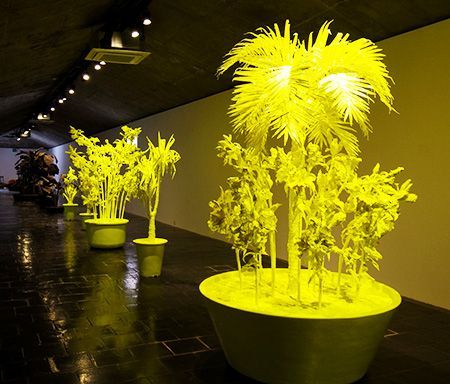
Choi Jeong-hwa’s "Flowers of Tomorrow" (2015) / Courtesy of MMCA
The space is designed by artist Choi Jeong-hwa, known for transforming everyday objects into artwork, and provides a fresh twist to the viewing experience.
The "Uproarious" section begins with An Jung-ju's six-channel video piece, "Ten Single Shots," installed in the hallway of the museum, and continues into the gallery where artwork related to the Korean War is displayed on a wire fence.
Political cartoonist Kim Sung-hwan, known for his work "Gobau," made sketches of people during the Korean War and 44 of them are on display. Jeon Joon-ho's short digital animation, "Hyper Realism ― Statue of Brothers," is a metaphor for separated families in the North and the South.
The second part, "Heated," deals with the rapid growth of Korea from the 1960s to '80s. Korea went through urbanization, industrialization and democratization expeditiously, which caused side effects.
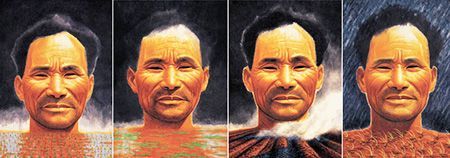
Lee Jong-gu’s “The Earth — Rice Planting, Summer, Fall, Winter” (1997-98) / Courtesy of MMCA
The exhibit also features early paintings of "Dansaekhwa" masters Park Seo-bo and Ha Chong-hyun, depicting the nation's industrialization.
Ha's abstract painting "White Paper on Urban Planning" reflects the sprawl of cities, while Jo Choon-man's "Industry Korea" photo series interprets industrial facilities in an artistic way. Bae Young-hwan describes modern Korea through popular songs, by making sheet music on wood panel using broken glass pieces as notes in "Pop Song" series.
The third section, "Inundated," continues on the upper floor, highlighting a more kaleidoscopic view of Korea now.
Themes for artworks diversify ― political and ideological works decrease and more artists become interested in social issues such as human rights, environmental problems, media and consumerism.
Gwon O-sang's photographic sculpture "Tree" reveals the complicated side of contemporary society, while Zin Ki-jong's "CNN" offers a sarcastic view on images distorted by the media.
Still the division of Korea overshadows the present, reflected through artwork such as Kim At-ta's photo "On Air Project 019 ― DMZ Series" and Sun Mu's painting "We Hope for Peace."
"We thought the liberation of Korea is not concluded yet, but currently underway after 70 years. The liberation, followed by the division of Korea, still casts a shadow over the Korean society overall,” the museum’s curator Kang Seung-wan said.
The exhibit runs through Oct. 11. Admission is 4,000 won. For more information, visit www.mmca.go.kr or call (02) 3701-9500.