National Theater focuses on contemporaries
This is the fifth in a series of special interviews with cultural and sports leaders. — Ed.
By Kwon Mee-yoo
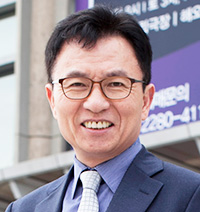
Ahn Ho-Sang, CEO of the National Theater of Korea
.jpg)
The National Theater of Korea (NTOK) is presenting a variety of performing arts, from Korean traditional music and "changgeuk" (Korean traditional opera) to ballet and modern dance.
Despite the status of a "national" theater, the venue struggled in the 1990s. But in recent years, the theater has enjoyed a renaissance with a wide range of performances, many of which sold out in minutes.
Ahn Ho-Sang, CEO of the National Theater, is seen as the agent of this change.
"I didn't see the renewal coming, so I hadn't prepared much for an extended term,” Ahn said in an interview with The Korea Times. “However, I was sorry not to round off some of the projects. Now I’m so glad that I have time to finish what I started."
He has been reappointed to the job and will serve until 2017.
Ahn said the theater had been behind the times and he wanted to make it more contemporary.
"The times are ever-changing, but the NTOK remained unchanged for a long time,” he said. “I have tried to go with the times."
One of Ahn’s major achievements was to reinforce the theater’s annual repertoire season, mostly with the NTOK’s three affiliated troupes ― the National Changgeuk Company of Korea, the National Dance Company of Korea and the National Orchestra of Korea.
"Korean traditional music, dance and changgeuk are not very popular and thus the troupes were in poor condition, with low budgets,” he said. “It also brought on the NTOK's identity crisis and resulted in the theater mostly renting its venues for commercial productions."
When he took the post, Ahn thought outside the box.
"The new generation enjoys cultural events such as music, ballet or opera,” Ahn said. “Older people might think of Korean traditional arts as old-fashioned, but the younger ones rather accept it as a part of our cultural diversity. But there are no troupes making truly contemporary Korean productions in Korea and I thought the NTOK could do it since we are a state-run organization."
Ahn made a few bold decisions for the theater ― he invited Finnish dancer Tero Saarinen to choreograph Korean dance and American director Andrei Serban to work on "changgeuk," or Korean traditional opera. His decisions paid off, attracting a wider audience, from hip theatergoers in their 20s to older people who relish the fresh twist on traditional arts.
As the NTOK's new productions gained attention in and out of the country, they received invitations from internationally acclaimed organizations. The National Dance Company of Korea's "Vortex," choreographed by Saarinen, was invited to the International Dance Festival Cannes and changgeuk "Madame Ong" also has eyes performances in France.
Ahn said the Korean tradition was ruptured in the midst of Japanese colonization (1910-1945) and rapid modernization afterwards.
"However, Korea is now much stabilized and people have become aware of our tradition with attempts to revive it,” Ahn said. “The renaissance of changgeuk could be a good example. The NTOK hopes to go hand in hand with this move, supporting our cherished culture."