Korea's best art collections

Choi Jeong-hwa’s “Alchemy” adds colorful twist to Mario Botta’s signature rotunda of Leeum, Samsung Museum of Art in Hannam-dong, Seoul. / Courtesy of Leeum
Leeum, Arario Museum feature wide range of international and local masterpieces
By Kwon Mee-yoo
Who collects what is a matter of great importance in contemporary art and people often wonder what is inside the top collectors’ storage.
Hong Ra-hee and Kim Chang-il, the two the most prominent art collectors in Korea, unveiled their proudest possessions to the public, which range from internationally renowned artists Damien Hirst and Tracey Emin to leading Korean artists Paik Nam-june and Lee U-fan, at their respective museums.
Leeum’s 10th anniversary
Leeum, Samsung Museum of Art celebrates its 10th anniversary with "Beyond and Between,” a special exhibition embracing all three buildings of the private art museum in Itaewon.
Hong, the director of Leeum and wife of Samsung Group chairman Lee Kun-hee, has been considered as the most influential figures in Korean art scene. Hong sets direction for the museum's collection and exhibition.

Yee Soo-kyung’s “Dark Side of the Moon” is displayed opposite “White Porcelain Jar” from 18th century Joseon in Leeum’s traditional art collection.
Leeum has one of the finest collections of ancient Korean art, inherited from Samsung founder Lee Byung-chul. The traditional art collection spans from prehistoric period to Joseon Kingdom (1392-1910), including famed Goryeo celadon and Buddhist paintings.
Sub-themed "Beyond Time," the museum placed matching contemporary artworks with the antiques. Byron Kim's color-field abstraction "Goryeo Green Glaze #1" and "Goryeo Green Glaze #2" are displayed with "Celadon Prunus Vase" from Goryeo Dynasty (918-1392), while Yee Soo-kyung's "Dark Side of the Moon" explores the quality of black-glazed ceramics opposite "White Porcelain Jar" from 18th century Joseon.
In the Buddhist art section, "Amitabha Triad" and "Ksitigarbha" paintings from Goryeo are matched with Mark Rothko's "Untitled" and Alberto Giacometti's sculpture "Diego Seated," questioning the religious belief transcending the mundane world.
The modern and contemporary collection is subtitled "Beyond Space" and has the most famous and the most expensive artworks on display, comparing and contrasting works of the master artists from the east and the west.
The beginning of Korean modern art is portrayed through works of Kim Whan-ki, Suh Se-ok and Lee Joong-seop, matched with Willem de Kooning's "Untitled XIV" and Clyfford Still's "Untitled 1956-H."
As for contemporary collection, Hirst's silver pill cabinet "Dance of Death" is replaced with "The Inescapable Truth," a dead dove and skull placed in a glass vitrine, which reminds of the terror of death. Gerhard Richter's "925-4 Strip" represents post-modernism by reinterpreting one of his previous paintings into color stripes.
The last section "Between Art and People" engages visitors in a more dynamic way. Visitors are invited to walk on a carpet embroidered with hair (Lee Se-kyung's "Hair on Carpet"), rest inside a large red and yellow biomorphic structure (Ernesto Neto's "Symbiointestubetime ― The Flavour Happens in a State of Being Flavour Flower Womb Domus") and experiment with sound (Janet Cardiff and George Bures Miller's "Experiment in F# Minor").
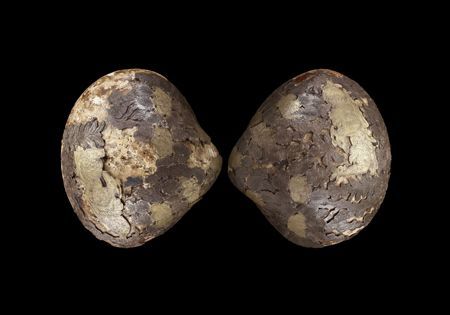
Leeum’s “Decorated Clams Shells” from the Unified Silla (668-935) inspired Moon Kyung-won and Jeon Joon-ho’s video installation “q0,” starring So Ji-sup.
"q0," a video piece created by Moon Kyung-won and Jeon Joon-ho, artistic duo to represent Korea in next year's Venice Biennale, highlights the exhibit. It revolves around "Decorated Clams Shells" from the Unified Silla ranging between the 8th and the 10th century, a collection of Leeum.
Starring top actors So Ji-sup and Jung Eun-chae, the video installation transcends time and space from an artisan crafting the clam shell and lovers in Joseon Kingdom to a shamanic woman and a futuristic lab in 2132, all centered the "Decorated Clams Shells."
The 20-minute film might seem to be an expensive promotional material of the museum and the idea of imagining a hidden story of a museum artifact is not very novel, but Moon and Jeon unraveled the tale in a sophisticated way, delving into the essence of art.
Some of the artworks shed new light on the architectural characteristics of the museum building. Choi Jeong-hwa graces Mario Botta's signature rotunda with "Alchemy." The colorful, shiny object hung from the apex of the rotunda to the bottom is in fact a row of chrome-plated plastic dishes and containers. Choi blurs the boundary between what is art and what is not and "Alchemy" adds a new twist to the spiral staircase.
The exhibit runs through Dec. 21. Admission is 10,000 won for adults. For more information, visit www.leeum.org or call (02) 2014-6901.
Architectural gem becomes museum

Arario Museum in Space breathed a new life into the architectural master piece by the late Kim Swoo-geun with Arario Group chairman Kim Chang-il’s art collection. / Courtesy of Arario Museum
When the Space building, a fine example of Korean modern architecture designed by the late Kim Swoo-geun (1931-1986), was put on the market earlier this year, who was going to be the new owner of the building was the talk of the town.
And it was Kim Chang-il, chairman of Arario Group, to come forward and purchase the iconic building for 15 billion won ($14.6 million). He said he would use the building as an art museum to display his prized collection worth some 150 billion won.
Kim, 63, is a self-made multimillionaire who is an entrepreneur, collector, gallerist and artist. He has spent decades building a collection of contemporary art since 1981 and now his collection accumulates up to 3,700 pieces, ranging from the world's most expensive artists to emerging Asian talents.
After months of preparation, Arario Museum in Space opened on Sept. 1 with inaugural exhibit titled “Really?” Kim carefully picked each artwork corresponding to the space, transforming the office building to a unique trove of art. The artworks do not overpower the architectural charm with bold use of black bricks and glass, but complement the building with artistic presentation.

Pioneer of video art Paik Nam-june’s artworks are on display at Arario Museum in Space.
The list of artists on exhibit at Arario Museum in Space is equivalent to that of an art textbook, including Andy Warhol, Kohei Nawa, Cindy Sherman and Barbara Kruger. Paik Nam-june’s "Nomad," a mini bus padded with monitors and a big antenna, and "TV Cello" found home on the second floor with large windows. The museum also has one of the three editions of Marc Quinn’s “Self,” a head sculpture made of blood and must be kept frozen.
The building was designated as a cultural heritage and the Arario Museum could not alter the structure. Even the wall shelves for office and bathrooms remained as they were and matching artworks found their way to the building. Douglas Gordon's video "The Making of Monster" is displayed over a hand basin and Gavin Turk's self-portrait sculpture stands in a moldy attic which was a night duty room. Gwon O-sang's "The Sculpture II," a bronze sculpture in the shape of a super expensive sports car, is displayed at a former garage space.
Pierre Huyghe's light box installation "L’Expedition scintillante, Act II" on the basement floor is not-to-miss. Maximizing the atmosphere of the room originally used as a small theater, the art of light and smoke accompanied with Erik Satie's "Gymnopedies" makes the viewer lapse into ecstatic state.
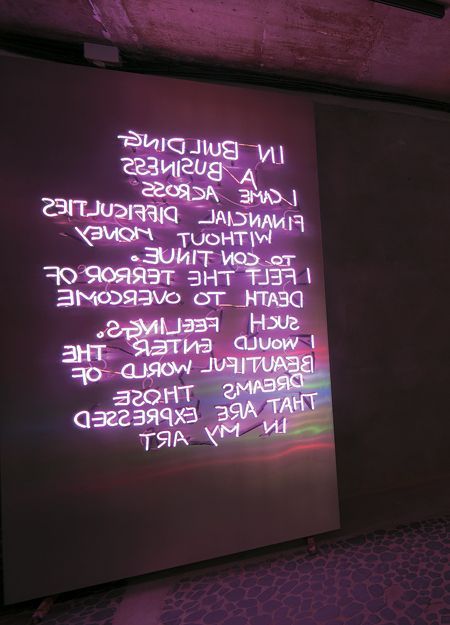
CI Kim’s neon artwork portrays Arario chairman Kim Chang-il’s life as an entrepreneur, collector and artist.
The best part of being an artist, art collector and museum director at the same time is that Kim's work is displayed with that of Quinn and Hirst. At the last hall of the museum, visitors will face CI Kim’s artwork, including a mirror writing neon artwork which summarizes of his life’s venture to open a museum. CI Kim is the nom de guerre of Arario founder Kim.
The museum opens year round. Admission is 12,000 won for adults. For more information, visit www.arariomuseum.com or call (02) 736-5700.