Nerds and geeks come out to play

Takashi Murakami poses with his work, “Miss ko2,” at the Plateau, Samsung Museum of Art, in downtown Seoul. / Courtesy of Plateau
Murakami’s pop art exhibition a tribute to Japan’s quirky ‘otaku’ culture
By Kwon Mee-yoo
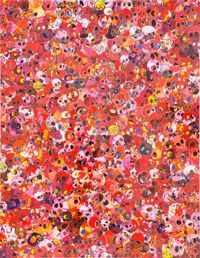
“MPGMP, 1960→2011” / Courtesy of Takashi Murakami and Kaikai Kiki
Takashi Murakami’s “Takashi in Superflat Wonderland” exhibition is an exercise in geeky glory.
Visitors are greeted by a life-size figure of a blonde, strikingly voluptuous woman dressed as a Victorian maid in a world where Victorian maids are required to be stuck in their childhood skirts.
There is a sculpture of flowers, colorful but flat as plates. There are three different paintings devoted to cartoon skulls.
Thirty-nine of the Japanese pop artist’s works are on display at Plateau, Samsung Museum of Art in Seoul in a tribute to the Japanese subculture of “otaku.”
Otaku was once a derogatory term used to describe a person who, in the obscurity of their bedrooms, becomes so consumed by a certain subject they risk becoming a shut-in.
Of course, these are the same people that have been fueling Japan’s enormous market for manga (comic books), anime (animated cartoons) and video games. And Murakami believes that this culture of obsession is acquiring newfound coolness in the age of social media.
.jpg?w=728)
“Superflat Flowers” / Courtesy of Takashi Murakami and Kaikai Kiki
Meeting with reporters in Seoul, Murakami said that watching the anime, “Galaxy Express 999,” as a teenager was a life-altering experience. That passion for anime continues to influence his art.
The woman in a short skirt and apron, titled “Miss Ko2,” was inspired by a waitresses at Japanese restaurant chain, Anna Miller’s. Miss Ko2 is a cultural product in Japan, where similar figurines are sold at toy and accessory shops around Tokyo.
“Some people criticize me for combining the superficial part of Japanese subculture with Western art techniques and exporting them as a form. But I believe when culture travels to another country, it acquires a new meaning and also provides new value to that culture,” Murakami said.
While Miss Ko2 is certainly an eyeball magnet, the exhibition also features many of Murakami’s colorful and quirky paintings featuring his famous manga characters, “Mr. DOB” and “Kaikai & Kiki.”
Murakami also shows a more poignant side. In “Homage to Yves Klein,” a set of three paintings with skulls, the artist portrays his fear of death triggered by Japan’s tsunami, earthquake and nuclear crisis of 2011.
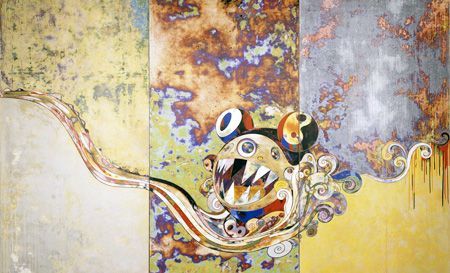
“727-727” / Courtesy of Takashi Murakami and Kaikai Kiki
His “727-727” looks like an old Japanese painting at first, only that Murakami’s Mr. DOB is lurking in the background showing his sharp teeth. Murakami said he applied layers of acrylic paint over and scraped it to create the effect of an old painting.
“Tan Tan Bo: Encountering a Flare He Can See Through His Closed Eye” reflects Murakami’s interest in social media services and how it reshapes the way people interact.
In the painting, “Tan Tan Bo,” a variation of Mr. DOB, vomits after what seems to be a large meal, as if he is spitting out a new world after swallowing the old one.
Murakami is an avid user of Twitter (@Takashipom, @Takashipom_En) and Instagram (@takashipom).
“Social media feeds the ego and individualism. I am always thinking about whether artists must do anything differently to adjust to this era,” Murakami said.
“It seems that social media is allowing people to access a larger amount of information but also overwhelming them with it.”
Murakami blurs the boundaries between high art and commercialism by exhibiting artworks next to the products he intends to sell. Plush dolls of Mr. DOB and Kaikai Kiki are displayed at the gallery, along with the sculptures of Kaikai & Kiki in front of French sculptor August Rodin’s “The Gates of Hell,” a permanent at Plateau.
This is Murakami’s way to survive in the harsh environment for an artist in Japan, where collectors are hampered by a tough economy, but he does not think this should be a goal for every artist.
“In an educated society where artists and creators are paid for their work, young artists can make abstract works and still make living from it,” he said.
“Takashi in Superflat Wonderland” runs through Dec. 8. Admission is 5,000 won for adults and 4,000 won for students. For more information, visit www.plateau.or.kr or call 1577-7595.