Come as you weren't

Kim Sun-young as Aerang in “Sweet, Come to Me Stealthily”
Technology gives Korea's oldest musical a facelift
By Kwon Mee-yoo
After several years of explosive growth, Korea’s musical market stands as one of Asia’s biggest. Giving the country’s oldest modern musical a 21st-century facelift was a predictable process in self-celebration.
Deciding to bring back “Sweet, Come to Me Stealthily,” first staged in 1966, was an ambitious decision by its current producers CJ E&M and Musical Heaven, as the musical comedy had retired to little fanfare in 1996.
Still, they believed they could do better with the story of a Joseon Kingdom (1392-1910) era “gisaeng” (female entertainer) attempting to seduce a man who wants to stay faithful to his late wife, based on the folk novel “Baebijang-jeon.”
Painstaking efforts were invested to make “Sweet,” currently being staged at the CJ Towol Theater of the Seoul Arts Center, a more fashionable theatrical product. Broadway veteran Gustavo Zajac was brought in to co-direct the musical with Kim Min-jung.
State-of-the-art technology was used in the stage systems and lighting effects, and props offer a magical version of Jeju Island, which is where the story is based. The newly-designed costumes are clearly a work of art as well.
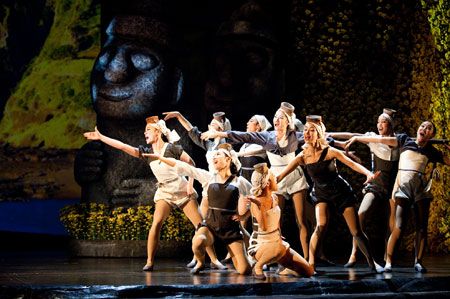
Designer Yoo Mi-yang’s costumes, which had to be stylish in contemporary terms but also a genuine reflection of Jeju’s traditional culture and nature, are clearly one of the musical’s strengths. / Courtesy of CJ E&M
What stayed the same, however, are the songs written by Choi Chang-kwon for the original version in 1966, although a 13-piece orchestra gives the music more drama and depth.
Choi’s main theme song, “Sweet, Come to Me Stealthily,” which the musical is named after, serves as a theatrical teleprompter indicating plot changes. It plays first when Aerang the gisaeng begins to seduce her indecisive customer, Bae, and again when Bae has a change of heart and confesses his love for Aerang.
Baebijang-jeon, of which the earliest records are found in an 18th-century document, has several different versions.
Some serve as a social commentary ridiculing Joseon’s class system and aristocrats, with the story concluding as a plank pulled by Aerang and Jeju residents on Bae. Others provide a “happy” ending, with Bae named a regional officer and recommitting himself to his family, and Aerang settling back to her place as well.
In going for the latter version, the current producers attempted a more straightforward romantic comedy than a satirical piece.
The musical begins with the arrival of a new magistrate in Jeju. He looks for a giseang to entertain Bae, one of his lower officers, who maintains a puritanical life out of loyalty to his late wife. Aerang is glad to do so and, after some early resistance, an indecisive Bae dares to secretly visit her at night.
The simplicity and predictability of the plot, perhaps inevitable for any work based on a folktale, makes “Sweet” more of a visual exercise than a dramatic one.
The recreation of Jeju’s famous yellow flower fields is stunning. A three-dimensional “dolhareubang” stone statue that smiles, cries, winks and sticks out its tongue also effectively strengthens the humor of the plot.
It could be said that the costumes, which had to be stylish in contemporary terms but also a genuine reflection of Jeju’s traditional culture and nature, are the show’s biggest achievement. Designer Yoo Mi-yang said she needed a three-day trip to the island to get the inspiration she needed.
Her giseang costumes are the most extravagant. Layers of exquisite colors and patterns and bouffant shapes immediately attract the gaze of the audience.
“It all began in Jeju, where the show is set,” Yoo said in a telephone conversation, adding that she was also inspired by Joseon era painter Shin Yun-bok’s “Portrait of a Beauty.”
“There is this aesthetic value for Korean gisaeng. They wear fancy, large wigs, jackets emphasizing narrow shoulders and bouffant skirts. I tried to maintain this aesthetic sense on the costumes.”
Bold black and red used for Aerang’s costume is another of Yoo’s efforts to give a modern twist. She mixed Korean traditional fabric with Western fabric to make the costume more sophisticated.
Yoo designed a pattern of “dancheong,” the spectrum of color found in traditional Korean buildings, on the shoulder of Bae’s costume to symbolize his social status.
“When I visited the residence of the Joseon-era regional magistrate left in Jeju, I was fascinated by the dancheong pattern and translated it onto the costume to give a sense of belonging,” she said.
The magistrate’s clothes are a fun mix-and-match of Korean and Western design. Overall the costume looks like a hanbok, but it has a Western-style collar and fur on the lapel. He even wears sunglasses, which existed in Joseon in the 19th century.
The suits of the “haenyeo,” or female divers, are in beige and navy, which is very similar to the Korean traditional clothing. “The original combination of color and shape were quite modern, so I just altered the pattern a little bit for more comfortable movements onstage,” Yoo said.
Actress Kim Sun-young plays Aerang and Choi Jae-woong and Hong Kwang-ho alternate the role of Bae. Veteran actors Song Young-chang and Park Chul-ho play the Jeju magistrate.
“Sweet, Come to Me Stealthily” runs through March 31. Tickets cost from 44,000 to 99,000 won. For more information, visit sweetcometome.interest.me or call 1588-0688.