Hanbok with whimsical twist
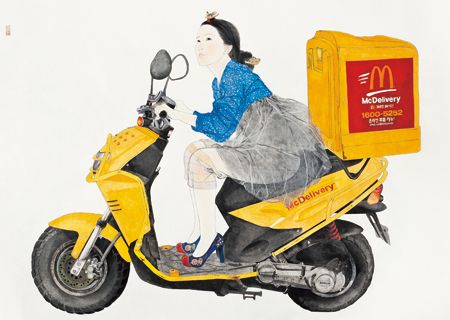
Using hanji, or traditional Korean paper, Kim Hyun-jung’s works represent hanbok in an unsual setting. / Courtesy of Kim Hyun-jung
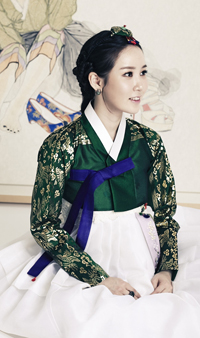
Artist Kim Hyun-jung is holding an exhibition at the Gana Insa Art Center next month. / Courtesy of Privilege
By Rachel Sang-hee Han
It’s still hard to find a non-Asian living outside of Asia who can correctly distinguish a Korean hanbok from a Japanese kimono. Instead of making nonsensical phrases and songs ranted and sung by celebrities, shedding light on the more down-to-earth elements may help, or at least stir some interest among the general public. This is why artist Kim Hyun-jung could be on the right track.
Kim focuses on oriental paintings of herself dressed in hanbok. But she’s not walking along traditional palaces or sipping tea in a temple. Her alter ego roams around the streets of Seoul on rollerblades, goes shopping or struggles with makeup before a night out.
“Hanbok is a very traditional element, but the daily lives portrayed in my work is also something very Korean. I don’t think the hanbok element makes it the ‘Korean wave’ of Korean art,” Kim said in an interview.
For her, hanbok was used as a tool to portray her work and passion. And it turned out to be a very interesting mix of tradition and the whimsical lives of young Koreans.
“I was mesmerized by Korean artist Kim Hong-do’s wit, keen eye of observation and his delicate brush strokes,” Kim said, referring to the famous Korean artist who is also known for his witty portrayals of Koreans during the Joseon Kingdom (1392-1910).
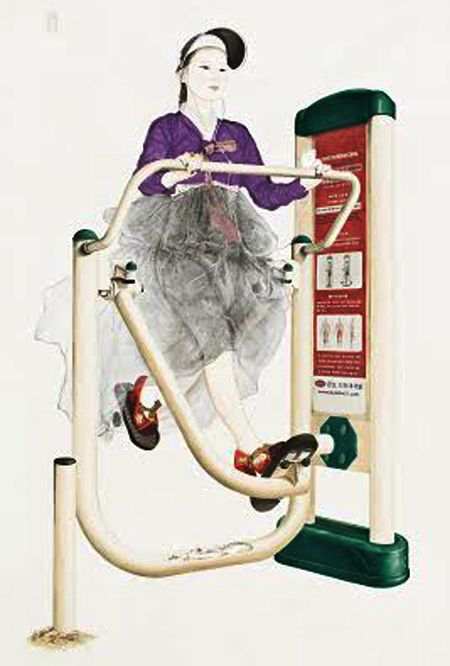
Using hanji, or traditional Korean paper, Kim Hyun-jung’s works represent hanbok in an unsual setting. / Courtesy of Kim Hyun-jung
Utilizing traditional Korean paper
The final results of Kim’s work are flowing and delicate but the process is quite complicated and time consuming. First comes the nude drawing of her alter ego, slowly adding details such as her hair and hair accessories. Then Kim carefully adds small pieces of hanji, or traditional Korean paper, to create the texture and flowing appearance of the hanbok.
“It’s difficult to show the crunchiness of the hanbok material, not to mention the curvy designs. I start with a nude because I can show the sheer texture of the hanbok in the end. I went through so many trial and errors, but ended up with this technique. It does take a lot more time than simply drawing the hanbok with a brush, but this process allows the painting to last longer the way it was intended to be,” Kim said.
Her upcoming exhibition “Feign Olympic” will feature herself wearing hanbok, yet exercising in the park like any other Korean “ajumma,” or a middle-aged lady. “After spending long hours in the studio working, I went out to the park to get some exercise and found myself working out with the ladies from my neighborhood. It felt like the Olympic Games. Everyone was doing their own thing, but in harmony. I wanted to portray the friendliness and familiarity of daily workouts, and that’s what this exhibition will be about.”
Kim sometimes wears hanbok while she works on her paintings. She sketched herself wearing a hanbok through a mirror when she first started her series. In fact, she still dons the colorful dress during interviews and public appearances.
“Of course, it was uncomfortable at first. But at the same time I felt sad it’s not worn enough by Koreans and also by the fact that it was being forgotten. But I have learned so much about the beauty and history of it, not to mention the endless possibilities. The embroideries, the accessories, the colors! It would be a great honor if people who see my work would feel the same way — if not now, maybe someday in the future.”
Like many young Koreans today, Kim was always sensitive to others’ attention, perspective and beliefs from an early age. Instead of following her own dreams, she found herself living someone else’s dream, just because everyone was telling her that was the right path. She studied art at one of the most prestigious universities in Korea, Seoul National University, and entered various art shows and won competitions. She didn’t have any doubts, until she finally realized it was time to do what she really wanted.
“I simply wanted to portray myself doing daily activities, no strings attached. I wanted to find myself and I wanted to do that through oriental paintings.”
Kim’s interest in bringing mundane activities to the canvas is closely linked to her belief in bringing art to a more practical, and friendlier, level. Like Japanese artist Takashi Murakami who collaborated with fashion powerhouse Louis Vuitton, she believes art can, and should, be integrated with other businesses.
“I want to art to become like music, a part of people’s lives. I want to be a part of that process in bringing art into the smallest parts of everyone’s lives.”
Kim’s exhibition will be held from June 18-30 at the Gana Insa Art Center. For more information, visit www.insaartcenter.com.
Rachel Sang-hee Han is a former staff reporter at The Korea Times and former editor at CNN Travel. She lives in Germany and runs a travel blog at www.rachelsanghee.com.