History: mixing facts, fantasy
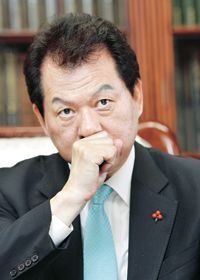
Education Minister Seo Nam-soo is spearheading government efforts to rewrite history textbooks at schools to reflect political views. / Korea Times photo by Shim Hyun-chul
By Kim Tong-hyung
Battling over what to put in schoolbooks, it seems that the Park Geun-hye government has gone from trying to control the narratives of history to possibly inventing them.
The Education Ministry has become a magnet of controversy in the past year for backing a disputed high school history book authored by right-wing scholars and pushing to overhaul the process of writing textbooks with the aim of dictating the content.
The ministry’s latest move, however, reaches a new level in absurdity. Meeting with a group of historians last month, Education Minister Seo Nam-soo said that the ministry is considering requiring textbook publishers to rewrite their chapters on ancient Korean history to incorporate “non-mainstream” views.
Such views may include arguments from the few but feverish defenders of “Hwandan Gogi,” a collection of texts on ancient history that is widely considered modern forgery, according to people close to the discussions.
Hwandan Gogi is comprised of four books (Samseonggi, Dangun Segi, Bukbuyeogi and Taebaek Ilsa) that combine to argue that a series of ancient Korean kingdoms ruled the broad territory that is now mainland China.
The books — rich with stories about great kings and soldiers — have inspired many works in fantasy novels, movies and video games. If these stories are ever allowed to reach classrooms, this would mark the pivotal moment when history submerged irrevocably into politics, historians argue.
The ministry’s direction is clearly being shaped by Park’s Saenuri Party, which continues to assert that schoolbooks are skewed too far to the left. Mainstream scholars have reacted angrily to such claims, accusing conservative politicians of attempting to replace history with glorified fiction to serve their right-wing brand of nationalism.
Suh’s meeting with historians came after the ministry announced it will spend 1 billion won more this year to finance state-run institutions researching Korean history before the Three Kingdoms’ Period (57-668), a realm of study that had been held back by the lack of historical evidence. The Academy of Korean Studies (AKS) had entered into a three-year, 2 billion won research project on this era in October.
It remains to be seen whether the ministry can avoid an overlap in investment, considering the limitations researchers face. There are fears that the extra money will benefit scholars whose works are based more on nationalism than science.
“The ministry’s opinion was that textbooks should include a more diverse set of views. They claimed it would be acceptable to introduce eccentric theories on ancient history when it’s written in a ‘there are people who think as such’ sort of way,” said one of the historians who attended the meeting.
“They claimed that nothing was conclusive yet, but I worry that the government already determined the way it wants to go. I wonder whether the government officials will end up using their resources on non-professional historians who suit their taste instead of supporting real research. Billions of won worth of ‘blind money’ is in danger of evaporating.”
A ministry official stressed that no decision has been made as to the changes in textbooks. The meeting was set up because Seo simply wanted to hear what historians thought, he said.
Inventing narratives
The origin of Hwandan Gogi is unclear. The only existing copy is Yi Yu-rip’s transcription published in 1979, although Yi claimed in the introduction that the texts were first “compiled” in 1911 by a person named Gye Yeon-su.
Most historians in Korea and Japan consider Hwandan Gogi to have been created in recent times — there are words from modern language, the content differs greatly from established historical theories, and the texts were unknown before Yi published his book.
While the supporters of Hwandan Gogi represent a minority in academic circles, there are reasons to think they have a much more authoritative voice in President Park’s inner circle.
Kim Jang-soo, chief of the National Security Office at Cheong Wa Dae, is an advisor for the Dhamul Research Center, which perhaps is the most powerful among the organizations that support Hwandan Gogi studies.
Kim is one of many members of the military elite, sharing Korea Military Academy ties, who hold executive posts at Dhamul, which frequently manages seminars and employee training programs for large companies such as Samsung, LG and POSCO.
The connection between Korean military officials and Hwandan Gogi supporters is deep. Yi’s book failed to register with the public’s consciousness until the 1980s, when his writing began to be highlighted in a magazine owned by Park Chang-am.
Park, of course, was one of the army generals who assisted the 1961 military coup led by Park Chung-hee, the slain dictator and father of the current president.
So a few historian feathers were ruffled when President Park said, “A nation is like a body to the man and history is like the soul,” a quote from Hwandan Gogi, in her Aug. 15 Liberation Day address last year. Park had also invited researchers from Dhamul to her camp during the 2012 presidential elections to participate in writing her national security-related promises.
Leaning right
Schoolbooks began leaning further toward the right during the previous Lee Myung-bak government, which empowered academics who were part of the conservative “New Right” movement, a loose association of people from different backgrounds close to the Lee administration. Under the administration of Park, it seems that “leaning right” could become the ideological stance in all schoolbooks.
In January, the ministry announced plans to establish a new unit within his ministry dedicated to editing textbooks approved for middle and high schools. Historians are concerned that this would effectively mean schoolbooks will be written by public servants again.
State-authored textbooks had been used for three decades until the early 2000s, first introduced in 1974 under the senior Park.
The country has since converted to a state-approval system — with history books published by private companies and evaluated by the National Institute of Korean History (NIKH) — to encourage more diversity in narratives.
The ministry has shown an urgency to strengthen the government influence in textbooks after schools rejected a disputed high school history book written by right-wing scholars close to the government.
The book released by Kyohak Publishing and approved last year by NIHK, has been criticized by mainstream historians for allegedly biased views, including defensive arguments about the military governments of the 1960s, ‘70s and ‘80s, and factual errors.
None of the country’s 2,300 high schools had picked the book for use in their classrooms, with the small number of schools that previously did backing out after resistance from parents of students and civic groups.
In a recent interview with the Korea Times, Lee Bae-yong, the president of the AKS, defended the need for changes in textbooks, claiming that the purpose of teaching history should be cultivating a “nationalistic pride” in students.
Historians disagree.
“There is a dramatic difference between representing a diversity of opinions in textbooks and disregarding objectivity entirely,” said Kim Young-ha, a professor of ancient Korean history at Sungkyunkwan University.
“Perhaps, there is a political urge to respond to the movements in Japan and China, where history books are being rewritten to reflect political views, but do we really want to lower ourselves to that level?
“The political intentions are predictable, but I am also worried that, as Korea becomes a more difficult place to live, there is a demand for a glorified narrative of history among the people to compensate for their hard realities. If we begin to invent stories for history books, the gap between those stories and the realities will only grow, and students will end up being more disappointed.”