Canned brilliance?

“Rice with Spam and fermented oysters” at Cafe imA, a trendy restaurant in Gwanghwamun, downtown Seoul.
The deal with Koreans and Spam
.jpg)
By Kim Young-jin
Walk into any market in Korea and one will find ample shelf space reserved for Spam, the canned meat that is as well-known for being a punch-line in jokes as being a convenient, if salty, food.
But if you’re expecting those iconic blue-and-yellow cans to be as cheap as they would be in the United States, where they originated, think again: a 340-gram can of the non-perishable stuff costs upwards of 6,800 won ($6.10).
That’s largely because Spam is not the outlier here that it is elsewhere. Instead, it is a staple with a history that dates back to the 1950-53 Korean War, a product that can be found in cupboards as well as pricey restaurants.
In Korea, as with other places with a history of a U.S. military presence, such as Hawaii, Spam doesn’t carry the reputation of a survival food slathered in gelatinous goo. Koreans have put their own spin on Spam — so much so that it is often given as a gift during holidays.
A cultish following worldwide, as well as wide popularity in certain areas, have brought some new attention to the maligned product, which chef Gordon Ramsey once described as “disgusting (expletive) Spam.” The annual Spam Jam festival in Hawaii has prompted some to wonder whether if it’s time to give the meat another chance.
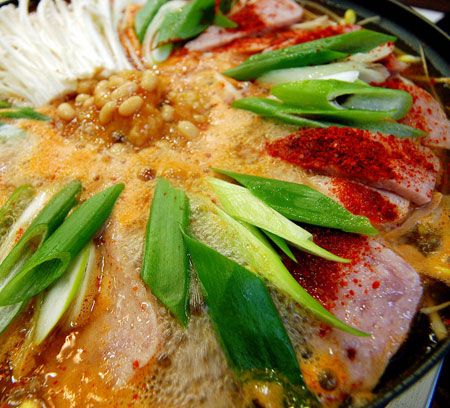
Spam is a popular item in Korean food like “budae jjigae.’’
A Korean office worker in Seoul in his thirties, identified as Tony, said Spam is convenient and goes with other staples such as rice, gim (dried seaweed strips) and kimchi. He usually fries it just long enough so that it is crisp on the outside, but admitted this isn’t always the case.
“It’s already cooked, so sometimes I eat it straight out of the can,” he said. “For instance, if I crack open a bottle of wine and need a snack to go with it.”
“SPAM” was created by Hormel Foods in Minnesota in 1937 and was intended as a higher-quality alternative to other tinned meat. It didn’t find its niche until WWII, when the product was distributed to U.S. soldiers.
The conveniently-sized cans made their way to military bases in Asia and the surplus began trickling to native populations, according to Sylvia Shin, a representative of CJ Cheiljedang, which has manufactured and distributed Spam in Korea since the early 1980s.
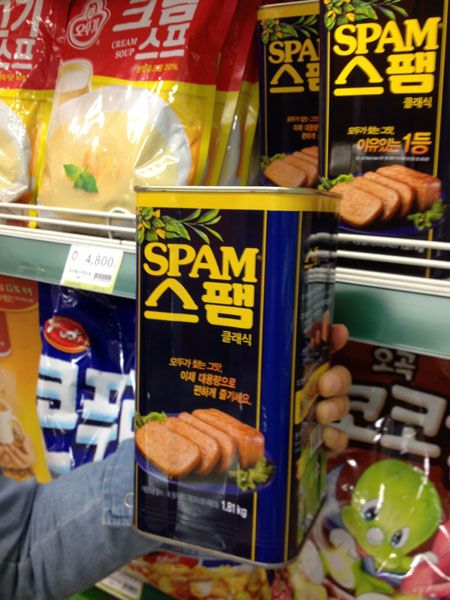
In some Korean stores, Spam is available in huge, 1.8-kilogram cans.
When war and famine struck the peninsula, protein sources became scarce. Military surplus foods such as Spam, hot dogs, cheese and canned beans became sought-after treats. All the ingredients were used, along with kimchi, in the still-popular stew “budae jjigae.”
After the war, the Spam was smuggled into the Korean market, along with coffee, gum, chocolate milk and other products. In 1987, CJ Corp bought the rights from Hormel and began producing its own version of Spam. The Korean product is more expensive than its U.S. counterpart because it uses “more qualified” pork.
Shin said the ingredients are slightly different in the Korean product to make it softer and less chewy, which is how it is preferred here.
Elsewhere, Spam became the brunt of jokes about things unwanted. The term “Spam,” used to describe junk email, is said to have been derived from a sketch by the British comedy group Monty Python. In the skit, two customers in a cafe try to order breakfast from a menu that includes Spam in almost every dish.
Not so here. Popular television commercials market Spam as simple dish to eat as a meal with rice and it is also sold in ornate gift sets during Chuseok, the traditional Thanksgiving holiday.
The marketing of Spam as a premium item can be jarring to those not used to the sight.
“When people see Spam being sold as gift sets its hilarious,” said a foreign resident originally from New Zealand. “It’s thought of as an over-processed food that’s eaten out of necessity.”
Popular at-home recipes with Spam include fried rice and kimbap rolls. It is also deep fried, or chopped and used in salads. Fried with a coating of egg, it often appears as “banchan,” or side dish.
Restaurants such as the popular Cafe imA in downtown Seoul serve rice plates with Spam, sausages, cole slaw and a sunny-side-up egg. Noodle restaurant Cheiljemyunso serves musubi, a favorite in Hawaii comprised of grilled Spam on a block of rice. Other restaurants serve Spam “deop-bap,” a rice bowl served with stir-fried chunks of the cubed meat. Budae jjigae restaurants are ubiquitous across the country.
Fans of Spam raise the question of whether its reputation as a “mystery meat” is deserved, comparing its relatively short list of ingredients to those of hot dogs or sausages. The U.S. “SPAM Classic” contains pork (shoulder and ham), salt, water, modified potato starch, sugar and sodium nitrite.
This is not to say that Spam is necessarily the healthiest option: a 56.7 gram serving contains 16 grams of fat, 6 grams of saturated fat and 790 milligrams of sodium.
Lee, an office worker in Seoul, said many Koreans have at least a can of Spam in their houses. But she limits her intake.
“I don’t normally keep it around because I think it is high in sodium. My husband really likes it and I don’t want to encourage him,” she said. But she added, “I do like it.”