A poignant immigrant song

Song Sheng-wan, a second-generation ethnic Chinese resident, fries wontons at his restaurant Ya Rae Hyang in Myeong-dong, Seoul.
Restaurants tell complex stories about ethnic Chinese in Korea
By Kim Young-jin, Baek Byung-yeul
On a small street in Myeong-dong, in downtown Seoul, one can find some of the city’s oldest Chinese restaurants ㅡ a welcome culinary destination in a country without a bustling Chinatown to speak of.
Clustered next to the Korea Post Building, the fading signs of these establishments advertise a wide range of cuisine from localized favorites such as noodles with black bean sauce (“jajangmyeon”) and sweet-and-sour pork (“tangsuyuk”) to more traditional offerings such as buns, dumplings and stir-fried greens.
Most of the restaurants have been passed down for generations by their ethnic Chinese (“hwagyo”) owners, as have others around the capital. Known for their food, these establishments are also symbols of perseverance for the hwagyo community, which scholars say has long existed as an “invisible” minority.
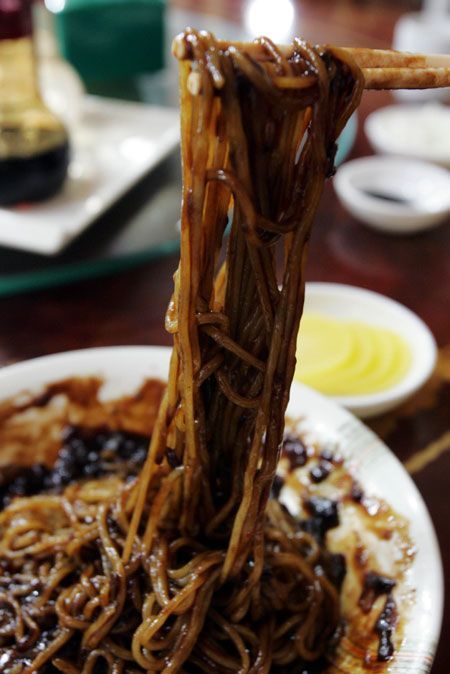
"Jajangmyeon,” or noodles with black bean sauce.
The plight of the country’s some 21,500 hwagyo remains little-known despite the country’s recent efforts to improve conditions for minorities, many of who feel they are in the shadows of a homogenous society.
Song Sheng-wan, a second-generation ethnic Chinese resident who opened a restaurant on the street in 2011, said cooking was the only viable profession after his family fled from Shandong Province during the Chinese Civil War (1927-50). Like his father, he took up the profession and eventually became a cook at the five-star Shilla Hotel.
“In the past, there were many hardships for hwagyo,” he said. “Koreans didn’t want us to join their companies. The restaurant business was the only option.
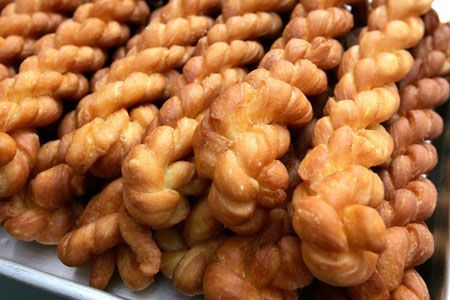
Fried dough
“At the time, there was no one who could cook Chinese food better than hwagyo. We taught the Korean chefs at the hotel.”
The restaurants on this street, located near the former Chinese embassy, include Hyangmi, famous for its succulent beef dumplings and spicy seafood noodle soup. Gaewha, passed down through three generations, is said to have some of the country’s best jajangmyeon. For the most part, the owners of these restaurants are reluctant to discuss their past.
Due to a turbulent history, Koreans long kept Chinese from immigrating here. In the 1880s however, China dispatched troops to put down a military revolt in Korea, and merchants followed in their footsteps. This set off a wave of immigration, especially from war-torn Shandong.
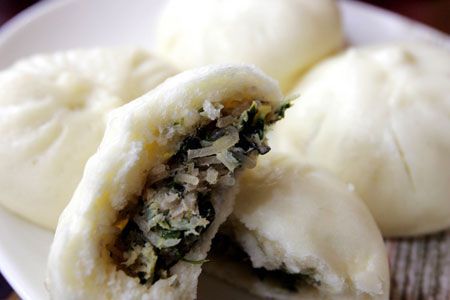
Dumplings
The migration continued during the Japanese occupation of the peninsula and, by 1937, as many as 65,000 ethnic Chinese had settled, many running businesses in Incheon and Seoul. Faced with difficult conditions, the number has fallen. Most of the hwagyo today maintain Taiwanese nationality.
Incheon is also home to a host of hwagyo-operated restaurants, though due to low numbers of Chinese residents in the port city, its Chinatown has yet to take off.
One restaurant owner in Yeonhui, a neighborhood in western Seoul known for its large population of ethnic Chinese, bristled when asked about her past.
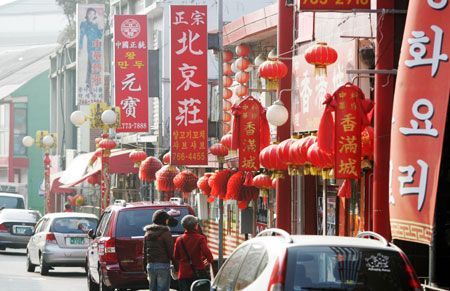
Incheon is home to a host of hwagyo-operated restaurants, congested around its Chinatown. / Korea Times photos by Kim Young-jin, Shim Hyun-chul
“What history? My family had to flee for safety. And we couldn’t go back after the Communist Party dominated the mainland,” she said, asking not to be named. “We’ve been running this restaurant for 40 years.”
Her 40-year-old son, identified as Yin, added that many hwagyo feel “rootless” due to their political circumstances.
“We have no concept of country or nationality, although we hold Taiwanese passports,” he said. “We are treated like foreigners here. When we go to mainland China, they regard us as Taiwanese. People in Taiwan think we are Korean.”
Perhaps the most difficult period, hwagyo say, came under the military dictatorship of Park Chung-hee, who restricted Chinese business activities and implemented a currency reform that excluded Chinese savings. Observers say Park’s negative view may have stemmed from a fear that they would disrupt the economy.
Such policies were accompanied by social stigmatization: Song, the restaurateur, recalls being bullied as a school boy because of his ethnicity. Voting rights were withheld until 2005.
Some say the situation improved since 1992, when normalized relations between Seoul and Beijing increased the visibility of Chinese in Korea.
“There’s not as much discrimination anymore,” said Chen Cheng-fu, a secretary of the Chinese Resident’s Association in Seoul. “But in the past, like 20-something years ago, when I went to a coffee shop with my hwagyo friends, we tried to speak quietly, in whispers.”
Despite improvements, some say annoyances remain, such as having to apply for travel visas even when their Korean counterparts do not have to, including when traveling to Taiwan.
As far as the efforts to improve the awareness of multiculturalism, some hwagyo feel they aren’t a big part of the conversation because they have been living and marrying in Korea for decades.
“Although hwagyo have been part of ‘multicultural’ families for a long time, the media doesn’t count us when they talk about the multicultural issue,” said Chen of the Chinese residents’ association. “Maybe Koreans already treat us as Korean.”
Yin, the restaurant worker added: “The difference between us and what is currently considered a ‘multicultural family’ is that we don’t have a much different lifestyle to Koreans.”