Movable objects

Performances from “Dance Unfolds Theater” / Courtesy of LG Arts Center
How experimental artists are breathing new life into architecture
By Kwon Mee-yoo
Buildings are immovable chunks of concrete, steel and glass. A new school of imaginative artists are attempting to do something about that.
Choreographers added vibrancy and otherworldly color to every corner of the LG Arts Center in southern Seoul, even between steel columns, tubes and pipes, in a recent experimental performance.
Meanwhile, the art world seems to be applying new meaning to the creations of the late maverick architect Chung Guyon, who died in 2011 after a bout with cancer. Chung talked as if his buildings were living organisms that breathed and evolved with their surroundings.
Dancing between the pipes
The LG Arts Center last week hosted an interesting collaboration between the Jung Young-doo’s Doo Dance Theater and the Society of Architecture (SOA), which was aimed at experimenting with choreography in spaces never attempted in before.
Performing arts have always been an interaction between the stage and audience. In “Dance Unfolds Theater,” the audience were taken to previously off-limits areas like loading docks and machinery rooms.
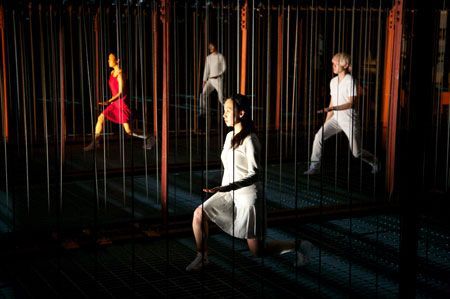
The performance, which was a one-off but was likely preceding a series of similar collaborations in the future, was only open to 30 people at a time and the tickets were sold out in 10 minutes.
The usual customer experience at the theater starts at the ticket box before moving on to the lobby, lounge and seats. Dance Unfolds Theater showed no regard for this order.
The performance began at the rehearsal room — another space the audience would find unfamiliar — with SOA architects Kang Ye-rin and Lee Chi-hoon offered a short explanation on the building’s structures and how they would be used for the performance. The LG Arts Center offering vast room for experiment because it’s basically a 38-story office tower with a massive theater in the bottom floor, they explained.
The performance of dancers from the Doo Dance Theater began in the lobby with office workers and business visitors passing right by them.
Three dancers moved across the lobby gracefully before interlocking their bodies in different shapes. Then they rolled out and left the lobby on the massive escalator in the hallway. The audience was led to the building’s loading dock, where another performance — assisted by glowing lights and unusual props — awaited them.
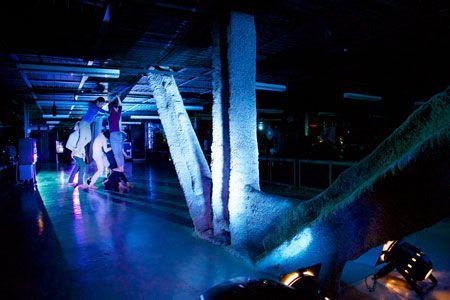
Then they took a freight elevator and got off at a floor with a small dark corridor that leads to the space behind the stage, where performances usually take place.
The next performance was on the grid deck above the stage and machine room, which required another ride in a small elevator, where the dancers presented another set of moves.
The two-hour performance did finish in a familiar place for the audience — the Proscenium Theater.
Though “Dance Unfolds Theater” was a one-off, LG Arts Center said it will continue to experiment with site-specific choreography works.
Remembering Chung Guyon
One of Chung’s most famous works is the Muae Building in Daehangno, the downtown Seoul art and leisure district, a beige-colored, asymmetrical building that is nestled in a cluster of small theaters.
While the building’s fading colors show the passing of time, the uniqueness of its structure still seems fresh, with the two, cone-shaped officer towers connected by a glass-covered bridge.
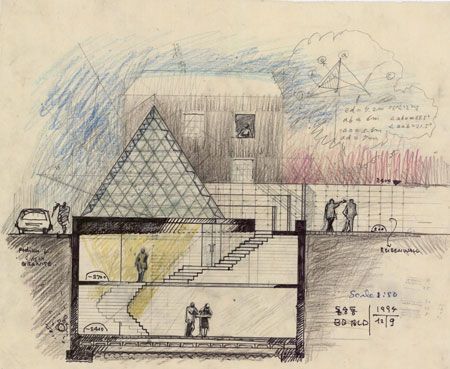
Chung Guyon’s original sketch for the Muae Building in Daehangno, Seoul. / Courtesy of NMOCA
Regrettably, this aging architectural gem will soon be reduced to a memory. The building, built 16 years ago, was long used as a theater, staging hit musicals like “Line 1” and “Blood Brothers,” was recently sold to a new owner, who plans to demolish it and build a new office building.
“The owner of the building just filed for alteration in the purpose of use. We heard he plans to build the headquarters of his company here,” said a spokeswoman from Hakchon Theater, which is currently renting the building.
The Muae Building will exist on paper at least. Chung’s original sketches of the building are on display at “Figurative Journal: Chung Guyon Archive” at the National Museum of Contemporary Art in Gwacheon, Gyeonggi Province.
These are some of the 2,000 sketches and miniature models left by Chung that will be on display at the museum. The items were donated by Chung’s family after his death.
Since Chung did not use computers, most of the sketches and notes are hand drawn and written. Browsing through Chung’s sketches and writings makes the viewers muse over the idea of architecture
The title “Figurative Journal” came from Chung’s favorite phrase, “the path records and preserves the landscape so that the same landscape can be seen from the same point. This is because the landscape is preserved in a path, just like sound is engraved in the grooves of a record. Therefore, sociologists and anthropologists refer to such aged paths as a figurative journal.”
Chung majored in craft art at Seoul National University and continued studying architecture in France. From the earlier part of his career, Chung showed great interest in harmonizing his buildings with the surroundings, and creating designs to maximize the social functions they could serve.
Other than the Muae Building, Chung’s other famous works include “Cotton House,” a leaf-shaped private house in Gwangju, the Kaywon School of Art & Design building, and the monuments and overall layout of the Jeju April 3rd Peace Park.
The exhibition will also enable visitors to read some of the books Chung authored and also watch the film, “Talking Architect,” directed by Jeong Jae-eun, who documented Chung’s last years and his passion for architecture.
Widely acclaimed among architects, Chung became more known to the public through “Miracle Library,” a project to build six state-of-the-art public libraries across the nation, which was followed by MBC.
The exhibit runs through Sept. 22. Admission is free. Director Jeong of "Talking Architect” will give a talk on March 9 after screening the movie at 3 p.m. For more information, visit www.moca.go.kr or call (02) 2188-6114.