Travel, seen through the eyes of a professional traveler
By Yun Suh-young
For ordinary people, traveling may simply be a getaway experience. But for those who travel for a living, it’s not simply leisure time. It’s a soul-refining process they go through every week or so.
Alain de Botton quotes Wordsworth in his book, “The Art of Travel,” saying, “Wordsworth urged us to travel through landscapes in order to feel emotions that may benefit our souls.”
He adds, “If our lives are dominated by a search for happiness, then perhaps few activities reveal as much about the dynamics of this quest than our travels. They express, however inarticulately, an understanding of what life might be about, outside of the constraints of work and of the struggle for survival.”
Travel takes a lot of effort and a lot of energy consumption. But it leaves us with a more educational experience than any other acquired from a book. It helps us look at the world in a completely different perspective and refreshes our mind and soul. It’s not just a physical journey; it’s also a mental journey ― a quest for discovering the meaning of life and oneself.
Traveling for life
Travel writers and reporters travel for a living. They choose to do it as a lifelong profession. What makes them so fascinated and attracted to the meandering lifestyle? The Korea Times interviewed four renowned Korean travel writers and journalist to talk about what travel meant to them.
“The beauty of travel is that it allows you to reflect on yourself. It’s not about being astonished at the beautiful scenery. It’s about looking back on myself through the overwhelming scenery. We realize that the trivial things we fight for in life aren’t so important after all,” said Park Kyung-il, a veteran travel journalist at the Munhwa Ilbo.
“Only through travel can we get this feeling. When we’re intimidated by a person, it’s not pleasant, but when we’re intimidated by scenery, it’s different. We see the world with a different perspective.”
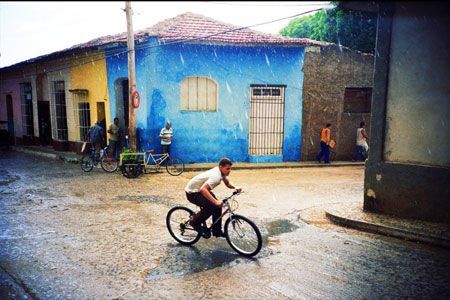
Park also said the people he meets on the road are the real joys of traveling.
“The relationships we have in the cities are based on interest and survival of the fittest. But the people you meet while traveling, there’s no such thing. You meet them with no interest involved. And the kindness you experience from these strangers is delightful,” he said.
Somehow, travel writers all seemed to feel the same way. “Meeting new people” was the common reason making them hit the road.
“The charm in traveling is that you talk about this and that with people you don’t know, people you’ve met in a little neighborhood in some remote place or country. Even if you don’t speak the language it’s possible to communicate with body language,” said Roh Chung-hun, a 40 year-old famed travel writer who regularly stars on KBS radio.
“Rather than enormous natural scenery, the small scenes that show how people live their everyday lives excites me. I like to use the term ‘the inner side of the scenes’ which shows the details of people’s livelihood.”
Choi Kab-soo, another bestselling travel writer said he thought travel allows people to become honest.
“We can become frank with the people we meet while traveling because the thought that we will never meet them again somehow unleashes us,” said Choi.
“Travel is good for the mind and body,” says Teddy Yoo, travel writer and professor who teaches a “travel writing” course at the School of Continuing Education at Dongguk University.
“Travel stimulates our curiosity. We meet people, scenery, history, and culture while we travel. Perhaps my physical disability pushed me to go out more.” Yoo has a third degree disability from polio he contracted when he was two years old. But he knows every corner of this country, to the point he memorizes the street names.
.jpg?w=728)
Courtesy of Korea Tourism Organization
The reality
Traveling as a profession isn’t as fancy as how it may look from the outside. Travel writers and journalists have to go a step further, deeper than ordinary people would and stay there longer to catch the best views. They go the distance many times to take a single photo.
“Sometimes, we tremble in the cold or risk falling off a cliff. We have to write articles even when we don’t feel like going or writing. We need to produce something from the trip. That’s one of the hard parts of being a travel reporter,” said Park.
“But it’s bearable and worthwhile because it’s something that I enjoy doing. We are able to see what others fail to see.”
Roh said mannerism can be a big enemy though.
“If you routinely go on a trip, you reach a point where you’re not that thankful with the scenery any more. When that kind of mannerism hits you, it’s painful,” he said.
“Also, we have a busier schedule than most package vacationers. We barely have enough time to look around properly because there are so many things to cover.”
Economic aspects are also part of the hardships.
“The stress about earning bread is quite disturbing. The writer’s fee we get from selling our work hardly comes in on a regular basis,” said Yoo.
“But there’s a way to tackle this: A change in mind. I decided to be satisfied with my earnings and not compare myself with others.”
What keeps them going
What makes these writers continue on with their jobs are the small delights they encounter.
“I continue traveling because of the people I meet and my change in attitude towards life after the trip. When you come back from a trip, you find everything interesting. Perhaps an ideal life is to live like you’re on a trip,” said Park.
Choi said, “The most exciting moment of travel is the first day on the destination. The scenery that you see when you open the windows on that first day is so exciting.”
Roh says he is propelled by watching people live.
“Seeing how people live is so interesting. The joy from watching people’s livelihood keeps me going on one trip after another.”
Another driving force is the reaction they get from readers.
“I can endure the pain of writing the travel log after coming back because I love getting feedback. The interaction with readers make the experience more exciting,” said Yoo.
Trend in the field
Perhaps because of these many charms travel provides the number of people taking classes to become professional travel writers are increasing.
The Korea Travel Writers’ Association started providing classes for travel writing since 2009. The 15 week class educates 50 to 60 students every spring and fall. The demand for it increased by 10 to 20 percent every year and subsequently the number of students taking the class has increased by 10 percent every year,” said Yoo, who founded and led the organization until last year.
“More people are becoming interested in this profession. They want to refine their writing and tell a good story after coming back from a trip,” said Yoo. “One other interesting phenomenon in this field is that companies are inviting travel writers like us to lecture their employees. This is probably because people these days don’t know how to enjoy travel.”
Travel is an act in which you voluntarily engage in to be emotionally moved. The rich experience in nature awakens a philosophical mind.
No wonder why the greatest writers were all great travelers. T.S. Eliot praised Baudelaire for being the first 19th century artist to describe the beauty of modern travelling, and this again is mentioned in 21st century writer Alain de Botton’s “The Art of Travel.”