Ultimate symphonic experience
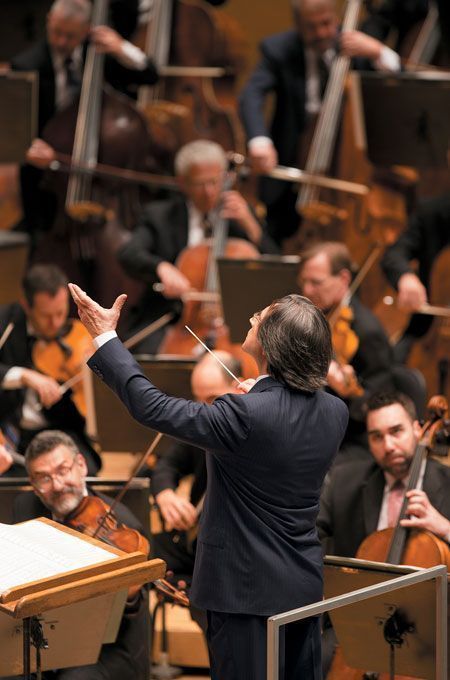
The Chicago Symphony Orchestra is in Korea this week for the first time in its 121-year history. / Courtesy of Hyundai Card
Chicago Symphony performs iconic works of Austro-German masters
By Do Je-hye
The Chicago Symphony Orchestra (CSO) arrived in Seoul Tuesday for its first-ever local performance without its music director Riccardo Muti, who had to pull out of the tour due to medical reasons.
Taking the Italian maestro's place for the 121-year-old ensemble's Asia tour that includes stops in Hong Kong, Shanghai, Beijing, and Seoul is U.S. conductor Lorin Maazel. The CSO and Maazel have a partnership that goes back almost 40 years, making him an ideal last-minute choice to cover for Muti.
A change in the musical leadership has also meant a change in the program. Maazel has replaced music by Stravinsky and Busoni with Mozart's "Jupiter Symphony," the last symphony that the Austrian master wrote and also the longest. It is one of the most significant symphonic works by any composer, ushering a new era of composition.
.jpg?w=728)
During a press conference in Seoul, Wednesday, Maazel expressed a particular appreciation for Mozart.
"His music is universal. Thorough his music, each one of us finds the truth within him or herself," Maazel said.
Maazel defined the work as a "tragic symphony." The last symphony of Mozart is written in a major key but the spirit is very dark.
Paired with the Brahms Symphony No. 2, the audience had the chance to hear two of the most important Austro-German symphonies in history at Seoul Arts Center Wednesday.
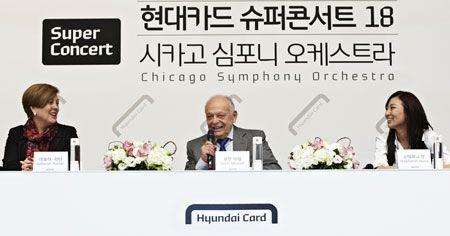
U.S. conductor Lorin Maazel, center, speak during a press conference in Seoul, Wednesday. Maazel is flanked by Chicago Symphony Orchestra (CSO) President Deborah F. Rutter, left, and Stephanie Jeong, right, CSO associate concertmaster. / Courtesy of Hyundai Card
Today, the CSO will perform Mendelssohn's fourth symphony and Beethoven's third symphony "Eroica."
The two dates on Feb. 6 and 7 are part of the Hyundai Card Super Concert Series, organized jointly by Hyundai Card and Credia.
The CSO is known for its industrial-strength brass, but Maazel underlined that there is more to the CSO sound.
"I expect people to be listening with particular attention to the sound made by the Chicago Symphony," Maazel said. "There are very few orchestras that make that kind of cohesive sound, which is at once very flexible, very rounded-out and warm and has an integrity of its own."
Maazel also lauded each musician's capacity to fuse their efforts with the conductor, resulting in an "amazing interaction between the conductor and the players."
The orchestra has many Asian players and its concertmaster Rober Chen is from Taiwan.
Recently, Korean-American violinist Stephanie Jeong joined as associate concertmaster. She trained at the Curtis Institute in Philadelphia and started her career at the New York Philharmonic.
Born in Chicago, Jeong said working with the CSO was like a dream come true.
"It is an honor to return to Chicago as associate concert master," Jeong said. "Former CSO concertmaster Samuel Magad used to come to my Suzuki school and I used to play for him."
Although the CSO has never performed locally, it is very popular among classical music fans, particularly those fond of Mahler symphonies.
A video recording of Mendelssohn Violin Concerto in E minor with Chung Kyung-wha playing under the baton of the legendary Hungarian-British conductor Sir Georg Solti (1912-1997), who led the CSO from 1969 until 1991, is loved by Korean violin fans.
The CSO took the classical music community by surprise when it was named the top U.S. orchestra in the latest U.K. Gramophone magazine critics' poll, ahead of the New York Philharmonic. Since 1891, world-renowned conductors have led the Chicago Symphony.
The CSO is a rare combination of sonic and financial health, making it a benchmark for Asia, where growing aspirations to create top-class orchestras have not yet yielded results.
The success of the CSO has been carried on through the years, regardless of transitions in its leadership.
"The orchestra has a strong identity of its own. It has a great work ethic and the players are passionate about what they do," said CSO concertmaster Robert Chen in a previous interview with The Korea Times.
The CSO is housed at the Symphony Center, which includes the 2,522-seat Orchestra Hall dating back to 1904.
The CSO went through a leadership change in 2010 from maestro Daniel Barenboim from Argentina to Italian maestro Muti.