Korean Americans live in ‘constant fear’ of Trump immigration policies, activist says
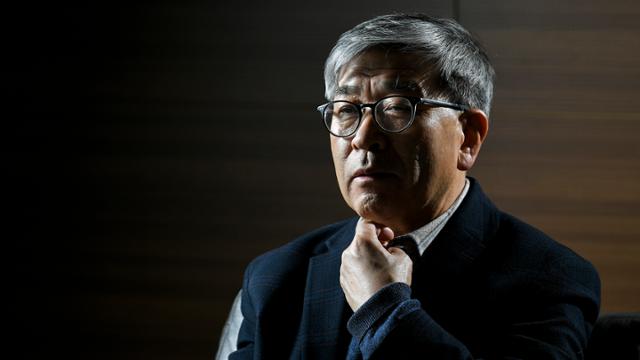
Kim Dong-seok, head of the nonprofit Korean American Grassroots Conference, speaks during an interview with the Hankook Ilbo at its headquarters in Jung-gu, Seoul, Jan. 8. Korea Times file
“Even though the U.S. government says it distinguishes between lawful and unlawful immigrants, and between those with and without criminal records, that line is not enforced in reality,” said Kim Dong-seok, head of the nonprofit Korean American Grassroots Conference, in an interview at Hankook Ilbo headquarters on Jan. 8. “People are being rounded up indiscriminately. For the past year, we have lived under constant fear.”
Kim is widely regarded as one of the most politically connected Korean American figures in Washington. Yet even for him, the first year of Donald Trump’s return to power was marked by what he described as “pure fear.”
How did President Trump manage to push through policies to this extent? Kim said the political conditions surrounding him have fundamentally shifted.
“During his first term, anti-immigration policies were largely justified on national security grounds. But his inner circle was unprepared, and at times restrained him from carrying out policies that went too far,” explained Kim.
“This time, however, Trump returned to office with Project 2025 — a comprehensive policy road map built on the premise that the United States should function as a stable and secure nation for white Americans.”
Kim said this, combined with the absence of dissenting voices within the White House, has allowed Donald Trump to wield power with little restraint.
For Korean Americans — among other minority communities — the shift has been keenly felt, as a once-prevalent sense of institutional tolerance toward immigrants has given way to a presumption of criminality.
“The country is now clearly divided between citizens and noncitizens,” said Kim. “For permanent residents who pay taxes like everyone else, being denied the same legal protections feels deeply unjust.”
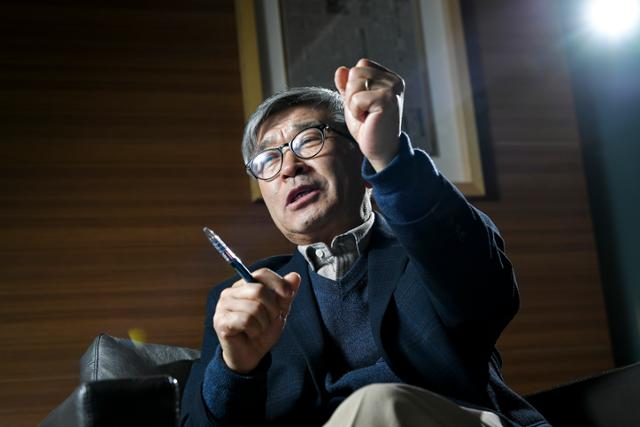
Kim Dong-seok, head of the nonprofit Korean American Grassroots Conference, speaks during an interview with the Hankook Ilbo at its headquarters in Jung-gu, Seoul, Jan. 8. Korea Times file
Kim, a U.S. citizen, said that in the past, green card holders were treated as “people in training for citizenship.” Now they are “simply those left outside the line drawn by the Trump administration.”
“While citizens remain protected unless they commit serious crimes, permanent residents can face deportation over relatively minor infractions,” Kim said.
Recent discussions among some Republicans about banning dual citizenship are another indication that the political space for those without full citizenship is shrinking — an ominous sign for permanent residents.
Under these circumstances, Kim argues, the only viable path for Korean permanent residents to secure protection lies in naturalization and sustained political engagement. In his view, the United States is approaching a “third civil conflict,” following the Civil War of the 1860s and the civil rights struggles a century later.
“This time, Asian Americans — as relatively recent immigrants — are the group that must step forward most decisively,” he said, adding that Black and Latino communities are watching closely to see whether Asian Americans will act in defense of racial equity and equality.
“It is time to stop being guests and become owners,” Kim urged, adding that Korean immigrants in the United States should pursue naturalization as soon as possible, as barriers and costs to citizenship continue to rise. “Korean Americans need to build political power not in Yeouido, but in Washington.”
He also called on Korean Americans to assert their civic identity as taxpayers and demand equal treatment.
“We contribute enormous tax revenues,” Kim said. “We should be asking why our community is treated as criminal suspects — and why we are not being protected.”
This article from the Hankook Ilbo, the sister publication of The Korea Times, is translated by a generative AI system and edited by The Korea Times.