Was Xi's stance on China-North Korea military ties also a message for US, Russia?

North Korean leader Kim Jong-un, left, walks alongside Chinese President Xi Jinping as Xi heads back to China from Pyongyang, Tuesday, after a two-day visit to North Korea, in this image from the Korean Central News Agency(KCNA). Yonhap

North Korea is gaining in strategic importance for China to counter the United States, but Pyongyang may refrain from intensifying military ties with Beijing, analysts say.
During his meeting with North Korean leader Kim Jong-un on Monday, Chinese President Xi Jinping said both sides should "enhance exchanges in diplomacy, law enforcement and military affairs", according to state news agency Xinhua.
Despite pledges from both sides to strengthen strategic communications, denuclearisation of the Korean peninsula was not included in their statements on the meeting, a sharp contrast with Xi's previous visit in 2019.
Also in a departure from their previous summits, Xi and Kim were accompanied by their defence ministers, Dong Jun and No Kwang-chol. It is the first time since 1992 that a Chinese defence minister has accompanied a Chinese president to North Korea.
It is also the first known case of a senior Chinese defence official visiting the country since Miao Hua, then-director of the Chinese Central Military Commission's Political Work Department, visited in 2019.
While a Chinese military delegation reportedly travelled to North Korea for the first time in six years in October last year, the level of the delegation was not revealed. The prominence given to military matters this week was an addition to the traditional priorities of economic and diplomatic affairs.
However, North Korea's state media did not include Xi's remarks on increasing military exchanges between the two countries, despite extensive coverage of the Chinese president's visit.
Kang Jun-young, a Chinese studies professor at Hankuk University of Foreign Studies in Seoul, said Xi's remarks showed Washington that Beijing had "firmly secured a military ally" while at the same time signalling "caution against excessive military closeness" between Pyongyang and Moscow.
Beijing officially rejects formal, binding military alliances, but it signed the 1961 Treaty of Friendship, Cooperation and Mutual Assistance with North Korea, which serves as China's only standing mutual defence agreement with a foreign country.
In Kang's view, North Korean media made no mention of Xi's comments because an open acknowledgement of enhanced military ties with China could place a "considerable burden" on Pyongyang, considering it was making significant progress in military engagement with Russia.
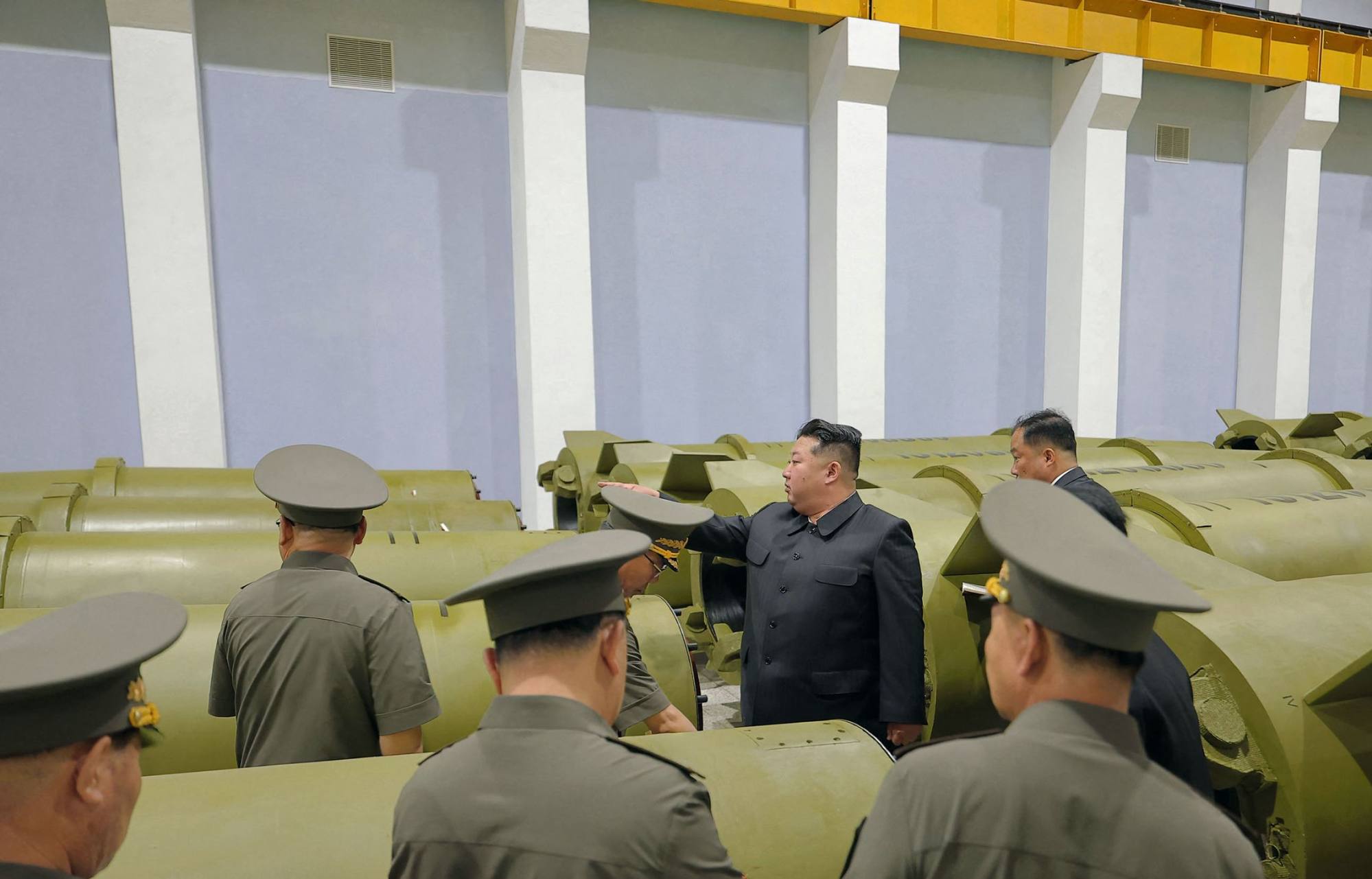
North Korean leader Kim Jong-un visits a military-industrial factory, Saturday, the North's state news agency KCNA reported. Yonhap
Sydney Seiler, who was the national intelligence officer for North Korea on the US National Intelligence Council from 2020 to 2023, said Beijing sought to send "subtle messages" that Pyongyang would be "well-advised" not to neglect China-North Korea relations.
While Chinese readouts suggested military exchange as part of a multi-sector cooperation the two countries could pursue, this did not translate into "bilateral, or even trilateral, military exercises in the near future", he said.
"For now, Russia-DPRK relations do not appear to have been dealt a significant blow: Russia is the lower-cost, less-burdensome partner for North Korea," said Seiler, who is a senior adviser for the Korea Chair at the Washington-based Centre for Strategic and International Studies.
"Kim is likely to look for low-risk, limited opportunities to expand cooperation with China but in a more reserved and cautious manner."
Pyongyang is thought to have received Russian technological help to develop its conventional weapons in exchange for sending troops and weaponry to aid Moscow's war in Ukraine. The two countries also signed a mutual defence treaty in June 2024, which mandates that an armed attack on either country requires the other to provide military assistance, marking the peak in North Korea-Russia defence ties.
Cho Han-bum, a senior research fellow at the Korea Institute for National Unification in Seoul, said that while closer military ties between Pyongyang and Moscow pushed China's needs to regain and strengthen its influence over North Korea, Pyongyang might still take a cautious approach.
"Given that North Korea has always maintained equidistant diplomacy, or walked a tightrope between China and Russia, it is wary of military cooperation with China that crosses the red line," Cho said.
The possibility of increased military exchanges between China and North Korea comes as Pyongyang continues to advance its nuclear and conventional weapons programme.
A day before last week's announcement of Xi's visit, North Korean state media reported that Kim had just toured a newly opened nuclear material production plant and pledged to "exponentially strengthen" his country's nuclear force while "numerically and continuously" accelerating its expansion.
On Sunday - the day before Xi's arrival - Kim's sister Kim Yo-jong remarked that North Korea's status as a nuclear power was an "absolute, indeterminate boundary", and that "hostile forces" such as the US "must cast aside their delusions of denuclearisation".
While China has previously supported a nuclear-free Korean peninsula, its recent actions reveal a pivot from that position.
In an op-ed published by North Korean state media Rodong Sinmun before his arrival, Xi stressed opposing "hegemonism and power politics, and all ambitions and schemes that seek the revival of militarism and endanger regional safety and stability" but there was no mention of denuclearisation.
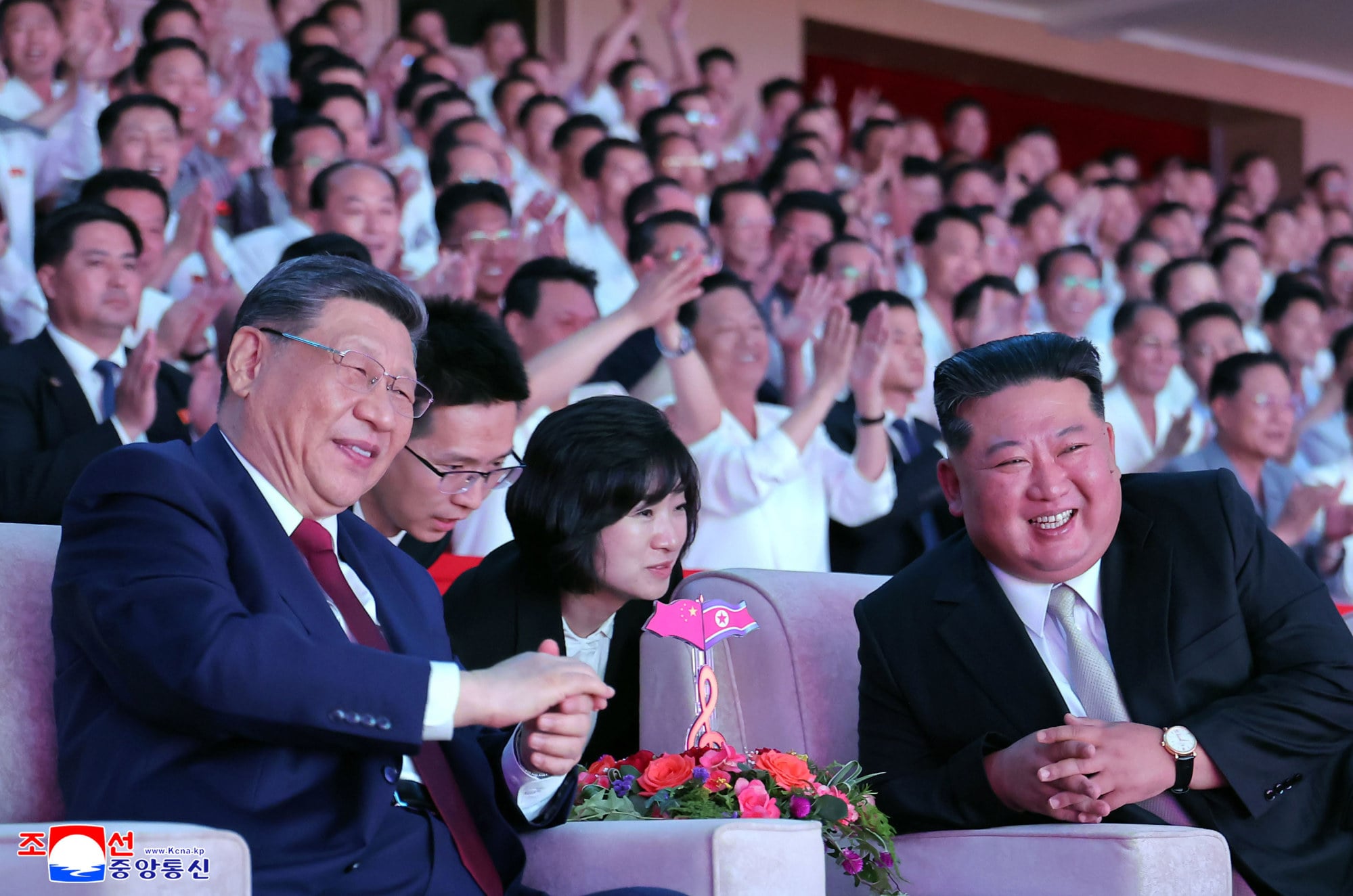
North Korean leader Kim Jong-un, right, and Chinese President Xi Jinping are seen at a welcome performance in Pyongyang Gymnasium, Monday, in this image from KCNA. Yonhap
It was in contrast with Xi's op-ed in the same publication ahead of his last visit seven years ago, which highlighted the promotion of peace and dialogue on the Korean peninsula.
China's official policy advocates for the complete denuclearisation and stability of the Korean peninsula through phased, multilateral dialogue. However, Beijing's policy appeared to depart from its original stance in November when it omitted support for the nuclear-free Koreas in its latest white paper, titled "China's Arms Control, Disarmament and Nonproliferation in the New Era".
Lim Eul-chul, from the Institute for Far Eastern Studies at Kyungnam University, said the differences in coverage of the summit revealed North Korea's wariness of its system "becoming subordinate to the Chinese economic model or global supply-chain systems".
China had a stance of "de facto acquiescence" to North Korea's status as a nuclear power through "intentional silence", Lim said, citing Xi "wholeheartedly" supporting the "Korean-style socialist feat" of designating itself as a nuclear power in its constitution.
"This appears to be an attempt to secure a security alliance between North Korea and China to counter South Korea, the US and Japan through military cooperation in exchange for the tacit acceptance of nuclear possession."
Patrick Cronin, the Asia-Pacific security chair at the Washington-based think tank Hudson Institute, said Xi's broad calls for increased trade and military exchange were a "strategic signal" to Moscow and Washington.
"Beijing is reinforcing the message that China, not Russia, remains North Korea's indispensable partner," he said.
"At the same time, it is reminding Washington that China holds considerable leverage over Pyongyang and should therefore be given greater deference in any future diplomatic efforts to maintain stability on the peninsula."
Kang noted that Xi's visit to North Korea itself amplified Pyongyang's strategic importance for China, which was also shown by the Chinese president's repeated remarks emphasising strategic cooperation and communication.
"As a reaction to the US strengthening South Korea and Japan into alliances, China is bringing North Korea, traditionally under its influence ... To do so, it has to relatively acknowledge North Korea's status."
However, drawing from the historical record, Kang added that North Korea would refrain from being too influenced by any single nation, whether China or Russia.
Read the article at SCMP.