Maduro’s fall may stoke Kim Jong-un’s fears: ‘He will cling more tightly to nuclear weapons’
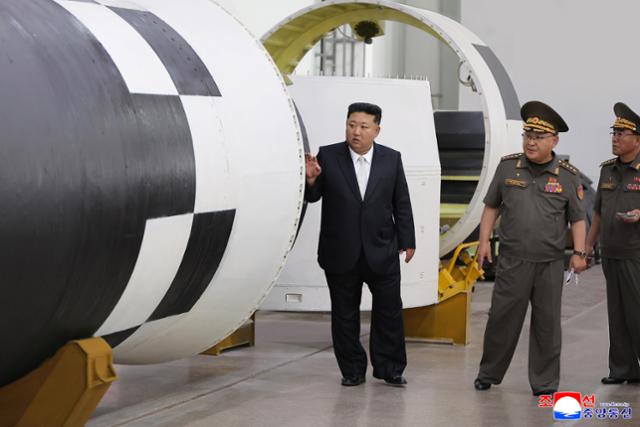
Kim Jong-un visits a research institute under the Missile General Bureau in this September 2025 photo released by the Korean Central News Agency. Yonhap
With the United States carrying out an operation to capture Venezuelan President Nicolás Maduro, diplomatic attention is turning to North Korean leader Kim Jong-un.
Observers say the latest U.S. attack on an authoritarian regime may have increased Kim’s fear of regime change. Experts say his conviction that "only nuclear weapons ensure survival" is likely to harden further.
North Korea strongly condemned what it called a U.S. "invasion" of Venezuela in a Q&A session on Sunday with a foreign ministry spokesperson and a Korean Central News Agency reporter. The spokesperson said it was “another case that once again confirms the gangster-like and beastly nature of the United States as witnessed by the international community.”
They added that North Korea brands Washington’s actions in Venezuela as “the gravest form of sovereignty violation and a violent breach of the U.N. Charter and international law, which are based on respect for sovereignty, non-interference in internal affairs and territorial integrity,” and said the country condemns it in the strongest terms.
Early Saturday morning, U.S. forces deployed to the presidential residence in Caracas and captured President Maduro and his wife in their bedroom. Kim and Maduro had maintained friendly ties, exchanging congratulatory messages at major political events. The two leaders were also similar in that both used anti-U.S. rhetoric as a justification for their rule.
Although Kim has met U.S. President Donald Trump three times and built a personal rapport with him, it appears difficult to avoid fear that the United States could strike North Korea the same way. Koh Yu-hwan, emeritus professor of North Korean studies at Dongguk University, said on Sunday, “For Kim Jong-un, this would have been a moment to once again recognize the power and threat of the United States, which can do anything if it sets its mind to it.”
When Libyan dictator Muammar Gaddafi was killed in 2011, North Korea barred overseas officials and citizens from returning home and tightened internal ideological controls. This suggested internal unrest was significant enough that Pyongyang felt it was necessary to block news of Gaddafi's death.
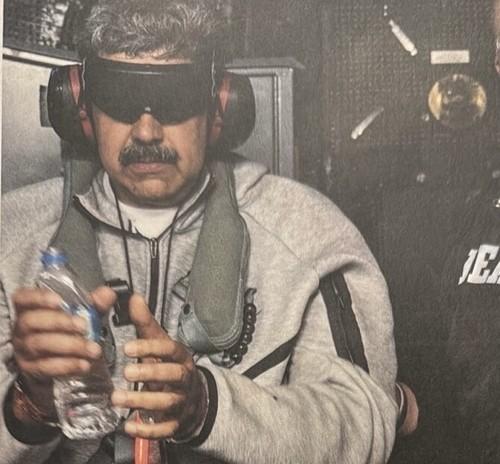
President Donald Trump released a photo on his social media of Venezuelan President Nicolás Maduro after his capture by U.S. forces in a surprise military operation. Captured from Trump's social media
Some say Kim’s fixation on nuclear weapons will only deepen as a result of Maduro's capture. A former diplomat said, “After Saddam Hussein in Iraq and Gaddafi in Libya, Kim Jong-un could view Maduro’s ouster as the fate of dictators who failed to obtain nuclear weapons.” This means his belief that the only path to survival lies in nuclear deterrence against U.S. threats, rather than in improving North Korea-U.S. relations, is likely to solidify.
Some analysts also say North Korea’s recent ballistic missile launches are related to recent events. Hong Min, a senior research fellow at the Korea Institute for National Unification, said, “Kim Jong-un is sending a message to the United States, saying ‘We are different from Venezuela. We have the capability to respond and retaliate with nuclear weapons.'”
Koh said that during Trump’s first term, when the U.S. president warned North Korea of “fire and fury,” Kim was frightened enough to engage in dialogue, but “now that he has completed his nuclear capabilities, the situation is different.” While Kim may make conciliatory gestures toward Washington after witnessing Maduro’s capture, Koh said, “This is not a situation in which he would enter talks premised on denuclearization.”
This article from the Hankook Ilbo, the sister publication of the Korea Times, is translated by a generative AI system and edited by The Korea Times.