Moon's peace initiative becomes elusive as Beijing Games begins
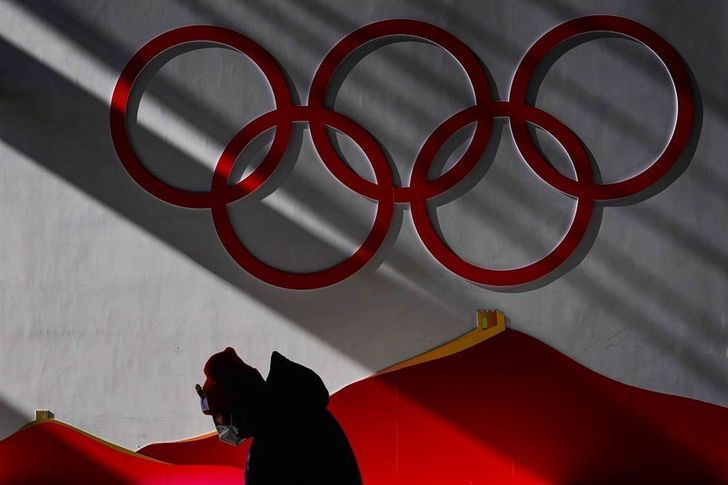
A man wears a protective mask while walking inside of the Zhangjiakou National Ski Jumping Centre before the start of competition at the 2022 Winter Olympics in Zhangjiakou, China, Wednesday. AP-Yonhap
By Nam Hyun-woo
The Beijing Winter Olympics starts Friday, but President Moon Jae-in's ambitious plan to facilitate talks to declare a formal end to the 1950-1953 Korean War on the sidelines of the sporting event remains little more than wishful thinking.
The Moon administration has sought the end-of-war declaration as a gateway to advance dialogue for the denuclearization of the Korean Peninsula, but the North is responding by escalating tensions. With Moon's tenure nearing its end, there seems to be no option left for the President to reverse the current deadlock.
The South Korean government will send a diplomatic delegation led by Minister of Culture, Sports and Tourism Hwang Hee to the Games, which will run for 16 days until Feb. 20.
Hwang said in a recent media interview that he is looking forward to seeing “an occasion of inter-Korean exchange” if North Korean officials visit the Games. But the outlook for a meeting between the two Koreas remains doubtful given the North's previous announcement that it will not participate in the event.
Initially, the government contemplated sending a deputy prime minister to the event, but decided to have Hwang head the delegation, apparently affected by diplomatic boycotts of the Games by the U.S. and other countries.
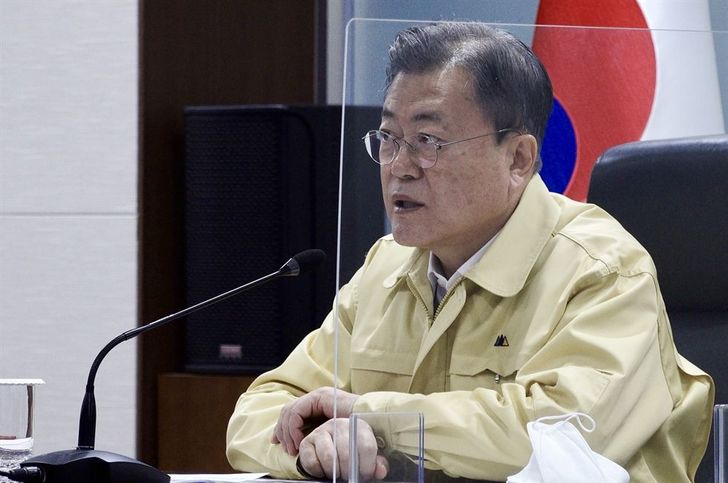
President Moon Jae-in speaks during a National Security Council meeting at Cheong Wa Dae, Jan. 30, when North Korea fired an intermediate-range ballistic missile. Yonhap
Moon has been seeking to use the Beijing Games as a vehicle to facilitate talks with North Korea, as his administration created a mood of rapprochement after high-profile talks between the two Koreas at the 2018 PyeongChang Winter Games. During the 2018 event, Kim Yo-jong, sister of North Korean leader Kim Jong-un, took part in the opening ceremony, and her participation led to a series of inter-Korean and U.S.-North Korea summits later that year.
After Moon resuscitated the idea of declaring a formal end to the Korean War in September, Seoul viewed the Beijing Games as a window of opportunity for a four-way dialogue among the two Koreas, the U.S. and China.
However, such hopes were dashed after the U.S. announced its diplomatic boycott of the Games, citing human rights abuses in Xinjiang, Hong Kong and Taiwan, while other U.S. allies followed suit.
North Korea also decided not to participate in the Games. In September last year, the International Olympic Committee suspended North Korea's National Olympic Committee from participating in the Beijing Games in an apparent punishment for its absence at the Tokyo Summer Olympics last year.
North Korean athletes are still allowed to participate in the Beijing Olympics individually. But the North on Jan. 7 officially announced that it will not send its athletes to the event, depriving Moon of a viable tool for his initiative to see tangible progress in inter-Korean peace talks during his tenure.
Instead of sending athletes, Pyongyang is increasing military tensions by test firing missiles. On Jan. 30, the North launched an intermediate-range ballistic missile (IRBM) into the East Sea, which was seen as a suspension of the regime's self-imposed moratorium on nuclear weapons and long-range missile tests.
Seoul's Minister of Foreign Affairs Chung Eui-yong had a phone call with U.S. Secretary of State Antony Blinken on Thursday and the two expressed “strong concern” over North Korea's escalating missile capabilities and agreed to further cooperation between the allies.
However, this was a weaker rhetoric compared to a Feb. 1 call between Blinken and Japanese Foreign Minister Hayashi Yoshimasa, where they “condemned” North Korea's ballistic missile launches and recognized those launches “were in violation of multiple United Nations Security Council resolutions.”
The Moon administration has been refraining from describing North Korea's missile launches as “provocations” or “violations.” Regarding the Jan. 30 launch, Moon said the IRBM launch “can be seen as a violation of U.N. Security Council resolutions,” which was the strongest rhetoric by the government against seven North Korean missile tests so far this year.
Against this backdrop, the U.N. Security Council has postponed its meeting on North Korea to Friday, a day later than its initial plan. The U.S. has requested this meeting, but it remains uncertain whether Russia and China will join the Washington-led campaign.