PHOTOS Kim Jong-un inspects 'socialist' spa resort in Yangdok

North Korean leader Kim Jong-un and his wife Ri Sol-ju visit the Yangdok County Hot Spring Resort, North Korea, in this undated picture released by North Korea's Central News Agency (KCNA). Yonhap
North Korean leader Kim Jong Un visited a spa resort under construction in the country's South Pyongan Province, and expressed “great satisfaction” at the development, praising its “socialist” architecture, state media reported Friday.
The Yangdok County Hot Spring Resort, located in a mountainous area east of the North Korean capital Pyongyang, will feature therapeutic hot springs and spas, ski slopes and a hotel. The resort has been touted in the North's media for several months as a key development project.
“[Kim Jong Un] expressed his great satisfaction over the fact that the resort is being successfully completed though it has been just over 50 days since he last inspected the construction site late in August,” the state-run Korean Central News Agency (KCNA) reported.
Kim added that the resort would be a model for developing other “cultural and tourist bases throughout the country” in “our style, Korean-style construction,” according to the agency.
The North Korean leader compared the site to the Mount Geumgang resort, which he visited Wednesday and where he ordered the removal of all the “unpleasant-looking” facilities built by South Korea.
Kim called the new Yangdok resort a “striking contrast” to Mount Geumgang, saying it was an “illustration of the fundamental difference between the architecture of capitalist businesses targeting profit-making” and “socialist architecture embodying the desire and aspiration of the working people,” the KCNA said.
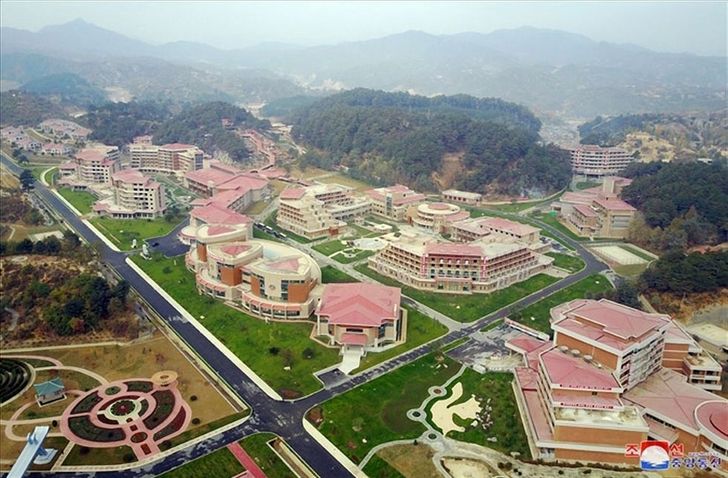
The Yangdok County Hot Spring Resort, located in a mountainous area east of the capital Pyongyang, will feature therapeutic hot springs and spas, ski slopes and a hotel and has been touted in North Korean media for several months as a key development project.
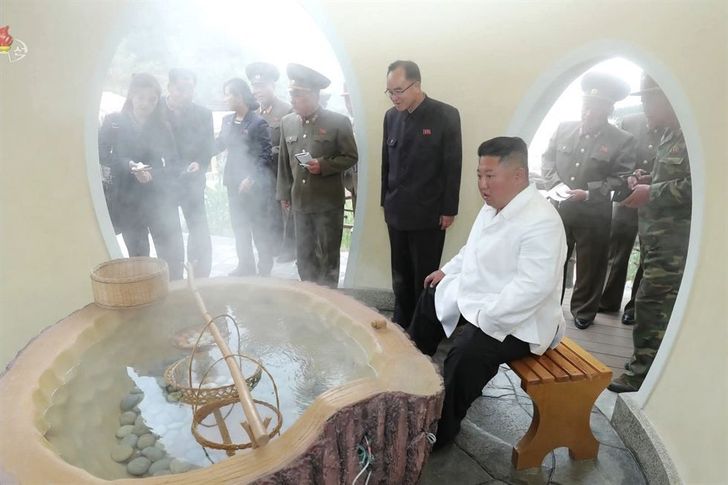
North Korean leader Kim Jong-un and his wife Ri Sol-ju visit the Yangdok County Hot Spring Resort, North Korea, in this undated picture released by North Korea's Central News Agency (KCNA). Yonhap
Mount Geumgang was opened as a joint tourism project between North and South Korea in 1998 but visits by tourists from the South were halted in 2008 after one was shot and killed by a North Korean guard.
During his visit to the site earlier this week, Kim made the rare move of criticizing the policies of his father, Kim Jong Il, as relying too heavily on South Korea when developing the tourism area.
“[Kim Jong Un] made a sharp criticism of the very wrong, dependent policy of the predecessors who were going to rely on others when the country was not sufficient enough,” KCNA reported.
During the visit, Kim implied that all future Mount Geumgang tourism would be handled solely by North Korea.
“We will always welcome our compatriots from the South if they want to come to Mount Geumgang after it is wonderfully built as the world-level tourist destination,” Kim said, according to KCNA, but added that “it is not desirable to let the South side undertake the tours of Mount Geumgang, our famous mountain."
President Moon Jae-in and Kim Jong Un had agreed to resume the tourism project last September, but that has stalled, as have plans to reopen the Gaesong Industrial Zone, a joint manufacturing area that was shuttered in 2016.
Inter-Korean economic projects that Seoul has touted as key to bringing peace to the Korean Peninsula, have been hampered by continued economic sanctions on the North. Nuclear disarmament negotiations between North Korea and the United States remain at a stalemate since a February summit between U.S. President Donald Trump and Kim Jong Un ended abruptly without any agreement.
A working-level meeting in Stockholm, Oct. 5, the first official talks since Trump briefly met Kim at the inter-Korean border in the DMZ in late June, broke down after one meeting with the North Koreans complaining that the United States remained inflexible. (UPI)