US envoy: North Korea denuclearization must not be incremental
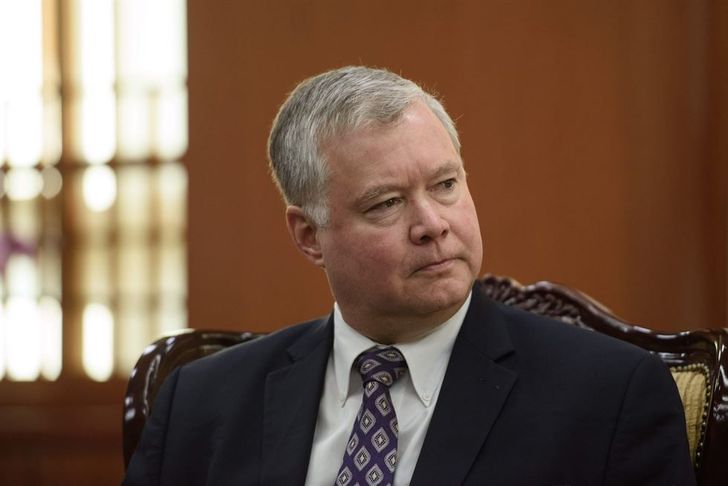
In this file photo taken on Feb. 9, U.S. Special Representative for North Korea Stephen Biegun listens to South Korea's Foreign Minister Kang Kyung-wha during their meeting at the foreign ministry in Seoul. Biegun said Washington's goal is the complete denuclearization of North Korea by the end of Donald Trump's first term, insisting it will not settle for incremental disarmament. AFP
The Trump administration will insist North Korea follow through on its commitment to completely eliminate its nuclear weapons before the U.S. agrees to the lifting of international sanctions, the State Department's special envoy for North Korea said Monday.
In his first public comments since President Donald Trump met with North Korean leader Kim Jong Un last month, envoy Stephen Biegun said ``the missing variable'' in making a deal is the North's unwillingness to offer complete, verifiable denuclearization.
``We are not going to do denuclearization incrementally,'' Biegun said at a conference sponsored by the Carnegie Endowment for International Peace.
He said there is room for ``confidence-building'' measures, such as a proposed establishment of a U.S. diplomatic liaison office in North Korea, to advance the process. But the U.S. will not agree to a step-by-step approach to eliminating the nuclear weapons, he said.
Biegun said that at last month's Hanoi summit, Trump rejected Kim's offer to eliminate a portion of his nuclear program in exchange for lifting ``basically all'' of the international sanctions. That was judged to be unacceptable, Biegun said, because it would have removed economic pressure that had been imposed by the international community.
Under the Kim proposal, ``We'd lift that pressure in exchange for only a portion of those weapons of mass destruction programs,'' Biegun said. ``That would have put us in a position _ a very difficult position _ of essentially subsidizing what would potentially be ongoing development of weapons of mass destruction in North Korea. We need a total solution.''
He said this does not mean the U.S. position has hardened. He said Washington remains open to further North Korea diplomacy aimed at four priorities: transforming relations, establishing a formal end to the Korean War, achieving the North's complete denuclearization, and returning the remains of thousands of U.S. troops missing from the Korean War.
Last August, North Korea turned over 55 boxes of war remains; so far the U.S. has identified three soldiers from those remains and is expecting to announce several more soon.
``We want to heal the wounds of war,'' Biegun said. ``We want to recover the remains of soldiers very much for the same reasons that helped us normalize relations in other places like Vietnam at the end of the conflict.' (AP)