Film depicts children of North Korean defectors born abroad

Kim Ye-lim (left) and Cho Yu-na (second from left), who are featured in a documentary film on North Korean defectors living around the world, titled “Children on the Border,” are on stage after a screening held in a meeting room at the National Assembly, together with an expert panel. Korea Times photo By Jung Da-min
By Jung Da-min
A documentary film on children of North Korean defectors born outside their homeland, titled “Children on the Border,” was screened at the National Assembly, Tuesday. Save North and New Korea (Save NK), a nonprofit corporation that has been helping North Korean refugees since 1999 with headquarters based in Seoul, produced the film and hosted the screening. Rep. Shim Jae-cheol of the main opposition Liberty Party of Korea arranged the event.
“People don't really know much about the difficulties and troubles of children born in third countries yet,” Shim said in a speech, calling for more attention to the dire situation of human rights in North Korea and those who have fled the country.
The children were not born in North or South Korea. Their parents are North Korean defectors who were mostly “sold” to Chinese farms by human trafficking brokers in late 1990s or early 2000s. The massive defection of North Koreans followed a great famine in the North, labeled the “Arduous March” in the 1990s.
According to the Ministry of Unification, the number of third-country-born children of North Korean defectors currently enrolled in South Korean schools outnumbers young North Korean defectors. Of 2,598 children of N. Korean defectors enrolled in South Korean schools, 1,437, or 57 percent, were born outside Korea as of 2017.
Born and raised in China, many of the third-country born children have been confused about their identity after they came to South Korea. They are not categorized as “multicultural” or “international” young people who came from China. Rather, they are called “defector children” although they actually have never been to the North.
In the film “Children on the Border,” two of third-country-born children Kim Ye-lim and Cho Yu-na, both 21, share what they have been going through since they came to South Korea, following their mothers. Save NK is now planning to submit the documentary to an international human rights film festival.
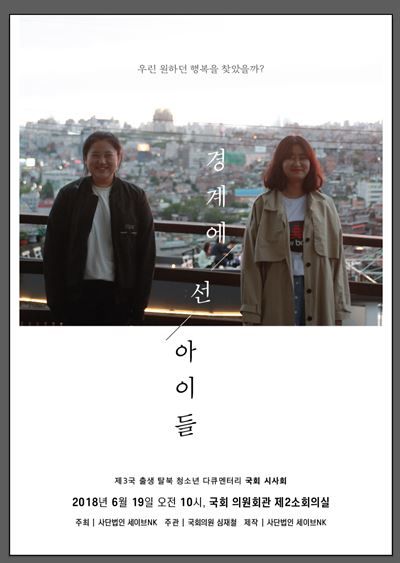
The poster for the screening of “Children on the Border” at the National Assembly. Courtesy of Save North and New Korea.
“I could not tell my friends my stories in fear of not being understood,” said Cho, who came to South Korea in 2015. “But I decided to appear in the film to encourage those who are in the same situation as me.”
Kim, who came to the South in 2007, also said she wanted to encourage third-country-born students. “I hope they will not give up their dreams,” Kim said.
Third-country-born children face a different situation after coming to the South than young North Korean defectors. They not only face a language barrier but they are also not getting equal support for educational opportunities as those defector children who came from the North. Their education records from abroad are not recognized in South Korea and they are getting less scholarships and admission opportunities for universities.
The unification ministry said that they are reviewing relevant laws to better help the third-county-born children, in a conference held in April. Basic plans to support North Korean defectors for 2018 to 2020 have also been discussed.