N. Korea: New ballistic missile can fly to US mainland with 'heavy nuclear warhead'

North Korea’s new type of ballistic missile, called the Hwasong-12, is launched Sunday in Kusong, North Pyongan Province, in this photo released by the North’s Rodong Sinmun, Monday. / Yonhap
Kim Jong-un says US mainland is within striking range
By Jun Ji-hye
North Korea announced Monday that it successfully test-fired a “new surface-to-surface medium to long-range” ballistic missile “capable of carrying a large-size nuclear warhead” and reaching the U.S. mainland.
Calling the new missile “Hwasong-12,” the North’s Korean Central News Agency (KCNA) said the missile fell precisely onto a designated target 787 kilometers away in the sea after reaching a maximum altitude of 2,111 kilometers.
Military analysts say if the North’s claim is confirmed to be true, the move marks a considerable technical advance in its development of an intercontinental ballistic missile (ICBM), believed to have a range of more than 10,000 kilometers.
The announcement came after the military authorities of South Korea, the United States and Japan detected the missile launch that took place in the vicinity of Kusong, North Pyongyan Province, at 5:27 a.m., Sunday.
The latest provocation came four days after liberal President Moon Jae-in took office.
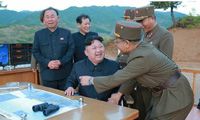
North Korean leader Kim Jong-un smiles with aides after confirming the successful missile launch in this photo released by the North’s Rodong Sinmun, Monday. Kim said the U.S. mainland is now within the regime’s strike range, according to its state media. / Yonhap
The KCNA said the test, observed by North Korean leader Kim Jong-un, was conducted “at the highest angle in consideration of the security of neighboring countries.”
It noted the launch was aimed at verifying the tactical and technological specifications of the newly-developed ballistic missile.
Claiming that the launch proved all the technical specifications such as “guidance and stabilization systems, structural system and pressurization, inspection and launching systems,” the state media added that the test also re-confirmed the reliability of a new rocket engine.
The announcement was construed as the Kim regime’s move to develop a ballistic missile carrying a larger nuclear warhead than what it earlier claimed were “miniaturized and standardized” ones.
The KCNA also claimed the latest launch tested the regime’s re-entry technology, saying “the homing feature of the warhead under the worst re-entry situation and accurate performance of detonation system” was verified.
Re-entry technology refers to the ability to construct a shroud that covers the missile’s warhead strong enough to withstand the extreme heat and other challenges involved in re-entering the Earth’s atmosphere from space. As the covered warhead re-enters the Earth’s atmosphere at Mach 24, it needs to be capable of withstanding temperatures of around 7,000 to 8,000 degrees Celsius.
Securing such technology is cited as the toughest challenge for the North in developing an operational ICBM.
The KCNA said Kim strongly “warned the U.S. should not to disregard or misjudge the reality that its mainland and Pacific region operations are in the DPRK’s sighting range for a strike and that it has all powerful means for a retaliatory strike.”
Later in the day, Seoul’s Ministry of National Defense downplayed the purported successful missile test, saying, “Additional analysis is needed to verify North Korea’s claims about the missile’s technical characteristics and the reliability of the engine.”
The ministry also dismissed the North’s claim about its re-entry technology. “We believe it is highly unlikely,” it said.
Experts, however, noted Pyongyang is showing considerable progress in its missile technology. If the missile had launched at a normal angle, it could have been assessed as an ICBM, they said.
“The North showed off its capability to strike the U.S. mainland with missiles,” said Yang Moo-jin, a professor at the University of North Korean Studies. “(Through the latest test) the North stressed that harsher pressure from the international community including the U.S. and China has been useless.”
Kim Dong-yup, a professor at the Institute for Far East Studies of Kyungnam University, said the repressive state implied an imminent additional nuclear test as it mentioned the new missile can carry “large-size heavy nuclear warheads.”