N. Korea says Kim Jong-nam died of heart attack, not VX
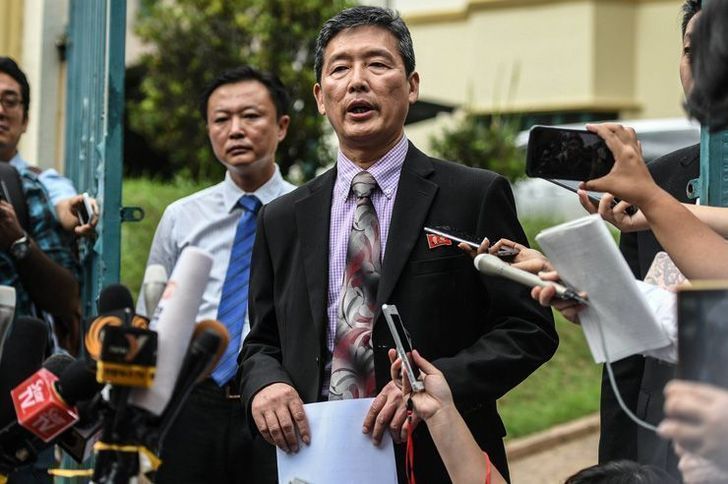
Ri Tong Il addresses journalists outside the North Korean embassy in Kuala Lumpur on Mar. 2. / AFP-Yonhap
By Ko Dong-hwan
A North Korean representative has denied the Malaysian health authority’s latest statement that the half-brother of the military regime’s leader died from a poisonous chemical, arguing that he had a heart attack.
Ri Tong-il, the former North Korean deputy ambassador to the United Nations, said on Mar. 2 that Kim Jong-nam, whom he instead referred to as Kim Chol as shown on his passport, had a history of heart disease.
He said Kim “had treatment from time to time while being hospitalized” and “under normal conditions, he cannot travel without medicine for heart disease, as well as for diabetes and high blood pressure,” according to Malaysian daily New Straits Times.
“This is a strong indication that the cause of death was a heart attack,” Ri told reporters outside the North Korean embassy.
Ri denied the Malaysian health ministry’s conclusion after conducting an autopsy that Kim died after two woman attacked him with VX nerve agent.
Indonesian Siti Aisyah and Vietnamese Doan Thi Huong attacked Kim at Kuala Lumpur International Airport on Feb. 13 in a hit-and-run assassination with what was allegedly a poisonous chemical. Waiting for a flight to Macau alone at that time, he had sought medical help at the airport but died in less than half an hour.
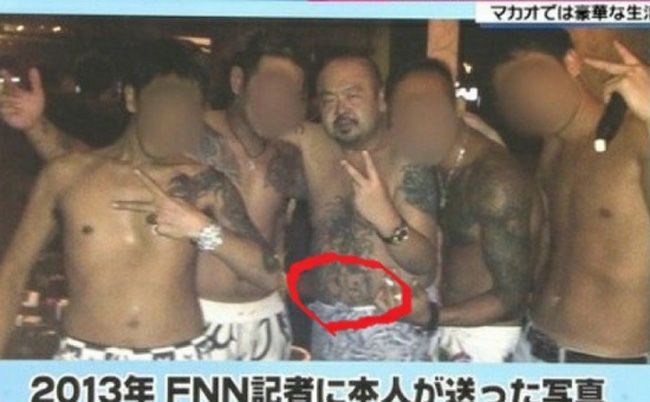
This photo, from a Japanese news outlet, reportedly was taken at a club in the Marina Bay Sands Hotel in Singapore in 2013. Kim Jong-nam has the same tattoo on his stomach, (circled) as the tattoo on the male body that has been in the Kuala Lumpur Hospital morgue since Feb. 15. The man was attacked with the deadly VX chemical agent at Kuala Lumpur International Airport. / Courtesy of online community
Ri’s denial of the Malaysian ministry’s toxicology report was based on an inference that no others who could have been in contact with VX had died.
Referring to the agent as “an extremely toxic material categorized as a chemical weapon by the Organizations for the Prohibition for Chemical Weapons,” he said none of the tens of thousands of people at the airport was reportedly contaminated or affected by the airborne agent.
“There were policemen and doctors who escorted the deceased to the hospital but none of them were affected by this very toxic material,” he said.
He further questioned how the two suspects who manually delivered the material on to Kim’s face could have survived the agent.
The Malaysian daily, meanwhile, has unearthed a new photograph that confirms Kim’s identity. The photo of Kim with his friends shows a tattoo on his stomach and another on his left arm. The one on his stomach particularly shows an Asian man reeling in a Japanese carp.
The photo, taken in 2013 at a club in the Marina Bay Sands Hotel in Singapore, was sent to a female Japanese journalist named Mizumi Fujita, who has known Kim for more than 10 years.
The tattoos are identical to those on the man whose body has been in the Kuala Lumpur Hospital morgue since Feb. 15 after the airport attack.
The latest evidence is expected to add weight to the belief that the dead man is Kim Jong-nam.