N. Korea able to strike US territory in Pacific
.jpg?w=728)
A Hwasong-10 strategic ballistic missile is launched in this photo released by the Rodong Sinmun, Thursday. The paper claimed North Korea successfully test-fired an intermediate range ballistic missile, Wednesday. / Yonhap
Kim Jong-un hails progress in missile technology
By Yi Whan-woo
North Korea hailed a purported successful test of an intermediate-range ballistic missile (IRBM), Thursday, claiming that it has secured technology to attack U.S. forces in the Pacific.
The launch comes at a time when South Korea and the United States are discussing deployment of an advanced missile defense system on South Korean soil.
Pyongyang’s state-controlled Korean Central News Agency (KCNA) reported that a Hwasong-10 missile reached an altitude of 1,413.6 kilometers before re-entering the atmosphere and landing in waters about 400 kilometers away from the launch site in Wonsan, Wednesday.
The Hwaseong-10, which South Korean authorities have been calling the Musudan, correctly travelled along a projected path, it said.
“We used a high-arc trajectory after simulating the maximum travel range of the ballistic missile,” the agency said. “It hit the target, proving its steady flight as well as endurance against high heat in the re-entry phase.”
It added that North Korean leader Kim Jong-un called the test “a great event.”
“The whole world, including our enemies, will be able to learn about capabilities of our intermediate-range strategic rocket by just looking at its trajectory,” the leader was quoted as saying. “We now certainly have secured the ability to attack U.S. forces in the Pacific.”
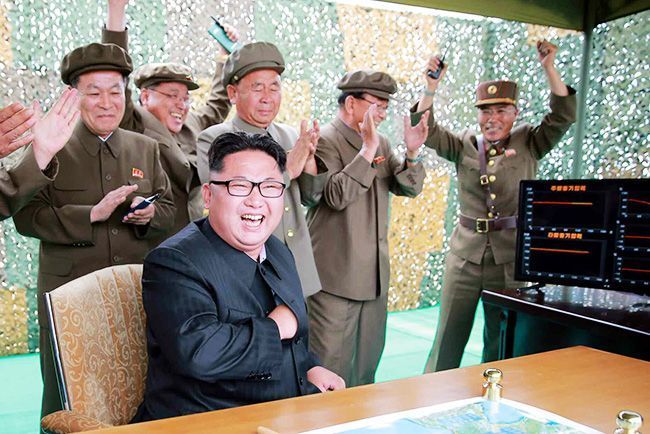
North Korean leader Kim Jong-un and military officials applaud after the launch of a Hwasong-10 missile in Wonsan, Wednesday. / Yonhap
The leader claimed this ability will bolster “capabilities of preemptive nuclear attacks” in order to protect the country from the U.S. and other hostile forces.
The Rodong Simun, the official newspaper of North Korean Workers’ Party, released a collection of photos taken at the launch site on the first three pages of its Thursday paper.
The Hwasong-10 was seen spewing flame and flying vertically in the air in some photos.
Other showed Kim Jong-un smiling while watching the test with his aides and officials throwing their hats in the air in celebration after the test.
A group photo showed the young leader posing with generals and senior members of the powerful Central Committee at the Workers’ Party. One of them was Ri Man-gon, who oversees development of military technologies as the party’s director. He is one of four North Korean officials blacklisted by the U.N. Security Council (UNSC) in its latest sanctions against Pyongyang imposed in March.
The propaganda adds to concerns that the successful test is a significant step forward for North Korea to strike the U.S. military base in Guam in preparation for a possible attack on the U.S. mainland.
It is speculated the IRBM could have travelled as far as Guam if North Korea had not used a high-arc trajectory
The Hwasong-10 has a theoretical range of up to 4,000 kilometers. It is suspected that North Korea deliberately used such a trajectory and aimed for a short horizontal range so as not to anger the U.S. and its regional allies.
An official at the Joint Chiefs of Staff denied North Korea’s missile capabilities, although he recognized its progress in engine technology.
“It’s too early to call the test a success,” he said. “It’s important to show that the missile is capable of travelling more than its minimum range on a normal trajectory.”
Defense Minister Han Min-koo warned that North Korea’s provocations will only lead to “complete isolation and self-destruction.”
Speaking at the Nuclear Suppliers Group (NSG) meeting in Seoul, Foreign Minister Yun Byung-se asked the international community to issue stronger warnings against the Kim Jong-un regime.
The latest missile test defies a string of UNSC resolutions that are aimed at deterring North Korea’s nuclear aggression.
The 15-member UNSC condemned North Korea in a closed-door meeting late Wednesday.
Its President Alexis Lamek said the members of the body were united in “strong concern and opposition” to Pyogyang’s provocations.
“I take away from these discussions a very large convergence of views in the Security Council,” Lamek said. “All members also considered that these launches were in violation of all Security Council resolutions.”